Blog
It is nearly midnight. The flights are booked and only the hotel is left, the booking page open and your finger hovering over the confirm button. Three small questions will not go away. Is breakfast in the rate? Does the pool cost extra? Will anyone meet you at the airport? In short, a stay at The Myst Dong Khoi usually includes a room with its own balcony and outdoor jacuzzi, free Wi-Fi, a shiso welcome drink when you arrive, afternoon tea at The Nest, and use of the infinity pool, gym, sauna and steam room. Breakfast usually comes too, depending on the rate, which is worth checking at the booking stage. Book direct on the hotel website for two nights or more and the Tân Sơn Nhất airport transfer is on the house: one way for two nights, both ways from three nights.
At a glance. Check-in from 3:00 pm, check-out by 12:00 noon. All 6 room types have a private balcony with an outdoor jacuzzi. Hotel guests can use the 24-metre infinity pool, gym, sauna and steam room. Breakfast is usually included depending on the rate; confirm when booking. Direct website bookings get a free Tân Sơn Nhất transfer: one way for 2 nights, both ways from 3 nights. Afternoon tea at The Nest is included; spa, tours and private cars are extras.
In this guide
What the room rate usually covers
Start with the room itself. The hotel has 108 rooms across 6 categories, from 40 m² up to the 70 m² Myst Suite, and none of them charges extra for outdoor space or a proper bath: a private balcony with an outdoor jacuzzi is part of every room. Torn between categories? Try our comparison of the six balcony room types.
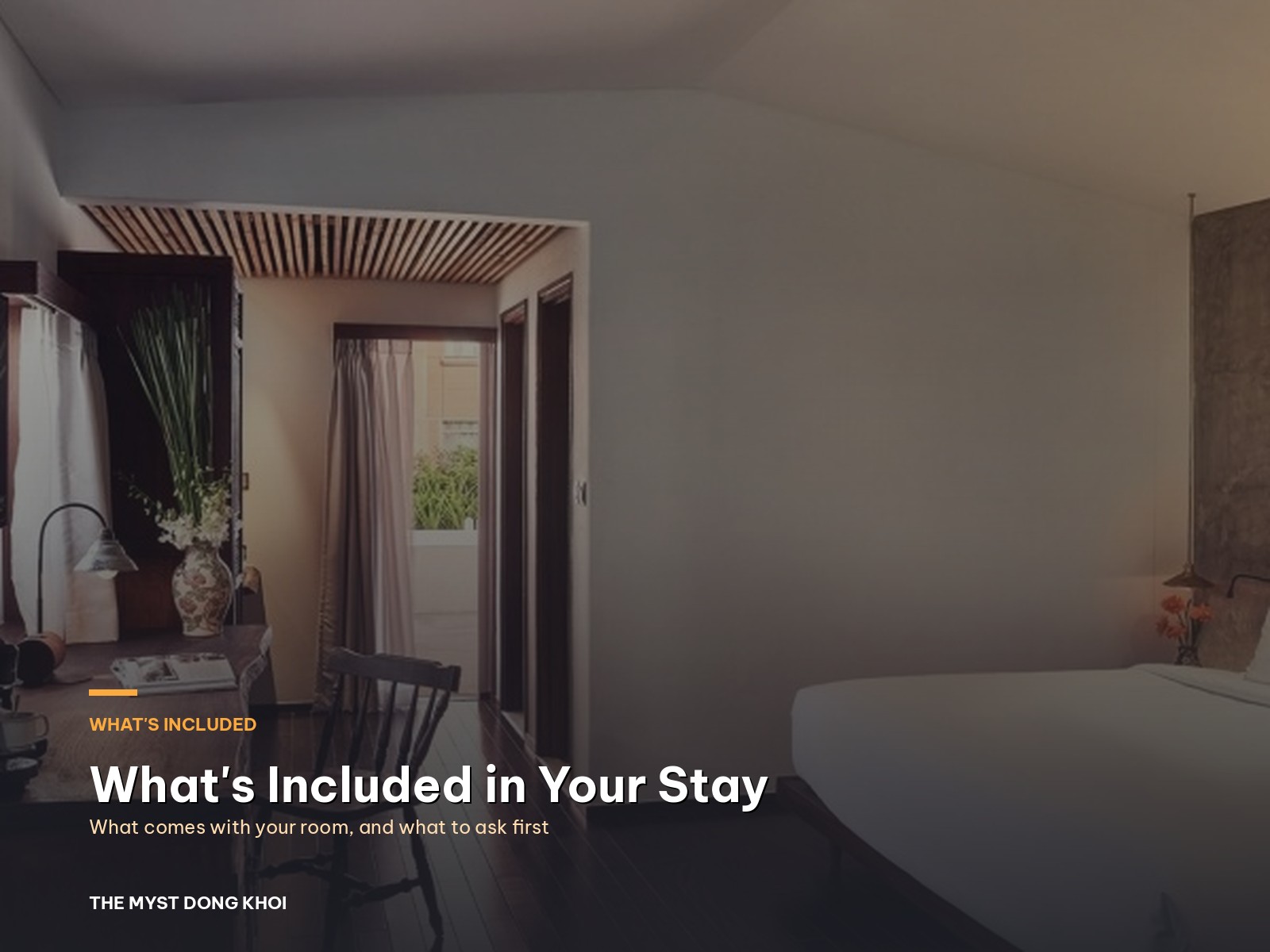
Inside there is free Wi-Fi, air conditioning, a 40-inch IPTV screen, an in-room safe, a tea and coffee maker, a minibar, a washlet toilet and Grohe bathroom products. The minibar is complimentary: two bottles of water, tea, coffee and soft drinks. For the tub, fill it until the water sits above the jets before pressing the button. Still stuck? Call down; the front desk is staffed around the clock.
Then there are the things no invoice lists. A glass of shiso when you arrive. The scent of ngọc lan, or ylang-ylang, the hotel's signature. And the city centre right outside the door, with Đồng Khởi street about a minute's walk away.
Included, extra or book ahead: a quick reference
The conditions of your rate always have the final word.
| Item | In the room rate? | Book or tell the hotel ahead? |
|---|---|---|
| Private balcony with outdoor jacuzzi | Yes, in all 6 room types | Ready in the room |
| Wi-Fi, 40-inch TV, safe, tea and coffee maker | Yes | Ready in the room |
| Shiso welcome drink | Yes | Served on arrival |
| Breakfast buffet at The Nest | Depends on the rate | 6:00 to 10:00 am, 12th floor; confirm when booking |
| 24-metre infinity pool, gym, sauna and steam room | Yes, for hotel guests | Use during opening hours |
| Tân Sơn Nhất transfer | Free on direct website bookings: one way for 2 nights, both ways from 3 nights | Email at least 72 hours ahead with your flight details |
| Private car, any airport | Charged | Book through reservations |
| Afternoon tea at The Nest | Yes, for every room booking | 2:00 to 4:00 pm, 12th floor; no booking needed |
| KL Spa, 10:00 am to 10:00 pm | Extra | Book a treatment time |
| Saigon, Mekong Delta and evening Vespa tours | Extra | Ask the hotel to arrange |
| Early check-in, late check-out | Book direct: from 12:00 noon and until 2:00 pm, free | Mention it when booking; subject to availability |
Breakfast depends on the rate, so read its name
Breakfast is the question guests ask most, and the one most easily misread. At The Myst Dong Khoi it is usually included depending on the rate, so the same room may come with breakfast on one rate and without it on another. Read the rate name and its conditions before you confirm, then check the confirmation email. Still unsure? Ask the reservations team.
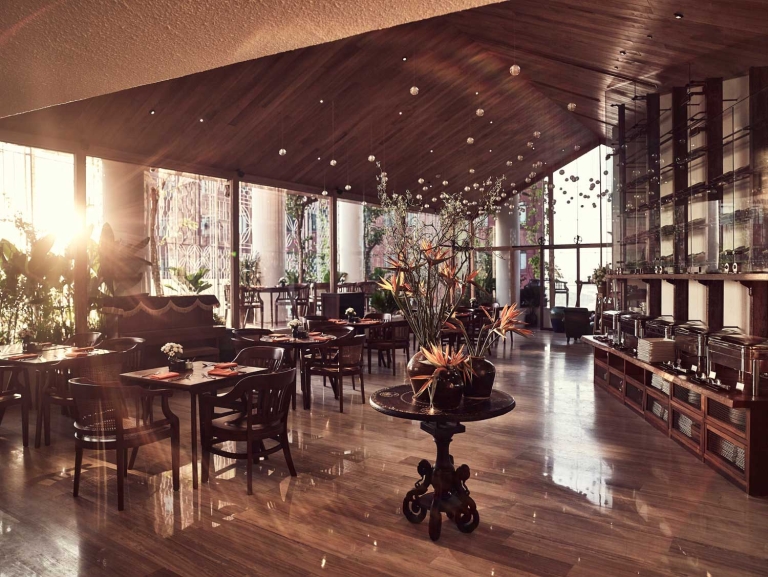
It is served at The Nest, the 12th-floor restaurant named after the swallow's nest, where the buffet is laid out on a nine-metre wooden boat recalling the flower boats that once tied up at Bình Đông market. On checkout day, eat a little earlier than usual and there is still time for a swim and packing before noon.
Airport transfers: read every condition
The transfer policy fits in a few lines, and every line carries a condition. The hotel offers a free transfer at Tân Sơn Nhất Airport for bookings made directly on its website: one way for a stay of two consecutive nights, both ways for three nights or more, for up to three guests per room. With one way, you choose the direction: pick-up on arrival, or drop-off when you leave.
Once you have booked, send your flight number and times, and the reservations team will receive the request and make the arrangements. Do it a few days ahead, not from the arrivals hall.
| Your situation | Free transfer? | What to do |
|---|---|---|
| Booked on the website, 2 nights, flying into Tân Sơn Nhất | Yes, one way | Choose a direction and email your flight details at least 72 hours ahead |
| 4 nights, booked through a travel app or agent | Not part of the offer | Book a paid private car if needed |
| Booked on the website, 3 nights or more | Yes, both ways | Email your flight details at least 72 hours ahead |
| Flying into Long Thành | No free programme yet | Book a paid private car |
Long Thành is a separate matter. There is no free transfer programme for the new airport yet, and details will be announced once it begins commercial operations. Meanwhile, a paid private car can be booked through reservations for any airport and any length of stay. If your ticket says Long Thành, read up on getting from Long Thành Airport to the city centre before you fly.
Pool, gym and sauna: who can use what
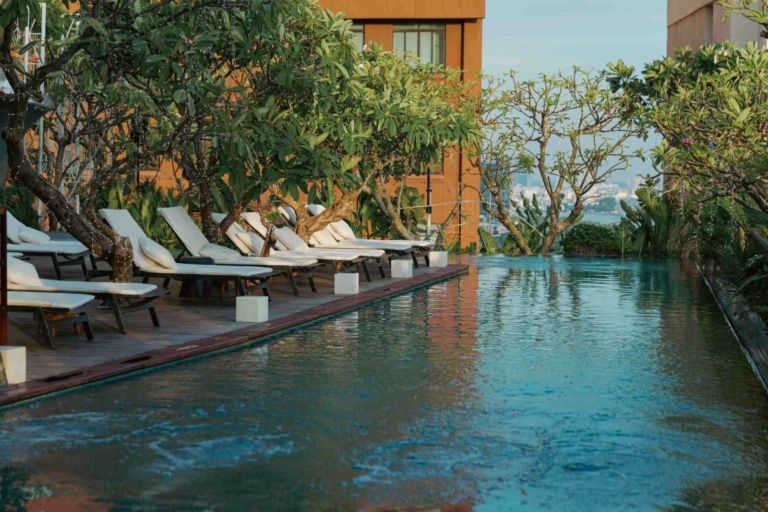
Staying here gives you the 24-metre infinity pool on the 15th floor, the gym, the sauna and the steam room. A friend staying elsewhere can use the pool, the gym, the sauna and the steam room with a day pass: 375,000++ VND for an adult, with one drink included, or 195,000++ VND for a child under 1.3 m; day passes for the rooftop pool explains how it works.
A little arithmetic helps. The pool closes at 7:00 pm and check-in starts at 3:00 pm, so day one offers roughly four hours of swimming. Arrive late and that first swim simply waits until morning, when the pool opens again at 7:00 am. Opening hours for each area are set out in our guide to the rooftop pool, gym and sauna.
There is no separate jacuzzi on the roof. Your jacuzzi is on your balcony, already part of the rate.
Extras worth booking ahead
None of these is in the room rate, and some are better reserved.
- Afternoon tea at The Nest. Served in the early afternoon on the 12th floor. For a window table at the weekend, reserve ahead.
- ROOTY Bar on the 15th floor. Open from 7:00 am to 1:00 am, with Saigon-inspired cocktails and Vietnamese small plates.
- KL Spa. Inside the hotel, with 4 treatment rooms, open from 10:00 am to 10:00 pm. Book on +84 909 375 438. For stiff shoulders or feet sore from walking the city, the treatment menu at KL Spa will help you choose.
- Bason Café on the ground floor. Coffee, creative drinks and local dishes.
- Tours. City tours, Mekong Delta trips, evening Vespa rides and temple visits, arranged by the hotel with a few days' notice.
Prices are not listed here; ask when you book for current figures.
Check-in at 3 pm, check-out at noon: handling both ends
Standard times are check-in from 3:00 pm and check-out by 12:00 noon. Flights, sadly, keep their own timetable. Guests who book directly on the website are given priority for a complimentary early check-in from 12:00 noon and a late check-out until 2:00 pm; anything beyond that carries a charge. It still depends on room availability that day, so mention it when you book, then again a few days before you arrive.
Arrived early and the room is not ready? Nguyễn Huệ walking street is about 4 minutes away on foot, 670 metres long and once a canal, the Kinh Lớn, until it was filled in during 1887; the history of Nguyễn Huệ Boulevard makes a good read. The Bạch Đằng riverside is around 5 minutes from the hotel. Walk the loop, stop at Bason Café for a coffee, and the wait flies by.
Booking direct versus other channels
No price comparisons here, only what the hotel's policy says. The clearest difference is the transfer: the free Tân Sơn Nhất transfer (one way for two nights, both ways from three) applies only to direct website bookings. Book the same room for the same nights through a travel app or agent and it falls outside the offer.
Booking direct also means dealing with the hotel from the start. The rate conditions sit on its own booking page, and you can tell the reservations team straight away which transfer direction you want. A paid private car can be booked whichever channel you used.
Questions to ask before you book
Jot these down. Asking them now saves a lot of back and forth later.
- Does my rate include breakfast, and for how many guests?
- How many nights am I booking, and through which channel? Does that qualify for the free transfer, and do I want pick-up or drop-off?
- Is my flight landing at Tân Sơn Nhất or Long Thành?
- Do I need an early check-in or a late check-out?
- Is someone joining me who is not staying and might want a pool day pass?
Call +84 28 3520 3040 or write through the hotel's contact page.
Frequently asked questions
Is breakfast included in the room rate at The Myst Dong Khoi?
Does The Myst Dong Khoi offer a free airport transfer from Tân Sơn Nhất?
Can the hotel pick me up from Long Thành Airport?
Can hotel guests use the pool, gym and sauna?
What are the check-in and check-out times at The Myst Dong Khoi?
Which services at The Myst Dong Khoi should I book in advance?
Staying two nights or more? Book direct and choose your transfer
Book on The Myst Dong Khoi website to secure the free Tân Sơn Nhất transfer (both ways from three nights), then email your flight details to reservations. Questions about breakfast? Call +84 28 3520 3040 first.
→ Contact the hotel's reservations team
Curated by Silverland Hospitality.
Blog
Half past nine on a Saturday, and the hardest decision so far is whether to order a second coffee at Bason Café. Your phone is face down. A hotel staycation in Saigon works best when everything a day off needs sits under one roof, and at The Myst Dong Khoi that day can run from 7:00 am, when the 15th-floor pool opens, to 1:00 am, when ROOTY Bar closes, without once stepping outside. What follows is the day hour by hour, a one-night version, and plans for couples and for anyone alone who simply needs rest.
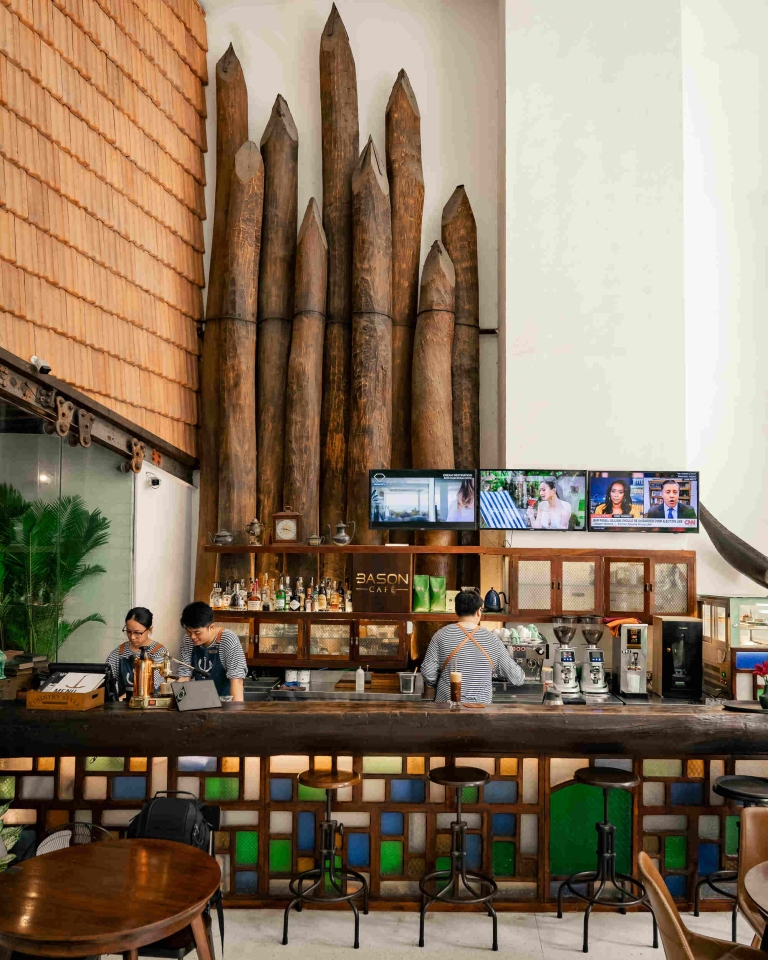
Hours at a glance. Infinity pool, 15th floor: 7:00 am to 7:00 pm. Gym, sauna and steam room: 7:00 am to 8:00 pm. KL Spa: 10:00 am to 10:00 pm. ROOTY Bar, 15th floor: 7:00 am to 1:00 am. The Nest, 12th floor: all day, afternoon tea in the early afternoon. Check-in from 3:00 pm, check-out by 12:00 pm.
In this guide
Why stay put for a day
For Saigon residents, a break usually means a long drive to Vũng Tàu or a flight to Đà Lạt. Lovely, once you arrive. But the journey can swallow half a day, and you often come home more tired than you left. A staycation skips the travel: check in, go upstairs, and the day shrinks to eating, sleeping, swimming, soaking and watching the street from the balcony.
The catch is picking the right place. If a swim means a taxi and a massage means two more streets, the day off turns into errands. The Myst Dong Khoi stacks things by floor: Bason Café at ground level, The Nest on the 12th, the infinity pool and ROOTY Bar on the 15th, with KL Spa inside the building. All 108 rooms have a private balcony with an outdoor jacuzzi, so a lazy afternoon in the room still counts.
What to book before you arrive
A slow day falls apart if you spend it on the phone, so make a few calls in advance.
- KL Spa. There are only four treatment rooms, so reserve early, especially for the evening. Call +84 909 375 438, or dial extension 222 or 501 once you are in the hotel.
- A tea table at The Nest. Reserve ahead and ask for a seat by the window.
- Breakfast. Often included depending on your rate; ask for confirmation when you book.
- Early check-in or late check-out. Request it when booking, subject to availability.
Still weighing up rooms? See our guide comparing the six balcony room categories. On arrival you are handed a shiso welcome drink, and the day off begins there.
Making a one-night stay count
A single night sounds short. Do the maths and it is generous, provided you plan around closing times. The pool shuts at 7:00 pm, so lie on the bed until five and you are left with two hours in the water. Evenings are forgiving, since the spa and the bar keep late hours, and the pool reopens at 7:00 am, which leaves an early riser five unhurried hours before check-out.
Afternoon tea is the one awkward fit. The Nest serves it in the early afternoon, which falls before check-in on arrival day and after check-out on the last. Either check out and go up for tea before leaving, or ask for a late check-out.
| Suggested time | What to do, and where | Hours to remember |
|---|---|---|
| Arrival, 3:00 pm | Check in, shiso welcome drink, change for the pool | Check-in from 3:00 pm |
| 3:30 pm | Swim in the infinity pool, 15th floor | Pool closes 7:00 pm |
| 5:30 pm | Sauna and steam room | Open until 8:00 pm |
| 6:30 pm | Vietnamese dinner at The Nest | All-day dining |
| 8:15 pm | Treatment at KL Spa | Open until 10:00 pm |
| 10:00 pm | A cocktail at ROOTY Bar | Open until 1:00 am |
| Next day, 7:00 am | Early swim | Pool opens 7:00 am |
| 7:30 am | Breakfast buffet at The Nest | Rate dependent |
| 9:30 am | Coffee, a last soak, packing | Leave time before noon |
| 12:00 pm | Check out; tea at The Nest if you linger | Check-out by 12:00 pm |
The full day, from 7:00 am to 1:00 am
Stay two nights or more and the middle day is the best of the lot: no check-in, no check-out, nothing forcing you out of a chair. Treat the times as suggestions and drop anything you like.
| Suggested time | What to do, and where | Worth knowing |
|---|---|---|
| 7:00 am | A few lengths in the pool, 15th floor | Open until 7:00 pm |
| 7:30 am | Breakfast buffet at The Nest, 12th floor | Rate dependent |
| 9:00 am | Coffee and a book at Bason Café | No rush |
| 10:30 am | Massage or facial at KL Spa | Opens 10:00 am |
| 12:00 pm | Nap, a long soak, time on the balcony | No rush |
| Early afternoon | Afternoon tea at The Nest in place of lunch | Free with your room, 2:00 to 4:00 pm; no booking needed |
| 4:00 pm | Second swim, with drinks from ROOTY | Pool closes 7:00 pm |
| 5:45 pm | Sauna and steam room | Open until 8:00 pm |
| 7:00 pm | Dinner at The Nest: steamed fish, seafood | All-day dining |
| 9:00 pm | A Saigon-inspired cocktail at ROOTY Bar | Open until 1:00 am |
Morning: an early swim and a long breakfast
At six the sun is still low over the 15th floor. The infinity pool runs 24 metres, and from the water you look across the rooftops towards the river. Twenty lazy minutes is plenty. Nobody is timing you.
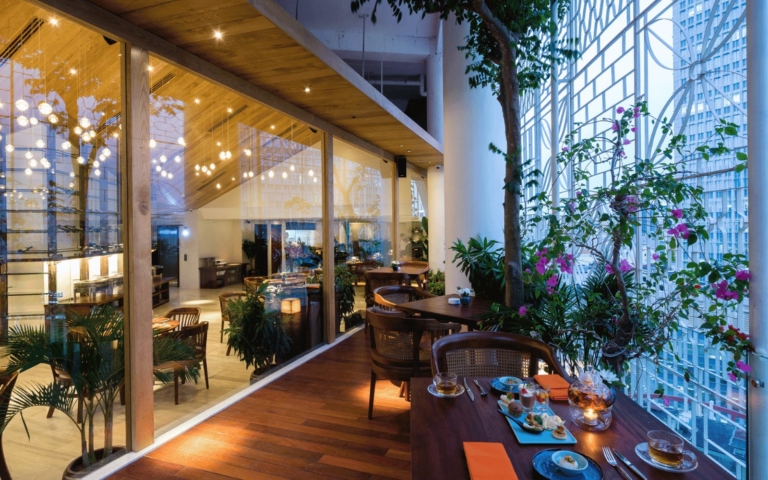
Breakfast is on the 12th floor, where The Nest lays out its buffet along a nine-metre wooden boat, a nod to the flower boats that landed at Bình Đông market in the days before Tết. There is no rush, so start with fruit, then tea, and only then a bowl of phở. More in our piece on breakfast along the wooden boat.
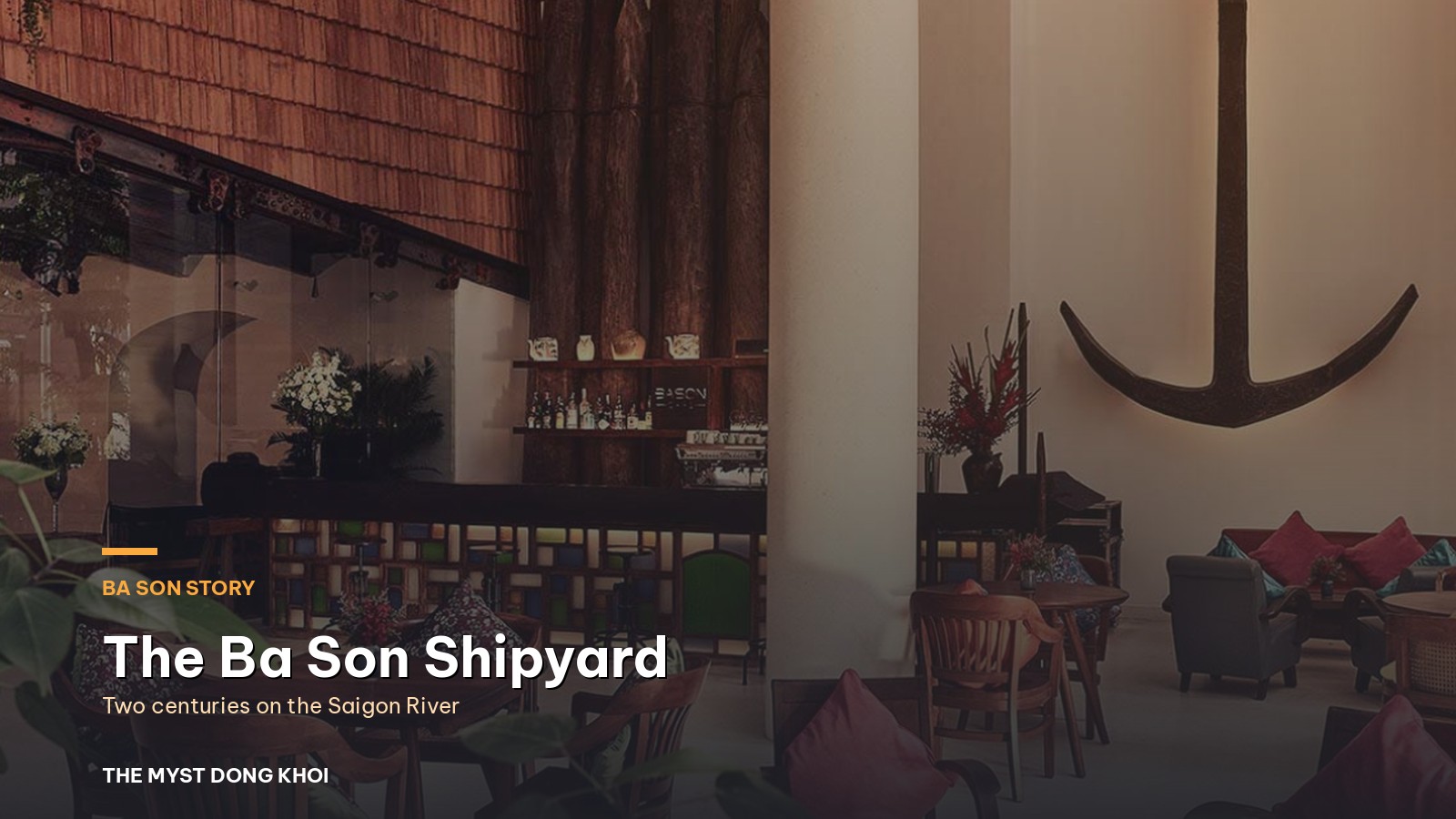
Afterwards, the ground floor. Bason Café is named after the Ba Son shipyard on the Saigon River, founded around 1788, and the hotel reuses timber and metal from the old yard in its design. Order a coffee, read a few pages, then watch people come and go. The story behind the café's name suits this moment well.
Midday: the spa, a nap and afternoon tea
KL Spa opens at 10:00 am, and a mid-morning appointment keeps the evening free for the rooftop. Our guide to choosing a treatment at KL Spa matches the long menu to whatever aches.
Then back to your room. The midday nap is a familiar habit in plenty of Saigon homes, and a staycation lets you take one with nobody ringing. Draw the curtains and sleep. When you wake, run the bath or sit out on the balcony, where the plants on every floor make midday easier on the eyes.
Early afternoon, go up to The Nest, named after a swallow's nest, with windows shaped like wrought-iron flowers. After a big breakfast, afternoon tea can double as lunch. Prefer savoury? The Vietnamese menu includes Northern-style phở bò, bún bò Huế, cơm tấm Long Xuyên and bánh xèo, though dishes can change, so ask. For what comes on the tea stand, read afternoon tea in Saigon, twelve floors up.
Late afternoon to midnight: back to the 15th floor
By four the sun has eased off. Return to the pool and order Vietnamese snacks and cocktails from ROOTY to have by the water. Watch the clock. Turn up at half past five and there is time for little more than dangling your feet.
Next comes the sauna and steam room, open until 8:00 pm, and a shower before dinner. Swimming times and the gym are covered in our guide to the pool, gym and steam room.
Dinner is at The Nest again, perhaps steamed fish or seafood. Then back up to ROOTY Bar for a Saigon-inspired cocktail and a few light Vietnamese bites. It stays open until 1:00 am, and ROOTY, the bar on the 15th floor has the full story. One more soak, then bed. You will not have set foot on the street all day, yet you may fall asleep feeling you have been far away.
A slow day for two
Couples rarely need the 7:00 am swim. Sleep in, and save the pool for the afternoon and the spa for the evening.
- The room. Every room has a balcony with its own outdoor jacuzzi, and The Myst Suite, at 70 m², is the largest of them. A soak out there after dark is a plan in itself.
- The spa. KL Spa's VIP Romantic Couple package includes a flower bath. Book it with the room, for around 7:00 or 8:00 pm.
- Dinner. A table by the wrought-iron flower windows at The Nest, then up to ROOTY.
One small suggestion: agree to put the phones away at dinner. Strict, perhaps. But two people on two screens is just an evening at home in a nicer room.
A slow day on your own
Sometimes the point is to be alone, with nobody asking what is for dinner. Keep this version sparse, with an earlier night.
- The room. Verdant Calm Balcony, at 42 m², faces greenery and is quiet.
- Morning. Swim at 7:00 am, or try the gym with its cardio machines, weights and massage machine.
- Spa. Long weeks at a desk call for Head-Back-Shoulder. A week of walking the city calls for Foot Reflexology.
- Afternoon. A book and a pot of tea at The Nest. A table for one is nothing to feel shy about.
- Evening. Sauna before 8:00 pm, a light supper, the balcony, then bed.
The usual mistake on a solo stay is trying to use everything. Don't. A long, unbroken sleep and a morning without an alarm are the whole return.
Frequently asked questions
How should I plan a one-night staycation at The Myst Dong Khoi?
Is there time to swim if I check in at 3:00 pm?
When can I fit in afternoon tea on a one-night stay?
What should couples book ahead for a staycation?
Which room and routine suit a solo guest who needs rest?
What is still open in the hotel after 10:00 pm?
Give yourself a whole day off
Book direct, ask for a spa appointment and a tea table while you are at it, and make your way to 6-8 Hồ Huấn Nghiệp street. The day itself needs no planning.
→ See the pool, spa and hotel facilities
→ Book your staycation night direct
Curated by Silverland Hospitality.
Blog
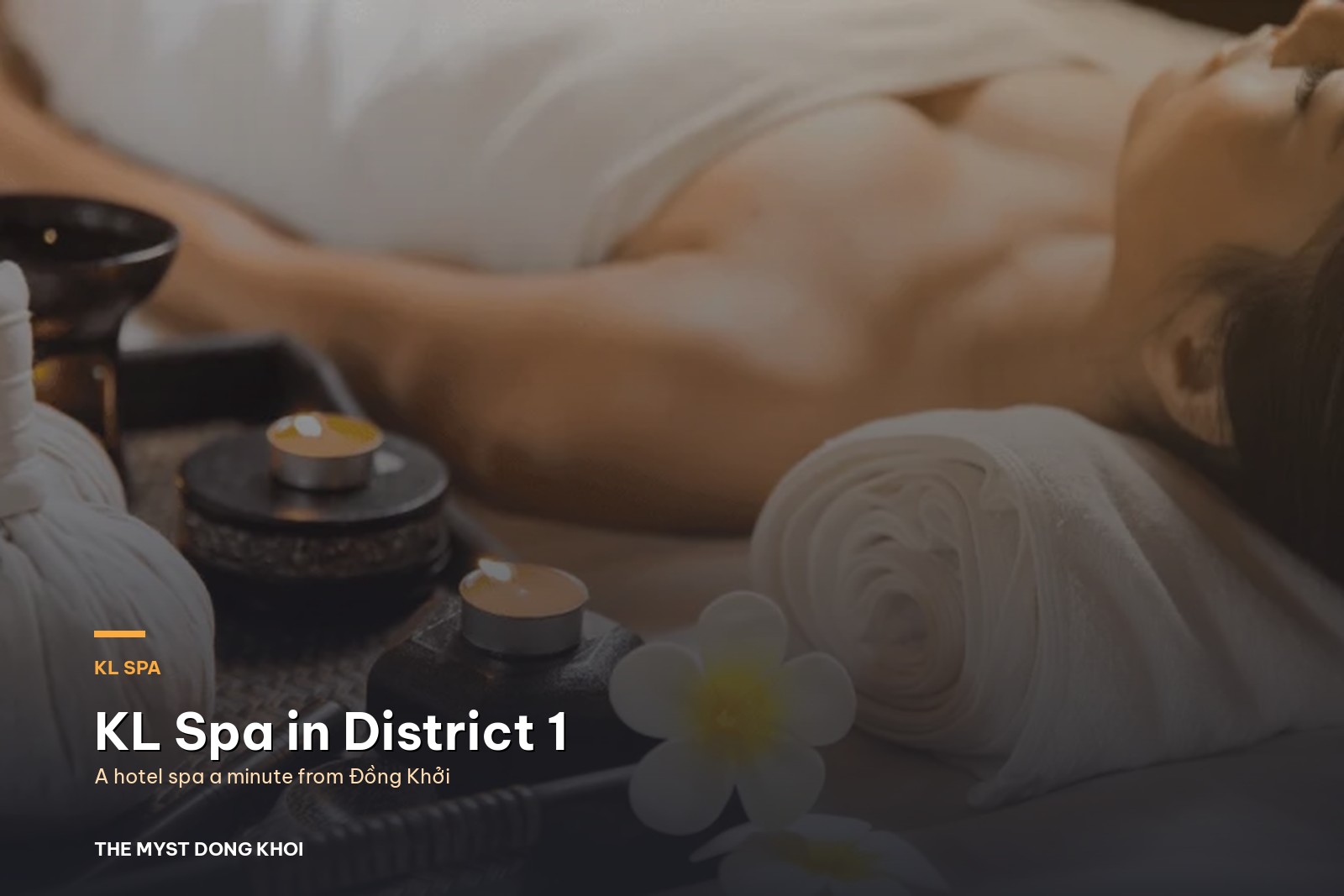
It is eight in the evening and you are walking back from Nguyễn Huệ walking street. You have been on your feet since lunch, your calves are tight and your sandal straps have started to rub. Turn onto Hồ Huấn Nghiệp, step into the hotel's own hẻm, and KL Spa is right there. If you want a hotel spa in District 1 that spares you one more taxi ride, KL Spa at The Myst Dong Khoi has four treatment rooms, is open from 10:00 am to 10:00 pm and sits about a minute's walk from Đồng Khởi street. This guide goes through the menu group by group, explains the KL Signature Massage in plain terms, and suggests what to book for sore feet, a stiff neck after a long flight, an evening for two, or a night when you simply want to sleep well.
At a glance. KL Spa is inside The Myst Dong Khoi, at 6-8 Hồ Huấn Nghiệp, Sài Gòn Ward, Ho Chi Minh City. It has four treatment rooms and is open from 10:00 am to 10:00 pm. The menu falls into six groups: body therapy, foot reflexology, facial care, body care, hair care and signature packages. The spa's own treatment, the KL Signature Massage, blends Thai, Shiatsu and Swedish techniques with essential oils. Prices and durations are best confirmed when you book.
In this guide
A small spa deep inside the hotel
KL Spa is not large. There are four treatment rooms in all, tucked deep inside The Myst Dong Khoi, a 108-room hotel at 6-8 Hồ Huấn Nghiệp. If you go to a spa mainly for quiet, a small number of rooms tends to work in your favour: fewer people coming and going, and less chance of waiting around in a busy reception. The flip side is simple. With only four rooms, it pays to ring ahead if you have a particular time in mind.
Opening hours of 10:00 am to 10:00 pm fit around most days out. You can drop in after breakfast before heading into the city, or stroll back at nine in the evening and still find the doors open. Just ask when the last appointment starts, so that your treatment finishes before closing.
The location is the real convenience. Đồng Khởi street is about a minute away on foot. Nguyễn Huệ walking street is roughly four minutes away on foot, the Bạch Đằng riverside around five, and Bến Thành Market a longer 12 to 15. In other words, you can keep walking until your legs complain and then wander home, with no need to think about transport. The pool, the gym and everything else are set out in the full list of facilities at The Myst Dong Khoi.
What is on the KL Spa menu
The KL Spa menu is organised by part of the body and by purpose, and the treatment names are in English. The table below gathers it into six groups, with a note on when each is worth a look.
| Menu group | What it includes | Worth a look when |
|---|---|---|
| Body Therapy | 10 treatments: Holistic, Swedish, Hot Stone, Thai, Sport, Four-Hands, KL Signature, Vietnam Traditional, Special Candle, Head-Back-Shoulder | Your whole body aches, or you want to focus on head, back and shoulders |
| Foot Reflexology | A treatment devoted to the feet | You have walked or stood for hours |
| Facial Care | 3 treatments: Vitamin Energy, Men Facial, Eye | You want time spent on your face or the skin around your eyes |
| Body Care | Scrub, wrap and combination treatments | You want care for the skin all over |
| Hair Care | Hair treatments; ask the spa for details | Sun and wind have left your hair wanting attention |
| Signature Packages | 6 packages: Relaxing, Detox, Foot Relax, Bliss for Her, VIP Gentleman, VIP Romantic Couple | You would sooner hand over the whole session than build your own |
Some names explain themselves. Hot Stone uses heated stones, Head-Back-Shoulder concentrates on exactly those areas, and Men Facial is a facial for men. Others, such as Holistic or Special Candle, are harder to guess, so ask the spa to describe them before you decide. You will not find prices in this article, and that is deliberate. Ask for prices and durations when you call, and you will have the current figures.
The KL Signature Massage, explained
The KL Signature Massage is the treatment that carries the spa's name. According to the menu, it blends three styles, Thai, Shiatsu and Swedish, and uses essential oils. Three names at once can sound like a lot. Taken one at a time, they are easy to picture.
The Thai part: pressing, stretching and rocking
In Thailand the traditional form is often called nuat phaen boran, which translates as "ancient-style massage". The therapist compresses, pulls, stretches and gently rocks the body, sometimes guiding you into assisted postures that look a little like yoga, and applies pressure along energy lines known as sen. The practice draws on Indian and Southeast Asian medical traditions, and in December 2019 UNESCO added it to its list of the cultural heritage of humanity. Done the traditional way, it uses no oil or lotion, and the person receiving it wears light, loose clothing. There is a good overview of traditional Thai massage and its history on Wikipedia.
The Shiatsu part: finger pressure
Shiatsu is Japanese, and the name tells you what it does: shi means finger and atsu means pressure. Beyond fingers and thumbs, practitioners also use palms, elbows, knuckles and even feet, along with assisted stretches. It grew out of an older Japanese massage form called anma. Tokujiro Namikoshi (1905 to 2000) founded his shiatsu college in the 1940s, and his legacy was Japan's formal recognition of shiatsu as a method of treatment in its own right. The origins of shiatsu and what the research says are set out clearly on Wikipedia.
The Swedish part: gliding and kneading
Swedish massage is the most widely recognised and commonly used kind. It rests on five basic strokes: effleurage, a long gliding movement; petrissage, or kneading; tapotement, a rhythmic tapping; friction; and vibration. There is a small twist in the naming. The style is often credited to the Swede Per Henrik Ling, yet Wikipedia calls that inaccurate, since it was a Dutch practitioner, Johann Georg Mezger, who gave the basic strokes their French names in 1868.
Putting the three together
Set the pieces side by side and you can picture the KL Signature as stretches and deeper pressure in the Thai manner, pointed finger pressure in the Japanese manner, and long Swedish strokes over a layer of essential oil. Unlike traditional Thai massage, this one does use oil. The menu does not say how long each part lasts or in what order they come, so ask your therapist before you lie down and say how firm you like it. If you like it firm, say so. If you bruise easily, say that too.
Choosing a treatment for the day you have had
The menu is long, but one question usually narrows it down: where do you ache today, or what do you need? A few situations come up again and again for people staying in the centre.
Sore feet after a day of walking
In central Saigon, walking is the easiest way to get around and also the quickest way to tire your legs. A there-and-back trip to Bến Thành Market alone takes 24 to 30 minutes on foot, before you count waiting to cross the road or stepping on and off kerbs. Back at the hotel, start with Foot Reflexology or the Foot Relax package, both of which, as the names suggest, are about the feet. Some people believe each zone on the sole connects to an organ elsewhere in the body; Wikipedia's article on massage describes that belief as pseudoscientific. No matter. Having your feet looked after at the end of a long day is reason enough.
A stiff neck after a long flight
Hours in an aeroplane seat, head tipped towards a screen or a book, and you land with shoulders that feel set in concrete. Head-Back-Shoulder works on exactly those areas and suits you if you would prefer not to lie down for a full session. For the whole body, choose Swedish if you like familiar gliding and kneading, or the KL Signature if you want stretches and point pressure as well. Rooms are ready from 3:00 pm and the spa stays open until 10:00 pm, so a flight that lands around midday or early afternoon still leaves time for an evening appointment. One caution: if neck pain has lasted for weeks or tingles down your arm, see a doctor first.
When you mostly want a good night's sleep
Some days nothing hurts, but your mind will not switch off. On those days the simplest plan is an appointment at around eight in the evening, then straight up to bed. Pick a gentle treatment and ask for moderate pressure. With shiatsu in particular, some studies found that people who received it reported better relaxation and sleep, though that is what they felt and not a firm conclusion. Every room category at The Myst Dong Khoi has a jacuzzi on the balcony, so a few minutes in warm water before bed is an easy addition.
Keeping up the swimming and training
If you keep your exercise routine going on holiday, ask about the Sport treatment in the body therapy group. A few lengths of the 24-metre pool in the morning and a spa appointment in the afternoon make an easy rhythm. Opening hours and the details of the rooftop pool, gym and sauna are covered in a separate guide.
For couples and longer sessions: the signature packages
The Signature Packages group bundles several steps into one booking. There are six: Relaxing, Detox, Foot Relax, Bliss for Her, VIP Gentleman and VIP Romantic Couple. The names give the general direction, so ask the spa exactly which treatments each one includes and how long it runs.
Package or single treatment? A package suits you if you would like to hand everything over: arrive, lie down, and leave the planning to the spa. A single treatment makes more sense when only one part of you aches or when time is short. Two people with different needs can split it sensibly too, one choosing Bliss for Her and the other VIP Gentleman.
For couples, the package to look at first is VIP Romantic Couple, because it includes a flower bath. Picture a wedding anniversary: dinner, then down to the spa together for a soak in the flower bath, and afterwards only a few steps back to your room, with no late-night taxi to find. Book this one earlier than you otherwise might, since there are only four rooms and you need a time that works for two. If it is a birthday or a honeymoon, mention it when you call.
Booking tips that get you the time you want
A few small habits make the whole thing run more smoothly.
- Ring ahead. The surest way is to call the spa directly on +84 909 375 438. If there are two of you, or you want an evening appointment, call that morning or the day before.
- Cover four points on the call. How many people, which treatment (or ask for a recommendation), what time you would like to start, and the price and duration.
- Count back from closing time. The spa closes at 10:00 pm, so longer treatments need an earlier start. Asking for the last start time settles it.
- On arrival day. Check-in is from 3:00 pm. Drop your bags, shower, rest a little, and book for the evening.
- On departure day. Check-out is by 12:00 noon and the spa opens at 10:00 am, so a short treatment still fits that morning if you reserve it the night before. Late check-out can be requested, subject to availability.
If you plan to stay put all day, the spa slots neatly in between breakfast, the pool and afternoon tea.
Before, during and after your massage
Avoid a heavy meal just beforehand. Lying face down on a full stomach is no way to relax. Arrive a few minutes early to change and have a sip of water, so you are not rushing onto the table out of breath.
If you are pregnant, recently injured, or have a skin condition or blood pressure concerns, tell your therapist before you begin. Massage is generally safe, yet Wikipedia's article on shiatsu still notes reports of adverse effects, a few of them serious. A quick word first costs nothing.
During the treatment, speak up if anything hurts or tickles too much. Nobody is grading your pain threshold. Afterwards, sit up slowly, drink another glass of water and keep the rest of the evening free of anything urgent. The quiet advantage of a spa inside your own hotel is that bed is only a short walk away.
What massage can and cannot do
In fairness, massage is no substitute for medicine or a doctor. Wikipedia's article on Thai massage puts it plainly: all types of massage, Thai included, can help people relax, temporarily relieve muscle or joint pain and temporarily boost a person's mood. The word "temporarily" matters. On shiatsu, the same encyclopaedia states that there is no scientific evidence it will prevent or cure any disease. And its general article on massage and the evidence describes the research as low to moderate in quality and limited when it comes to long-term effects.
So come to KL Spa with sensible expectations: an unhurried session, someone looking after your feet or shoulders, and, with luck, a lighter step on the way out than on the way in. Persistent back pain, weeks of poor sleep or numbness in your hands and feet are questions for a doctor.
Frequently asked questions
Where is KL Spa and what are its opening hours?
What is the KL Signature Massage?
Which treatment suits tired feet after a day of walking?
Does KL Spa have a package for couples?
Can massage cure neck pain or insomnia?
Do I need to book KL Spa in advance, and how do I find out prices?
Book an evening at KL Spa after a day on foot
KL Spa is inside The Myst Dong Khoi and open until 10:00 pm, so even a late stroll home leaves time to look after your feet. Stay a few nights in the centre and you can give one evening to your feet, another to your shoulders, and the last to the two of you.
→ See KL Spa and the hotel's other facilities
→ Book your stay direct, steps from the spa
Curated by Silverland Hospitality.
Blog
Seven in the morning, and the lift doors open on the 15th floor. Nobody has touched the water yet. Down in the streets the traffic is only just starting, and the air on the roof is noticeably cooler than at ground level. Give it two hours and the city is hot and loud again. The short answer, then: The Myst Dong Khoi has a 24-metre infinity pool on its roof, open from 7:00 am to 7:00 pm, and a gym, sauna and steam room open from 7:00 am to 8:00 pm. There is no shared jacuzzi up top, because every room has its own jacuzzi on the balcony.
At a glance. The 24-metre infinity pool is on the 15th floor, 1.2 to 1.5 m deep and not supervised, open from 7:00 am to 7:00 pm. The gym, sauna and steam room run from 7:00 am to 8:00 pm. Visitors can buy a day pass that covers the pool, the gym and both heat rooms. ROOTY Bar, on the same floor, is open from 7:00 am to 1:00 am. There is no rooftop jacuzzi, but all six room categories have a private jacuzzi on the balcony.
In this guide
What you will find on the 15th floor
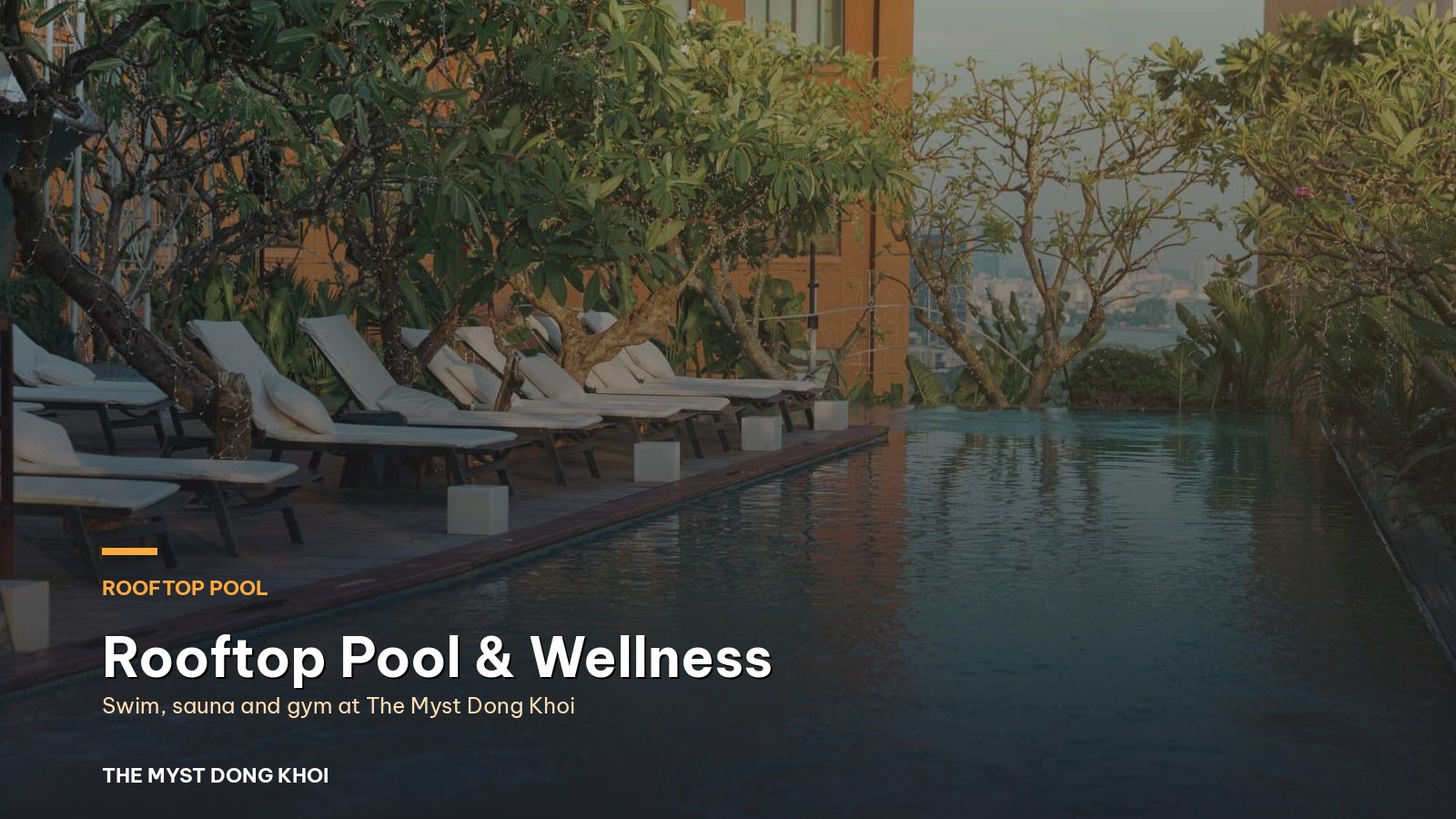
Start with the pool. It runs 24 metres, sits between 1.2 and 1.5 m deep, and is built as an infinity pool, its outer edge designed for the water to spill over, so from inside the surface seems to run straight on into the sky. Swim to the far end and the city is in front of you, the river off to one side. The walls are lined with mosaic tiles from Bát Tràng, the long-established ceramics village in northern Vietnam, set piece by piece into patterns. The hotel's design notes say the northern ceramics were chosen as a nod to a city that has always made room for people from every region.
The water in the distance is the Saigon River as it passes the city centre, a river 251 kilometres long that rises in south-east Cambodia and eventually meets the Đồng Nai. The Bạch Đằng riverside is only about a five-minute walk from the hotel.
ROOTY Bar shares the floor, open from 7:00 am to 1:00 am, with Saigon-inspired cocktails and light Vietnamese dishes; our guide to ROOTY, the hotel's rooftop bar covers it properly. The gym and the two heat rooms are in the hotel's wellness area. The gym is small and boutique in feel, with cardio machines, weights, a massage machine and a view over the city.
Opening hours and who can use what
Each area keeps its own hours and admits a slightly different mix of guests, so it is easy to get muddled. In one place:
| Facility | Hours | Who can use it | Notes |
|---|---|---|---|
| Infinity pool | 7:00 am to 7:00 pm | Staying guests; visitors with a day pass | 24 metres, 15th floor |
| Sauna | 7:00 am to 8:00 pm | Staying guests; included in the day pass | Dry heat, low humidity |
| Steam room | 7:00 am to 8:00 pm | Staying guests; included in the day pass | Dense steam, lower temperature |
| Gym | 7:00 am to 8:00 pm | Staying guests; included in the day pass | Cardio, weights, massage machine |
| ROOTY Bar | 7:00 am to 1:00 am | Hotel guests and visitors | 15th floor, cocktails and light bites |
| KL Spa | 10:00 am to 10:00 pm | Book ahead on +84 909 375 438 | Inside the hotel, four treatment rooms |
| Jacuzzi | On your balcony | Staying guests | No jacuzzi on the roof |
Note the one-hour gap. The pool closes at 7:00 pm, but the heat rooms stay open until 8:00 pm, so a late return from the city still leaves time for a session before dinner.
Not staying? A day pass covers the pool, the gym, the sauna and the steam room: 375,000++ VND for an adult, with one drink included, and 195,000++ VND for a child under 1.3 m. Our article on the infinity pool day pass for non-residents has the details.
The best time of day to swim
Early morning, from 7:00 am to around 9:00 am, is the gentlest. The air is cool, the light low and the water calm. There is time for a few lengths and breakfast at The Nest on the 12th floor before a first meeting. Sunrise in Saigon comes no later than about 6:18 am, in early February, so by opening time the light over the city is still low and soft.
Midday is best avoided. Saigon averages about 28°C across the year, and the midday sun bounces straight back off the water. If you must swim then, keep it short and wear plenty of sunscreen.
Late afternoon belongs to the sky. Being close to the equator, Saigon sees sunset shift by less than an hour through the whole year, from about 5:28 pm in mid-November to about 6:21 pm in mid-July. The pool stays open until 7:00 pm, so in any month you can watch the sunset from the water.
| Time of year | Sunset around | Where to watch it |
|---|---|---|
| Mid-September to end of October | 5:31 pm to 5:57 pm | From the pool; arrive by about 5:00 pm |
| November and December | 5:28 pm to 5:41 pm | From the pool; the earliest dusk of the year, so come up by 4:30 pm |
| January to early February | 5:42 pm to 5:58 pm | From the pool; arrive by about 5:15 pm |
| Mid-February to early September | 6:02 pm to 6:21 pm | From the pool, which stays open until 7:00 pm |
Times are rounded to the minute from astronomical tables for Ho Chi Minh City. The wet season usually runs from May to November. If dark clouds build or you hear thunder, get out of the water and go inside. The US National Weather Service advises keeping away from water during storms and waiting at least 30 minutes after the last rumble before returning to outdoor activities.
Sauna or steam room: how they differ
The names sound alike. Five minutes in each and you will not confuse them again. A traditional Finnish sauna, as the Wikipedia entry on sauna bathing explains, usually holds the air at around 75 to 100°C with low humidity, so the heat is dry and fierce and you sweat quickly. A steam room in the manner of a Turkish bath works the other way round: humidity approaches 100%, so the temperature is set far lower, around 50°C.
The hotel's rooms may be set differently, so ask the staff if you want numbers. If you like dry heat and a quick sweat, choose the sauna. If dry heat feels harsh, try the steam room, where the air is thick enough to leave you damp within minutes. On tiered benches, the lower one is cooler.
A simple swim, heat and rest routine
Move first, heat second, rest last. The two versions below are built around the opening hours.
A 90-minute morning for business travellers
- 7:00 am. Twenty to 30 minutes of light gym work.
- 7:30 am. About 20 easy minutes of swimming.
- 7:50 am. Rinse off, dry and take roughly 10 minutes in the sauna.
- 8:00 am. Drink water and sit until you have cooled down.
- 8:30 am. Change, then breakfast at The Nest.
A late afternoon of about two and a half hours
- 4:30 pm. A few relaxed lengths, then rest by the pool.
- 5:15 pm. In the months when the sun sets before 6:00 pm, the sky starts to turn about now.
- 6:30 pm. Out of the pool. Shower, then 10 to 15 minutes in the steam room.
- 6:50 pm. Two or three glasses of cool water, sitting quietly while your heart rate settles.
- 7:00 pm. A warm soak in the jacuzzi on your balcony, or a call to KL Spa about an evening appointment.
On a longer stay, spread it out: swim in the morning, heat rooms in the evening.
Pool and sauna safety in brief
The pool has no lifeguard on duty, so keep an eye on anyone who is not a confident swimmer, and on children in particular.
A sauna feels restful, yet Harvard Health notes that heart rate can rise by 30% or more and that a short session can cost about a pint of sweat. The Harvard Health guidance on saunas comes down to a few general points, which are no substitute for medical advice.
- Keep each session to 15 to 20 minutes at most, and less if you are new to it.
- Drink two to four glasses of cool water afterwards.
- Avoid alcohol before and after, since alcohol and some medicines impair sweating and can lead to overheating. Save that ROOTY cocktail until you have fully cooled down.
- Cool down gradually. Going from the heat straight into cold water puts considerable stress on the circulation, even in healthy people.
- Skip the sauna when ill, and leave at once if you feel dizzy or unwell.
- If you have heart disease or uncontrolled high blood pressure, check with your doctor first.
At the pool, keep young children within arm's reach. And if you have had a few drinks at the bar, leave the swim for tomorrow.
What to bring to the roof
- Swimwear, and sandals for the wet deck.
- Sunscreen, sunglasses and a hat for afternoon visits.
- Goggles if you plan to swim lengths.
- A water bottle, especially if the sauna is on the list.
- A waterproof pouch, so your phone survives the poolside photos.
Ask the staff on the roof about towels and somewhere to leave your things. Day-pass visitors should ring ahead to check what to bring.
No rooftop jacuzzi, so where do you soak?
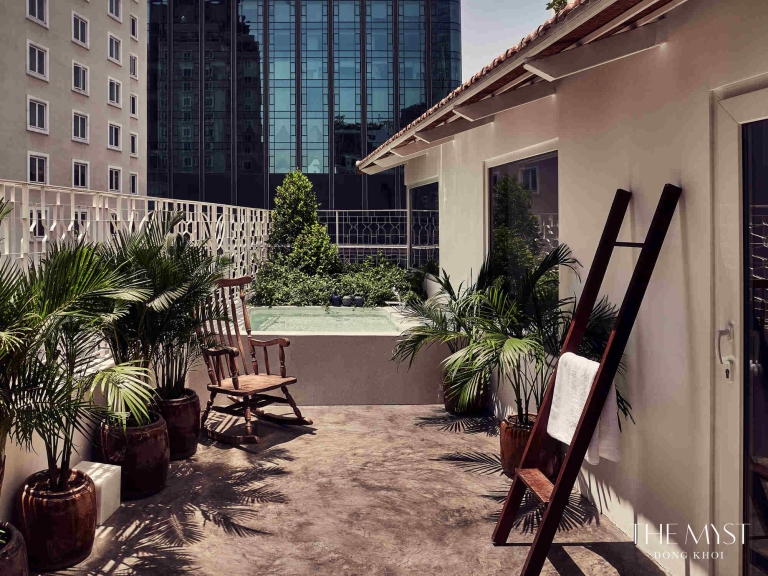
The roof has the infinity pool and the bar, and no shared jacuzzi. For a warm soak, go back to your room: all six room categories, from the 40 m² Saigon Balcony to the 70 m² The Myst Suite, have a private balcony with its own outdoor jacuzzi.
One tip from the hotel's guest information: fill the tub until the water covers the jets before pressing the button, and call reception if you need a hand. Coming straight from the steam room? Cool down first and keep the water warm, not hot.
After the pool: spa or bar
If your legs and shoulders are still complaining after a day on foot, KL Spa is inside the hotel and open from 10:00 am to 10:00 pm; book ahead on +84 909 375 438. Or sit on at ROOTY Bar on the 15th floor until 1:00 am, starting with something non-alcoholic if you have just left the sauna.
Frequently asked questions
What are the rooftop pool opening hours at The Myst Dong Khoi?
Can I use the pool if I am not staying at the hotel?
Is there a jacuzzi on the roof?
When can I watch the sunset from the pool?
How long should I stay in the sauna?
Should I swim before or after the sauna?
Keep a morning free for the 15th floor
A night at The Myst Dong Khoi gives you the pool, the heat rooms and the gym, with a jacuzzi waiting on your balcony. Book direct, choose your room and set an alarm for a 7:00 am swim above the city.
→ Book a stay with an early swim
Curated by Silverland Hospitality.
Blog
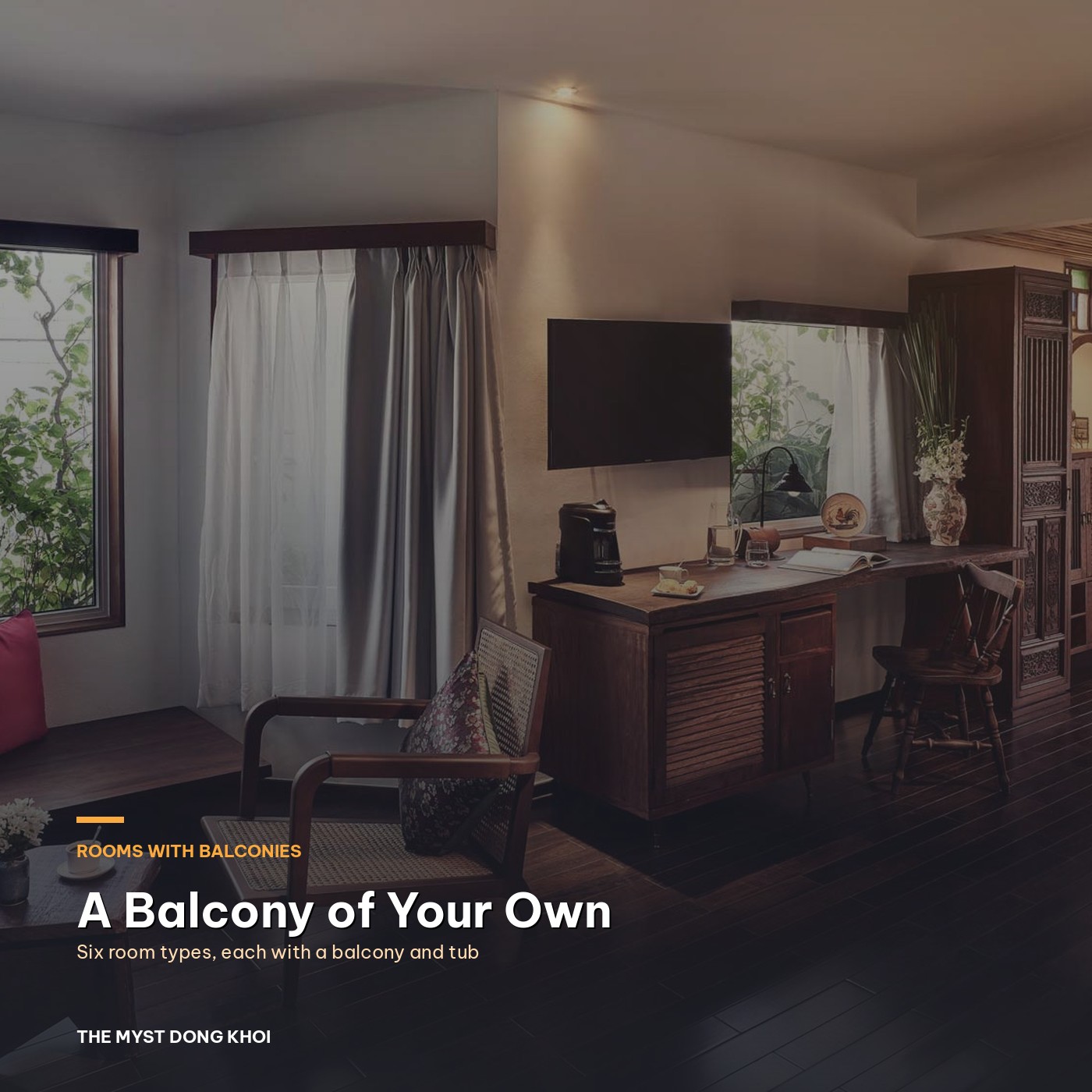
Six in the morning, and the glass door slides back onto the balcony. The leaves in the planters are still damp, the first motorbikes are buzzing along the street below, and up here the air has not yet warmed. In a city centre full of towers, a bit of open sky you can step into from your own room counts for a lot. At The Myst Dong Khoi, every room has one. All six room types come with a private planted balcony and an outdoor jacuzzi on that balcony, in sizes from 40 to 70 m². This guide compares the six, matches them to different trips, and suggests how to make good use of the balcony and tub.
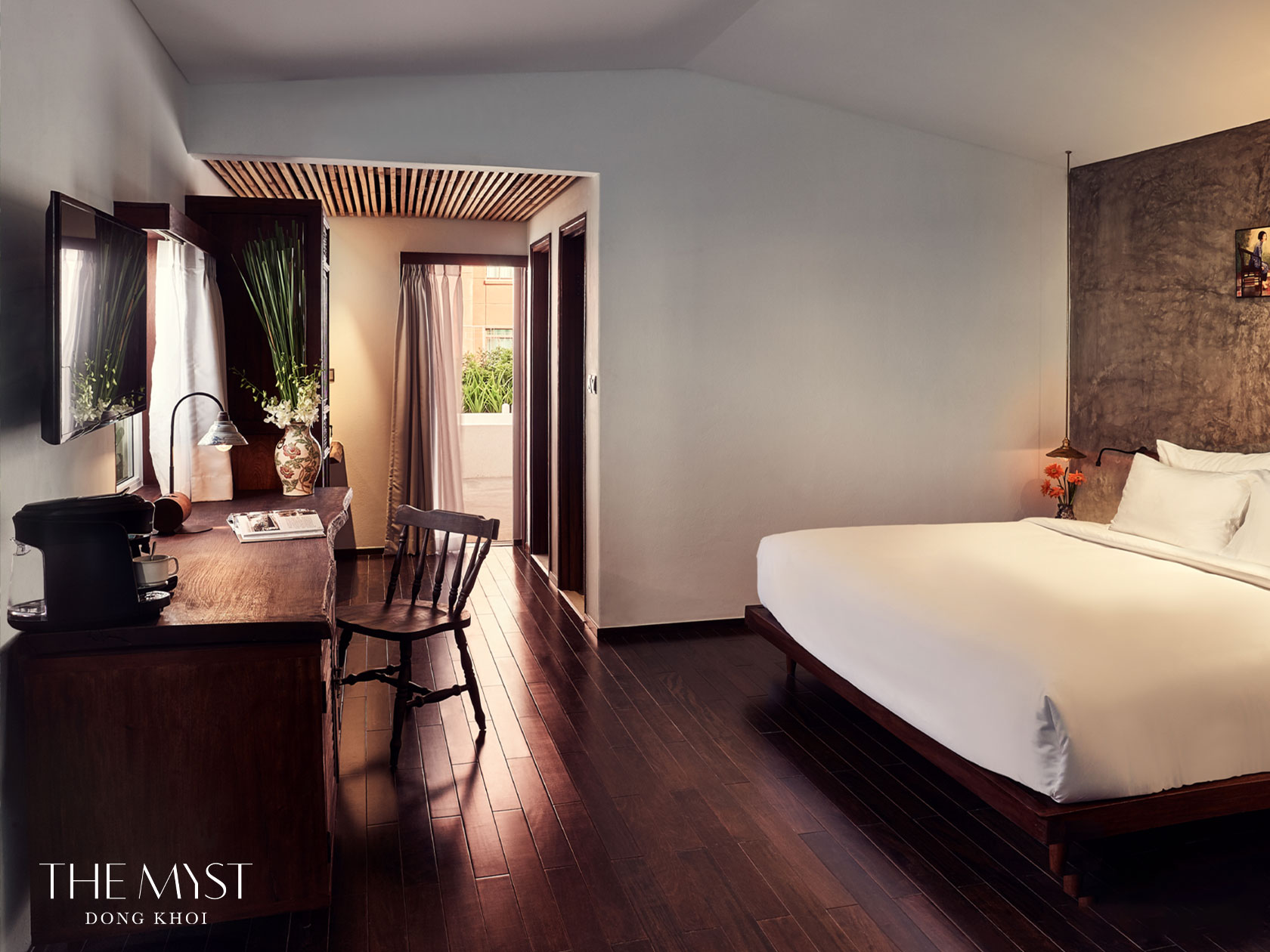
At a glance. The Myst Dong Khoi has 108 rooms across six types, from 40 to 70 m². Every room has a private balcony with an outdoor jacuzzi. The six types differ in size, floor and outlook. Check-in is from 3:00 pm, check-out before 12:00 noon.
In this guide
Why Saigon loves a balcony
Walk past any row of Saigon townhouses and look up. However narrow the house, there is usually a balcony, and it is rarely empty: laundry drying, a line of potted plants, a low stool for sitting out in the evening breeze. When it rains, somebody stands there watching. The balcony is the part of a Saigon home that half belongs to the street.
The rooms at The Myst Dong Khoi follow that habit. Each is furnished like a local home, with folk paintings, handmade ceramics or an old-style mirror depending on the room, and beyond it sits the balcony, planted with greenery on every floor. The building as a whole, with its winding corridors laid out like a hẻm, is covered in a hotel laid out like an old Saigon neighbourhood. Here, just the rooms.
The six room types side by side
On paper the six types are not far apart: the smallest is 40 m² and the largest 70 m². What separates them is the size, the outlook and where the room sits in the building.
| Room type | Size | What sets it apart | Best for |
|---|---|---|---|
| The Myst Suite | 70 m² | The largest type; looks over the city and the river | Anniversaries, honeymoons, stays spent mostly in the room |
| Saigon Signature Balcony, City View | 50 m² | City outlook; second largest type | Couples on longer stays, heavy packers |
| Serene Corner Balcony, City View | 46 m² | Corner room with a city outlook | Anyone who always asks for a corner room |
| Verdant Calm Balcony | 42 m² | Faces greenery; quiet | Light sleepers, anyone who needs proper rest |
| Dong Khoi Balcony | 40 m² | Private balcony and outdoor jacuzzi, as in every type | Business trips, short stays |
| Saigon Balcony | 40 m² | Private balcony and outdoor jacuzzi, as in every type | Solo travellers, short stays |
A closer look at each room type
The Myst Suite: 70 m², the largest type
The largest of the six types. From its balcony you look over the city and towards the Saigon River, which runs for 251 km from south-eastern Cambodia. Seventy square metres lets two people keep to their own corners, one reading, one napping.
The Suite suits trips where time in the room matters as much as time on the street: an anniversary, a honeymoon, a few days of doing very little.
Saigon Signature Balcony, City View: 50 m²
The second largest type, at 50 m², with a balcony facing the city. That is roughly ten square metres more than the 40 m² rooms. It does not sound like much. Travel as a couple with two large suitcases, though, and you notice at once: both cases can lie open on the floor and nobody has to give way.
Serene Corner Balcony, City View: 46 m²
This type sits on a corner of the building, at 46 m², its balcony also looking over the city. Some travellers ask for a corner room wherever they go. Here they can skip the request: book the type by name and the corner comes with it.
Verdant Calm Balcony: 42 m²
This type turns towards greenery. Open the large sliding door and you step into a small balcony garden, where the noise of the city drops away. Inside are handcrafted pieces and patterns taken from old Saigon's urban architecture; the longer you look, the more you find.
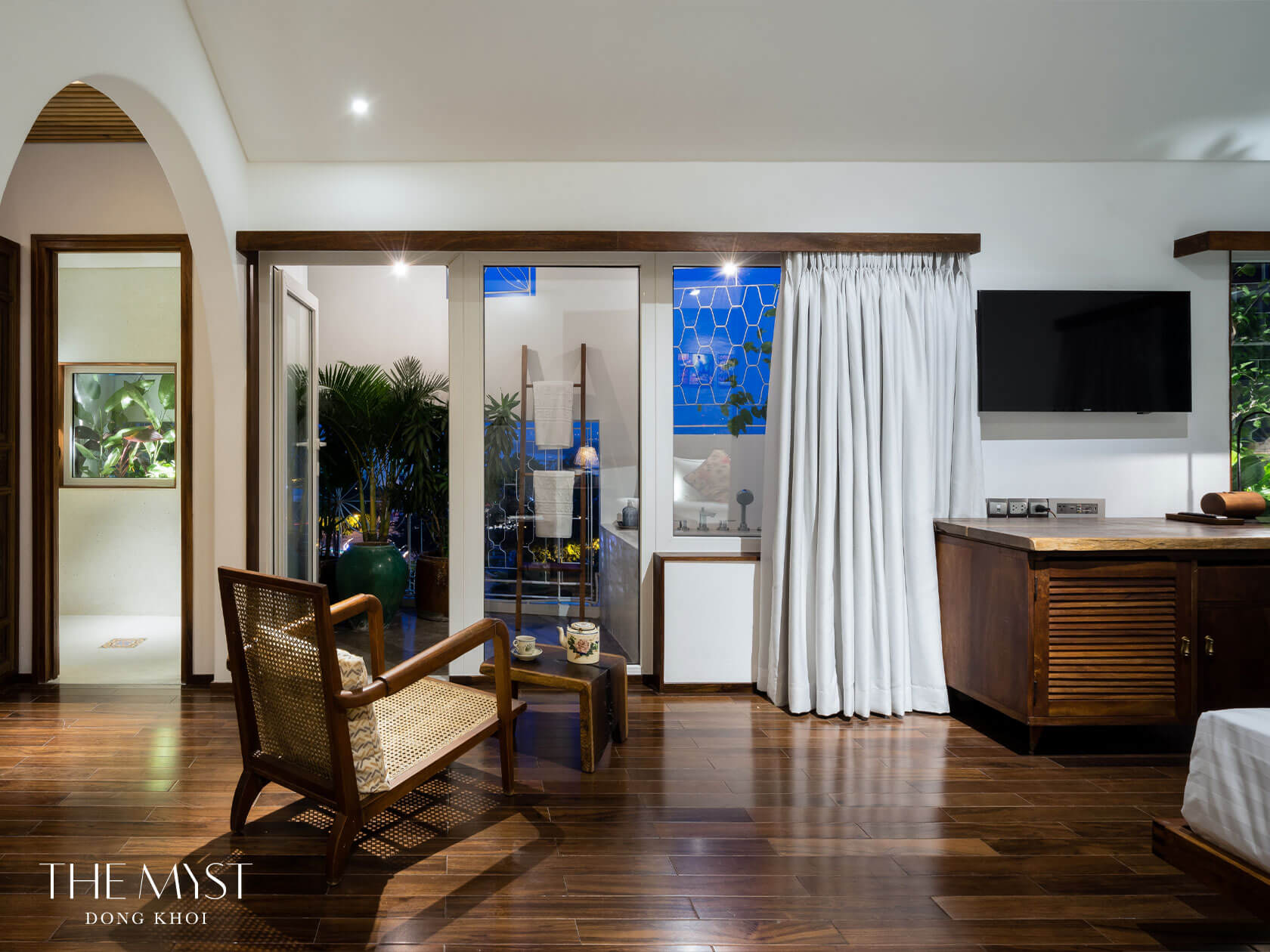
Dong Khoi Balcony and Saigon Balcony: 40 m²
Both measure 40 m² and share the private balcony and outdoor jacuzzi of the larger types. The names will not tell you which floor a room is on or which way its balcony faces, so check with the reservations team when you book. For a few nights on business or a trip alone, 40 m² is generous, with floor to spare for a morning stretch.
Matching the room to the trip
No single type suits everyone. Four kinds of guest come up again and again, and each has an obvious place to start.
Couples marking an occasion can choose between The Myst Suite, for the most space, and the 50 m² Saigon Signature Balcony, City View. Dine at The Nest on the 12th floor, behind windows shaped like wrought-iron flowers, then come back for a long soak. KL Spa, inside the hotel, has a VIP Romantic Couple package with a flower bath.
On business, a 40 m² room covers what you need. Đồng Khởi street is about a minute's walk from the hotel, and the nearest metro stop is Opera House station on Line 1. Just off a night flight and desperate for sleep? Take the Verdant Calm Balcony instead. The gym, open 7:00 am to 8:00 pm, suits a workout before meetings.
For solo trips, the Saigon Balcony or the Verdant Calm Balcony are natural picks, and light sleepers should go straight to the latter. The balcony becomes your own outdoor sitting room, somewhere to read, ring home or watch the rain. Nobody else wants the chair.
Small families should begin with a phone call. Ask the reservations team about maximum occupancy, extra beds and children sharing before settling on a type. If space comes first, look at the Suite (70 m²) or the Saigon Signature (50 m²). Watch little ones around the balcony and its jacuzzi.
A day with the balcony and the tub
A balcony opened once, for the arrival photo, is a waste. Each part of a Saigon day suits it differently, and the same goes for the tub.
Early morning belongs to the balcony. Before seven the sun is still gentle; brew tea with the set in your room, carry it outside and listen to the street stirring below. For coffee, Bason Café is downstairs. Breakfast is a buffet at The Nest.
Midday is another matter. At noon a minute on any balcony has you sweating, plants or no plants. Draw the curtains and rest, or head up to the 24-metre infinity pool on the 15th floor, open from 7:00 am to 7:00 pm; the gym, sauna and steam room are open from 7:00 am to 8:00 pm.
Rainy-season afternoons make the best case for plants on a balcony. Sit behind the glass while a downpour drums on the leaves, and going out loses its appeal. When it stops, the air cools, the damp soil gives off its smell, and stepping outside is the loveliest moment of the day.
Evening is for the tub. After a day on foot around Đồng Khởi and Nguyễn Huệ, twenty minutes in warm water does tired legs a lot of good. The tub is a jacuzzi with jets, and the information card in the room gives one tip worth knowing: fill the water above the jets before pressing the button. If it still refuses, ring reception.
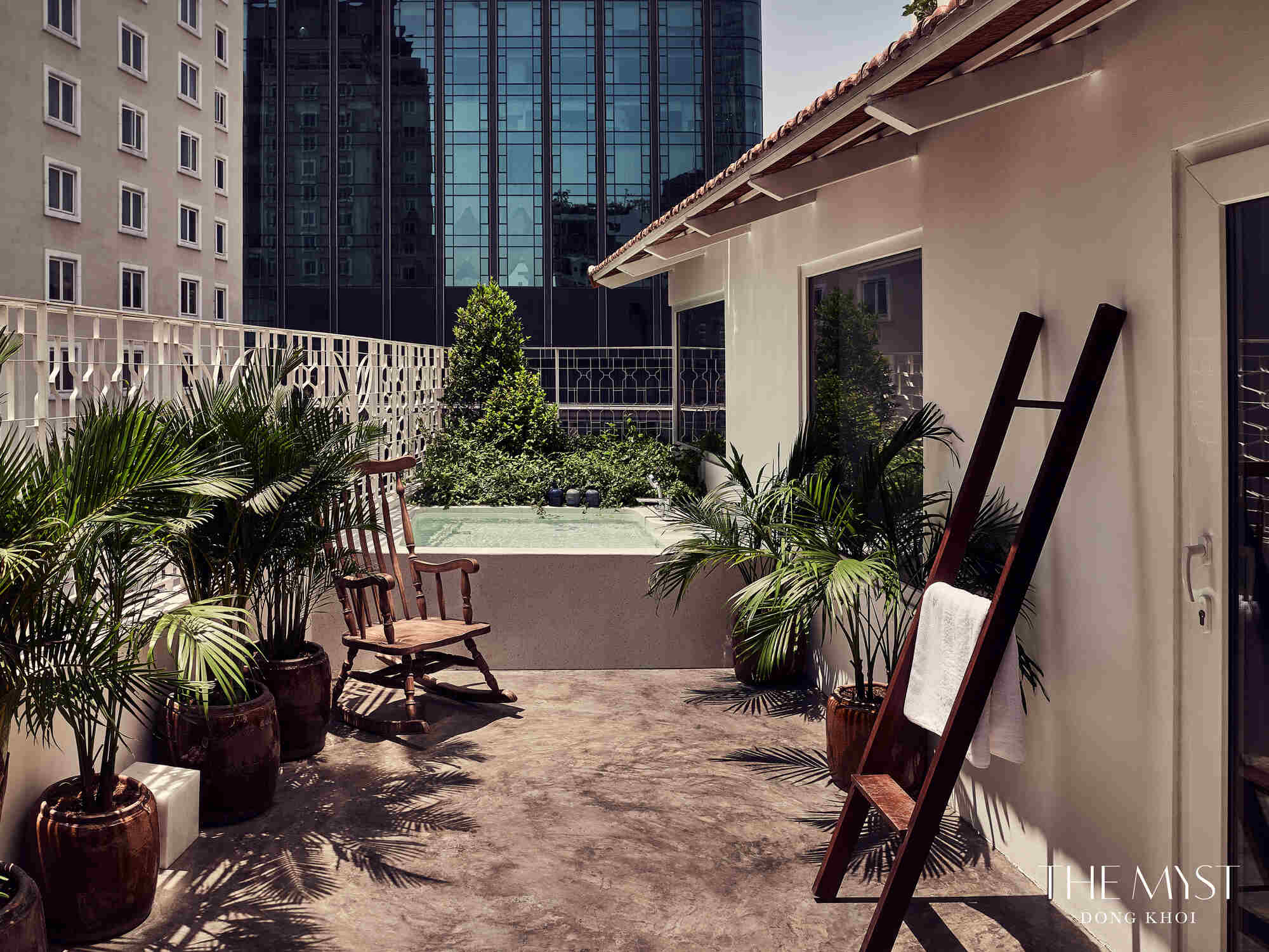
Check-in, check-out and flight times
Check-in is from 3:00 pm and check-out before 12:00 noon. Early arrival and late departure can both be requested, subject to availability. Small print, perhaps, but it decides how many hours you get with your balcony.
Say you land at Tân Sơn Nhất off an overnight flight and reach the hotel at about 8:00 am. That leaves seven hours before standard check-in. Give your arrival time when you book and ask for an early check-in. If no room is ready, ask to leave your bags and walk the four minutes to Nguyễn Huệ for breakfast.
Going home works the same way. With an evening flight and a noon check-out, the afternoon just hangs there, so ask for a late check-out: a nap and one more soak before the airport. Ask the reservations team about airport transfers and whether breakfast comes with your rate.
Questions worth asking when you book
Book online or call +84 28 3520 3040. Either way, ask these first.
- What are the bed options in the type you want: one large bed or two?
- Which way does the balcony face? This matters most for the Dong Khoi Balcony and Saigon Balcony, whose names give nothing away.
- Can an early check-in or late check-out be noted now, to fit your flights?
- How many people can stay, and is an extra bed possible for a child?
Frequently asked questions
Which rooms at The Myst Dong Khoi have a private balcony?
Which room types have an outdoor bathtub?
Which room suits a light sleeper?
Can I check in early if I land in Saigon in the morning?
Which room type works for a family with a young child?
How do you use the balcony jacuzzi?
Book a balcony of your own in Saigon
Six room types, one thing in common: every morning, open air steps from your bed. Browse each type, then book direct and tell us the outlook you prefer.
→ See photographs of all six room types
Curated by Silverland Hospitality.
Blog
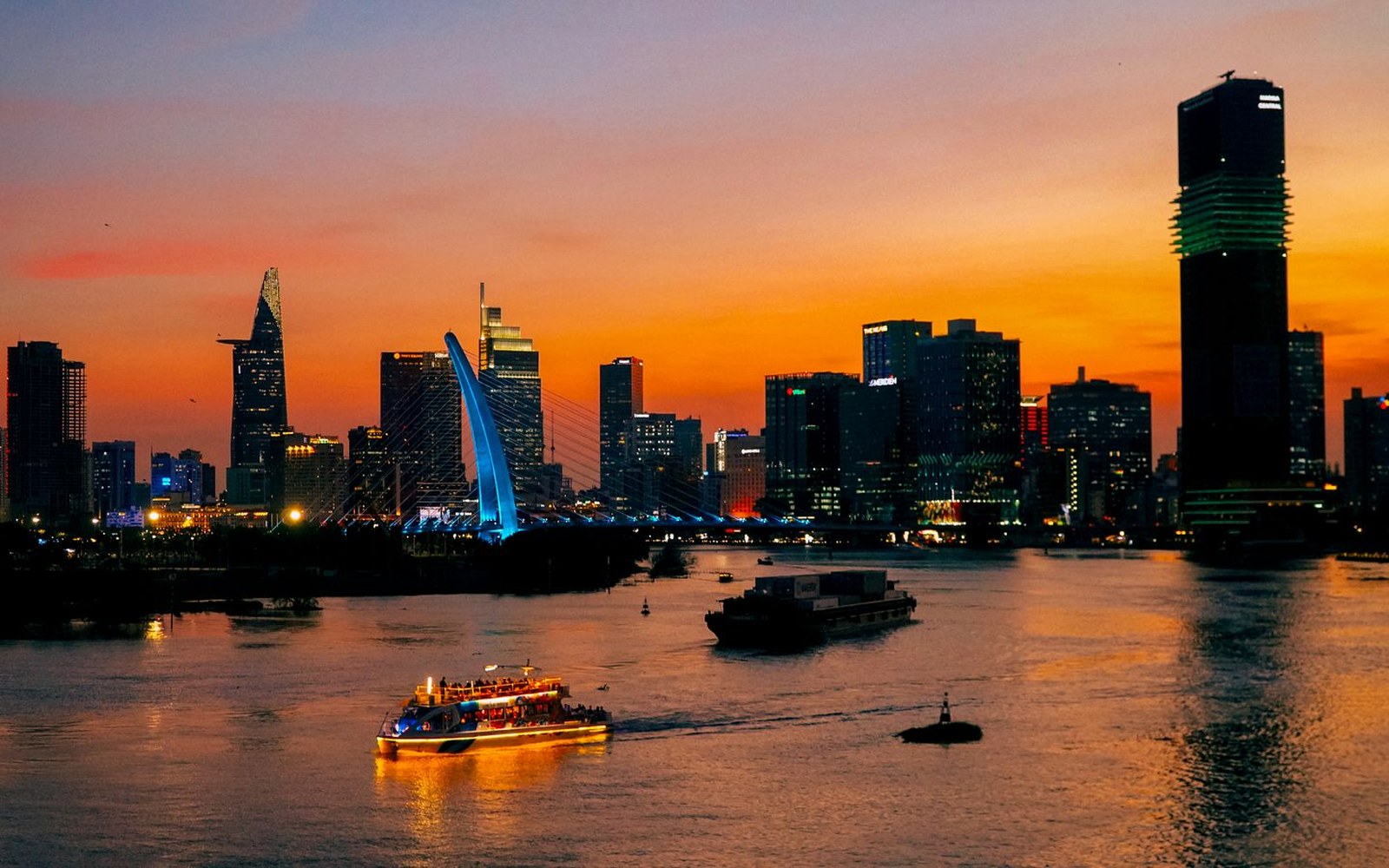
By five o'clock the sun has started to ease off Hồ Huấn Nghiệp. It is a minute's walk to Đồng Khởi, and that street runs straight to the water; you feel the river breeze before you see the river. A few minutes more and you are on the bank. The Myst Dong Khoi, at 6-8 Hồ Huấn Nghiệp, is about five minutes on foot from the Bạch Đằng waterfront and about four from Nguyễn Huệ walking street, often written Nguyen Hue in English. So a whole evening, from sunset beside the Saigon River to the boulevard after dark and a last drink on the 15th floor, never needs a taxi.
At a glance. The Myst Dong Khoi is about five minutes' walk from the Bạch Đằng waterfront and about four from Nguyễn Huệ walking street. Sunset in Saigon comes as early as 5:30 pm in November and as late as 6:20 pm in early July. Nguyễn Huệ began as a canal, filled in by 1887, and has been a 670-metre pedestrian boulevard since 2015. ROOTY Bar on the hotel's 15th floor stays open until 1:00 am.
In this guide
Before sunset: down to the Bạch Đằng waterfront
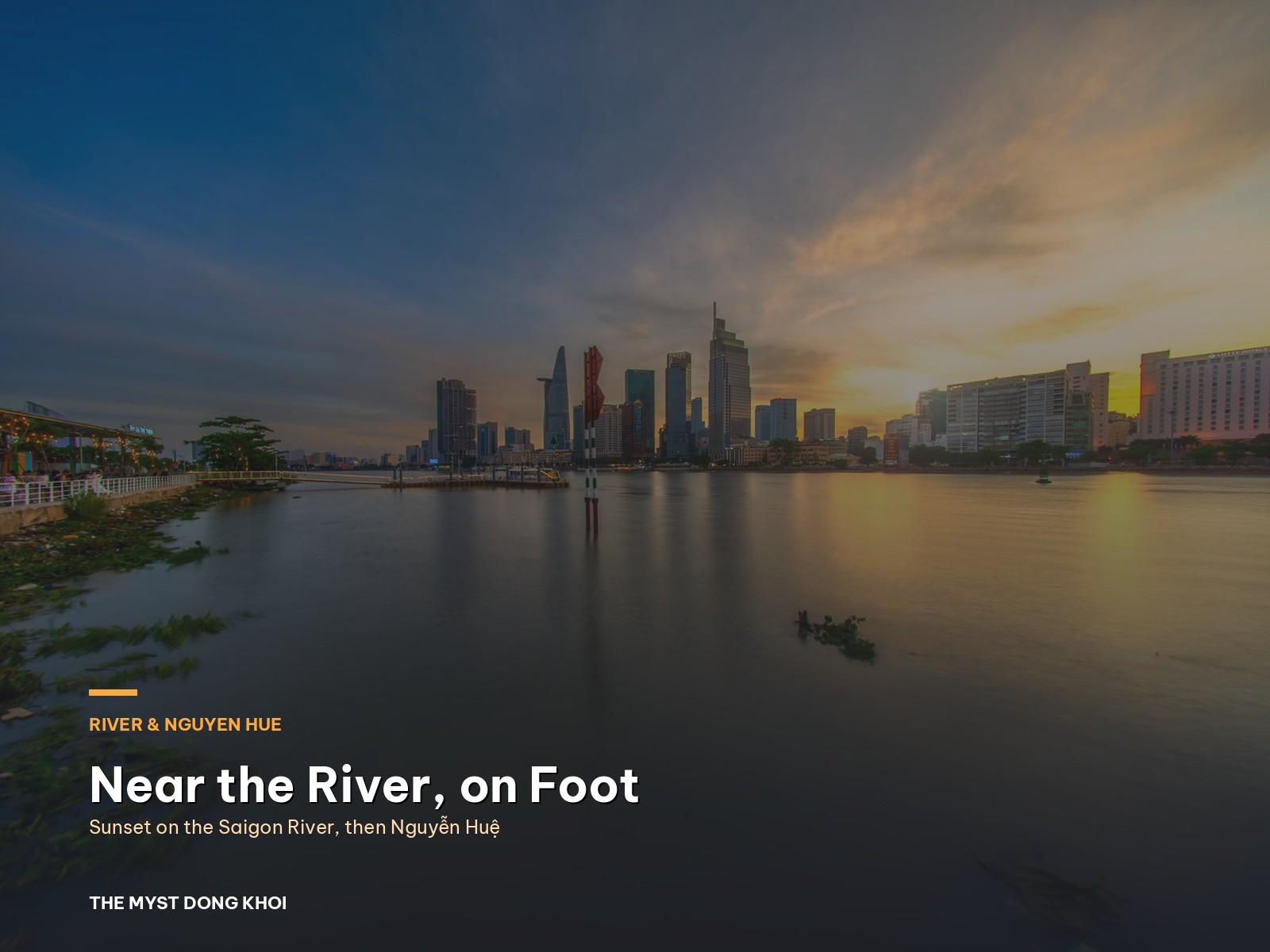
Sunset by the river is easy to miss by five minutes, so do not cut it fine. In Saigon the sun sets earliest in November, at around 5:30 pm, and latest in early July, at about 6:20 pm. Less than an hour between them. Still enough to catch you out. The simplest plan is to leave the hotel half an hour before sunset, wander down, and arrive with time to choose your spot. The Bạch Đằng quay looks east across to Thủ Thiêm, so the sun goes down behind the city at your back; what you watch is the water and the sky over the far bank taking on its colour.
The Saigon River is 251 km long: it rises in south-eastern Cambodia, flows south and south-east for about 230 km, leaves the Dầu Tiếng reservoir behind and meets the Đồng Nai River south-east of downtown. Within the city it ranges from roughly 50 to 1,000 metres wide, with stretches as deep as 20 metres. Its lower reaches are tidal, rising and falling twice a day, so the waterline at the quay depends on when you turn up. Wikipedia's page on the Saigon River from source to confluence has more detail.
The Bạch Đằng park reopened after a renovation on 17 March 2022, with granite paths and new planting. For a stretch-by-stretch route along the water, read our local's guide to the Saigon riverfront; the green spaces on both banks have their own piece, the Bạch Đằng and Thủ Thiêm riverside parks. Tonight we are only passing through.
Why the waterfront is called Bạch Đằng
Under the French, this bank had no Vietnamese name. Its riverside roads carried names such as Quai Francis Garnier and Quai d'Argonne. In 1955 the government of the Republic of Vietnam merged two of those roads into one and called it Bến Bạch Đằng. In 1980 the city joined it to part of Đinh Tiên Hoàng street, and together they became Tôn Đức Thắng, the name on the street signs today.
The old name survives in the park and in the Bạch Đằng water bus station, where a river service has run since 2017 towards Thủ Đức. Stops and fares are covered in our guide to riding the Saigon water bus from Bạch Đằng. One coincidence: 1955 was also the year the boulevard that ends at this very quay took the name Nguyễn Huệ.
Sunset times by month, and when to leave the hotel
The figures below come from sunset tables for Ho Chi Minh City, rounded to the nearest five minutes. The last column gets you to the river about twenty minutes before sunset.
| Month | Sunset, approximately | Season | Leave the hotel by |
|---|---|---|---|
| January | 5:45 to 6:00 pm | Dry season | 5:15 pm |
| March | 6:05 pm | Dry season | 5:35 pm |
| May | 6:05 to 6:10 pm | Rainy season begins | 5:35 pm |
| July | 6:20 pm, the latest of the year | Rainy season | 5:50 pm |
| September | 5:50 to 6:05 pm | Rainy season, one of the two wettest months | 5:20 pm |
| November | 5:30 pm, the earliest of the year | End of the rainy season | 5:00 pm |
Saigon's rainy season runs from May to November and brings about 90% of the year's rain, most of it in June and September. December to April is the dry season, which suits anyone who would prefer not to keep one eye on the clouds.
Nguyễn Huệ was once a canal
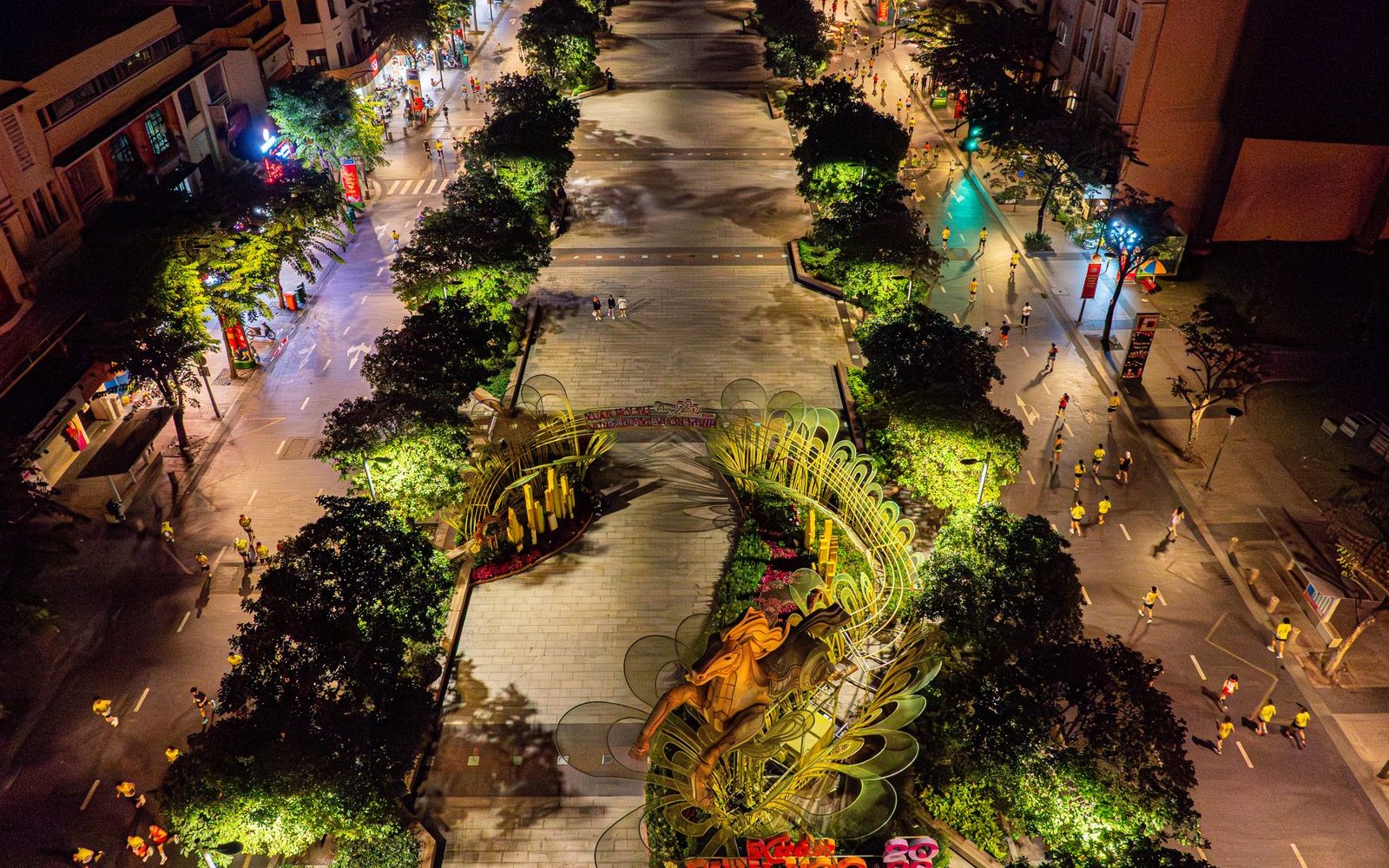
Follow the bank a short way to where Nguyễn Huệ meets the river, then turn your back to the water. The whole walking street lies ahead of you, running straight up to City Hall at the far end. It is 64 metres wide. More than a century ago, you would have been looking along a waterway.
The canal was called Kinh Lớn, the Great Canal, and it linked the Saigon River with the Bát Quái citadel that Nguyễn Ánh built at Gia Định in 1790. Once the French had taken Cochinchina, the streets along its two banks were named Quai Charner and Quai Rigault de Genouilly, in 1865. The upper section was filled in towards the end of the 1860s. By 1887 the rest had gone as well, and the old canal bed became Boulevard Charner.
The boulevard went on changing. In 1926 it gained two wide central carriageways separated by a thin strip of grass, and in 1955 Boulevard Charner was renamed Nguyễn Huệ. The history of Nguyễn Huệ Boulevard has the rest. Walk up from the river, then, and you are tracing the line of the old canal, except that there is granite underfoot and the only water left is in the fountains.
After dark: 670 metres of walking street
On 29 April 2015 the city opened the Nguyễn Huệ pedestrian square: 670 metres long, 64 metres wide, paved in granite and set with fountains. The middle of the boulevard has belonged to people on foot ever since.
Come once it is properly dark. The sun has gone, the paving has lost some of the day's heat and the buildings on either side have switched their lights on. Walk slowly from the river end up to City Hall, pause to look back down towards the water, then return along the other side. At 670 metres each way, the round trip is well under two kilometres.
The pleasure of the place is simple: you can amble down the middle of a wide boulevard without once checking over your shoulder for motorbikes. For walking times to the Opera House and Bến Thành Market, see what lies within a 15-minute walk of the hotel.
Tết flowers on Nguyễn Huệ
From 1960, a spring flower market was held on Nguyễn Huệ every Tết, the Lunar New Year. Around 2000 the city moved the market to 23 September Park. In 2004 the flowers came back to Nguyễn Huệ in a different form: a flower street laid out for strolling and photographs, with nothing for sale.
Stay in the centre over Tết and the flower street is a few minutes' walk away. Back at the hotel, the buffet counter at The Nest on the 12th floor is a nine-metre wooden boat, a nod to the flower boats that used to tie up at Bình Đông market in the days before the New Year.
Back up to the 15th floor
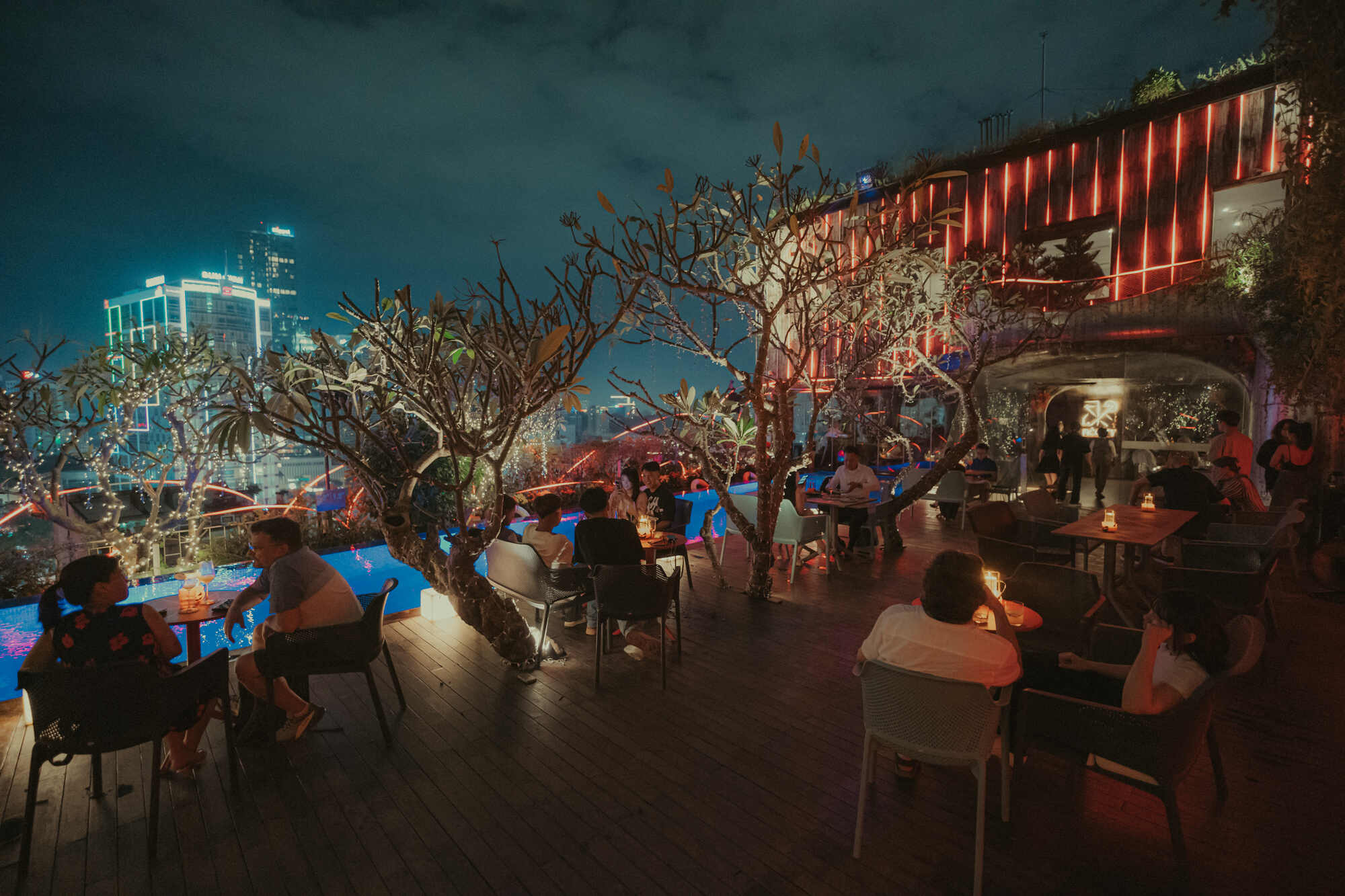
From Nguyễn Huệ it is about four minutes back to Hồ Huấn Nghiệp. The lobby carries a faint note of ngọc lan, the ylang-ylang that is the hotel's signature scent. On the 15th floor, ROOTY Bar is open from 7:00 am to 1:00 am, with Saigon-inspired cocktails and small Vietnamese dishes. Up here the traffic noise fades, and only once you sit down do your legs tell you how far you have walked. There is more on the menu in our guide to ROOTY, the rooftop bar.
The 24-metre infinity pool on the same floor looks over the city and the river, and it is open until 7:00 pm, so you can swim before you set out. For a river view without leaving your room, The Myst Suite (70 m²) has an outdoor bathtub on its balcony facing the city and the river.
A suggested evening, step by step
- Afternoon. A few lengths of the rooftop pool before it closes at 7:00 pm.
- Half an hour before sunset. Leave the hotel and follow Đồng Khởi to the river.
- At sunset. Stand on the Bạch Đằng waterfront, then follow the bank to the foot of Nguyễn Huệ.
- Once it is dark. Walk the length of the walking street and come back down the other side.
- Later. Dinner at The Nest, the all-day restaurant on the 12th floor, or near Đồng Khởi, then up to ROOTY Bar with no need to rush.
What to bring for an evening by the river
- A folding umbrella from May to November.
- Shoes with grip. The Bạch Đằng quay and park alone run for 1.3 km, and wet paving turns slippery.
- Water. The city averages 28 °C, with humidity around 78 to 82%.
- A bag worn in front in crowded spots.
Cross Tôn Đức Thắng at the lights, and keep small children close near the embankment edge.
Frequently asked questions
How far is a loop of the riverfront and Nguyễn Huệ walking street?
What was Nguyễn Huệ Boulevard before it became a walking street?
What time is sunset on the Saigon River?
When did the Nguyễn Huệ flower street begin?
Is anything open late at the hotel after an evening walk?
What should I bring for a riverside walk in the rainy season?
Sunset by the river, a nightcap on the 15th floor
From The Myst Dong Khoi, the Saigon River and Nguyễn Huệ walking street are both a few minutes away on foot. Stay a few nights, try a different loop each evening, and end every one with a cocktail at ROOTY Bar.
→ See ROOTY Bar and the hotel's restaurants
→ Book direct for evenings by the river
Curated by Silverland Hospitality.
Blog
By five o'clock the sun has started to ease off Hồ Huấn Nghiệp. It is a minute's walk to Đồng Khởi, and that street runs straight to the water; you feel the river breeze before you see the river. A few minutes more and you are on the bank. The Myst Dong Khoi, at 6-8 Hồ Huấn Nghiệp, is about five minutes on foot from the Bạch Đằng waterfront and about four from Nguyễn Huệ walking street, often written Nguyen Hue in English. So a whole evening, from sunset beside the Saigon River to the boulevard after dark and a last drink on the 15th floor, never needs a taxi.
At a glance. The Myst Dong Khoi is about five minutes' walk from the Bạch Đằng waterfront and about four from Nguyễn Huệ walking street. Sunset in Saigon comes as early as 5:30 pm in November and as late as 6:20 pm in early July. Nguyễn Huệ began as a canal, filled in by 1887, and has been a 670-metre pedestrian boulevard since 2015. ROOTY Bar on the hotel's 15th floor stays open until 1:00 am.
In this guide
Before sunset: down to the Bạch Đằng waterfront
Sunset by the river is easy to miss by five minutes, so do not cut it fine. In Saigon the sun sets earliest in November, at around 5:30 pm, and latest in early July, at about 6:20 pm. Less than an hour between them. Still enough to catch you out. The simplest plan is to leave the hotel half an hour before sunset, wander down, and arrive with time to choose your spot. The Bạch Đằng quay looks east across to Thủ Thiêm, so the sun goes down behind the city at your back; what you watch is the water and the sky over the far bank taking on its colour.
The Saigon River is 251 km long: it rises in south-eastern Cambodia, flows south and south-east for about 230 km, leaves the Dầu Tiếng reservoir behind and meets the Đồng Nai River south-east of downtown. Within the city it ranges from roughly 50 to 1,000 metres wide, with stretches as deep as 20 metres. Its lower reaches are tidal, rising and falling twice a day, so the waterline at the quay depends on when you turn up. Wikipedia's page on the Saigon River from source to confluence has more detail.
The Bạch Đằng park reopened after a renovation on 17 March 2022, with granite paths and new planting. For a stretch-by-stretch route along the water, read our local's guide to the Saigon riverfront; the green spaces on both banks have their own piece, the Bạch Đằng and Thủ Thiêm riverside parks. Tonight we are only passing through.
Why the waterfront is called Bạch Đằng
Under the French, this bank had no Vietnamese name. Its riverside roads carried names such as Quai Francis Garnier and Quai d'Argonne. In 1955 the government of the Republic of Vietnam merged two of those roads into one and called it Bến Bạch Đằng. In 1980 the city joined it to part of Đinh Tiên Hoàng street, and together they became Tôn Đức Thắng, the name on the street signs today.
The old name survives in the park and in the Bạch Đằng water bus station, where a river service has run since 2017 towards Thủ Đức. Stops and fares are covered in our guide to riding the Saigon water bus from Bạch Đằng. One coincidence: 1955 was also the year the boulevard that ends at this very quay took the name Nguyễn Huệ.
Sunset times by month, and when to leave the hotel
The figures below come from sunset tables for Ho Chi Minh City, rounded to the nearest five minutes. The last column gets you to the river about twenty minutes before sunset.
| Month | Sunset, approximately | Season | Leave the hotel by |
|---|---|---|---|
| January | 5:45 to 6:00 pm | Dry season | 5:15 pm |
| March | 6:05 pm | Dry season | 5:35 pm |
| May | 6:05 to 6:10 pm | Rainy season begins | 5:35 pm |
| July | 6:20 pm, the latest of the year | Rainy season | 5:50 pm |
| September | 5:50 to 6:05 pm | Rainy season, one of the two wettest months | 5:20 pm |
| November | 5:30 pm, the earliest of the year | End of the rainy season | 5:00 pm |
Saigon's rainy season runs from May to November and brings about 90% of the year's rain, most of it in June and September. December to April is the dry season, which suits anyone who would prefer not to keep one eye on the clouds.
Nguyễn Huệ was once a canal
Follow the bank a short way to where Nguyễn Huệ meets the river, then turn your back to the water. The whole walking street lies ahead of you, running straight up to City Hall at the far end. It is 64 metres wide. More than a century ago, you would have been looking along a waterway.
The canal was called Kinh Lớn, the Great Canal, and it linked the Saigon River with the Bát Quái citadel that Nguyễn Ánh built at Gia Định in 1790. Once the French had taken Cochinchina, the streets along its two banks were named Quai Charner and Quai Rigault de Genouilly, in 1865. The upper section was filled in towards the end of the 1860s. By 1887 the rest had gone as well, and the old canal bed became Boulevard Charner.
The boulevard went on changing. In 1926 it gained two wide central carriageways separated by a thin strip of grass, and in 1955 Boulevard Charner was renamed Nguyễn Huệ. The history of Nguyễn Huệ Boulevard has the rest. Walk up from the river, then, and you are tracing the line of the old canal, except that there is granite underfoot and the only water left is in the fountains.
After dark: 670 metres of walking street
On 29 April 2015 the city opened the Nguyễn Huệ pedestrian square: 670 metres long, 64 metres wide, paved in granite and set with fountains. The middle of the boulevard has belonged to people on foot ever since.
Come once it is properly dark. The sun has gone, the paving has lost some of the day's heat and the buildings on either side have switched their lights on. Walk slowly from the river end up to City Hall, pause to look back down towards the water, then return along the other side. At 670 metres each way, the round trip is well under two kilometres.
The pleasure of the place is simple: you can amble down the middle of a wide boulevard without once checking over your shoulder for motorbikes. For walking times to the Opera House and Bến Thành Market, see what lies within a 15-minute walk of the hotel.
Tết flowers on Nguyễn Huệ
From 1960, a spring flower market was held on Nguyễn Huệ every Tết, the Lunar New Year. Around 2000 the city moved the market to 23 September Park. In 2004 the flowers came back to Nguyễn Huệ in a different form: a flower street laid out for strolling and photographs, with nothing for sale.
Stay in the centre over Tết and the flower street is a few minutes' walk away. Back at the hotel, the buffet counter at The Nest on the 12th floor is a nine-metre wooden boat, a nod to the flower boats that used to tie up at Bình Đông market in the days before the New Year.
Back up to the 15th floor
From Nguyễn Huệ it is about four minutes back to Hồ Huấn Nghiệp. The lobby carries a faint note of ngọc lan, the ylang-ylang that is the hotel's signature scent. On the 15th floor, ROOTY Bar is open from 7:00 am to 1:00 am, with Saigon-inspired cocktails and small Vietnamese dishes. Up here the traffic noise fades, and only once you sit down do your legs tell you how far you have walked. There is more on the menu in our guide to ROOTY, the rooftop bar.
The 24-metre infinity pool on the same floor looks over the city and the river, and it is open until 7:00 pm, so you can swim before you set out. For a river view without leaving your room, The Myst Suite (70 m²) has an outdoor bathtub on its balcony facing the city and the river.
A suggested evening, step by step
- Afternoon. A few lengths of the rooftop pool before it closes at 7:00 pm.
- Half an hour before sunset. Leave the hotel and follow Đồng Khởi to the river.
- At sunset. Stand on the Bạch Đằng waterfront, then follow the bank to the foot of Nguyễn Huệ.
- Once it is dark. Walk the length of the walking street and come back down the other side.
- Later. Dinner at The Nest, the all-day restaurant on the 12th floor, or near Đồng Khởi, then up to ROOTY Bar with no need to rush.
What to bring for an evening by the river
- A folding umbrella from May to November.
- Shoes with grip. The Bạch Đằng quay and park alone run for 1.3 km, and wet paving turns slippery.
- Water. The city averages 28 °C, with humidity around 78 to 82%.
- A bag worn in front in crowded spots.
Cross Tôn Đức Thắng at the lights, and keep small children close near the embankment edge.
Frequently asked questions
How far is a loop of the riverfront and Nguyễn Huệ walking street?
What was Nguyễn Huệ Boulevard before it became a walking street?
What time is sunset on the Saigon River?
When did the Nguyễn Huệ flower street begin?
Is anything open late at the hotel after an evening walk?
What should I bring for a riverside walk in the rainy season?
Sunset by the river, a nightcap on the 15th floor
From The Myst Dong Khoi, the Saigon River and Nguyễn Huệ walking street are both a few minutes away on foot. Stay a few nights, try a different loop each evening, and end every one with a cocktail at ROOTY Bar.
→ See ROOTY Bar and the hotel's restaurants
→ Book direct for evenings by the river
Curated by Silverland Hospitality.
Blog
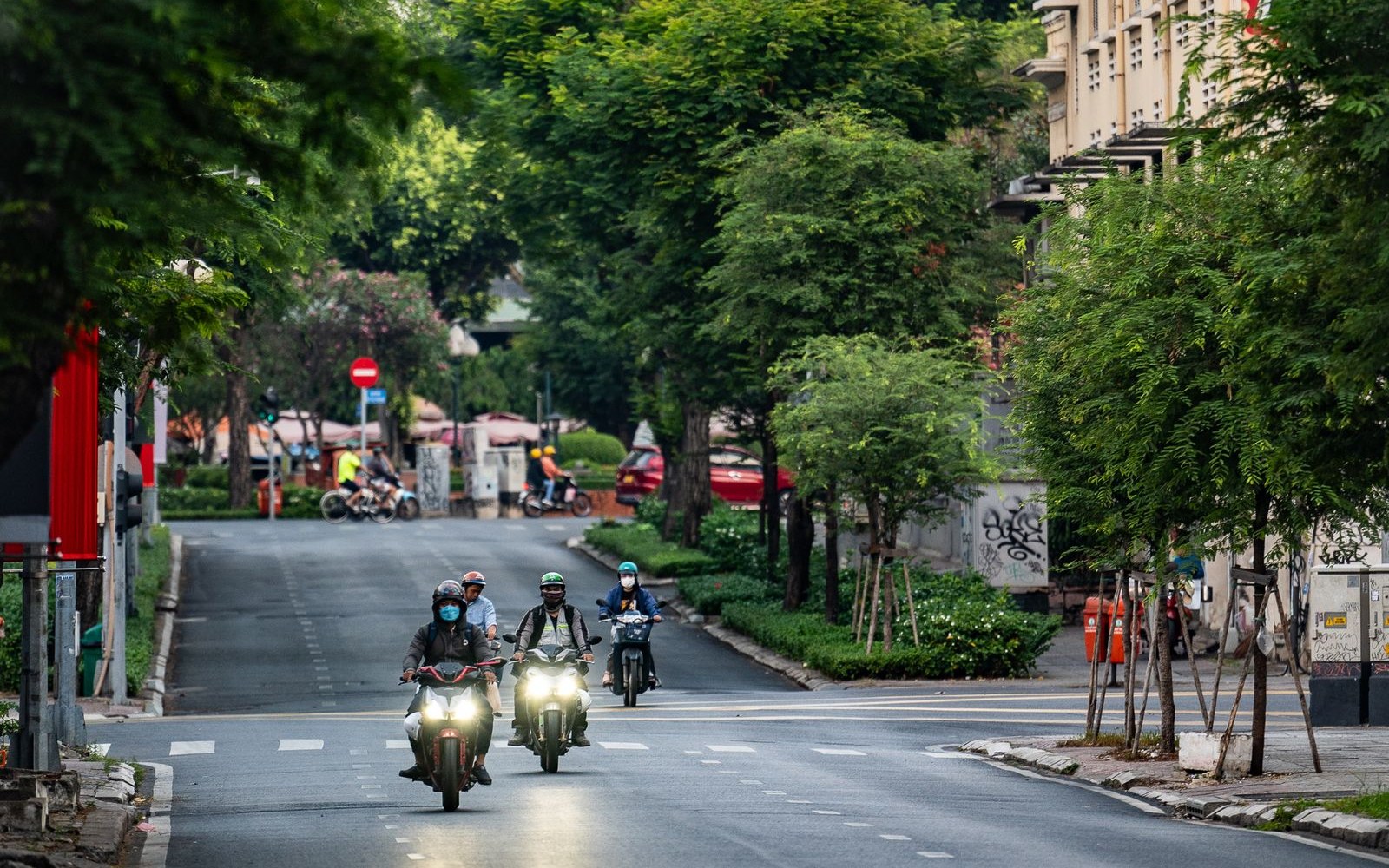
At six in the morning, a one-minute walk along Hồ Huấn Nghiệp street brings you out onto Đồng Khởi. Shutters are still down, the traffic is thin and a breeze is coming up from the river. A few minutes on, Nguyễn Huệ walking street is quiet enough to hear your own footsteps. That is the point of a walkable hotel in District 1, Saigon: the city starts at the door. From The Myst Dong Khoi, Nguyễn Huệ is about four minutes away, the Bạch Đằng riverside five and the Opera House seven, while Bến Thành Market, the furthest point, takes 12 to 15. Each stop below comes with a piece of its history, followed by two routes and advice on the heat.
At a glance. The Myst Dong Khoi is at 6-8 Hồ Huấn Nghiệp, Sài Gòn Ward. Đồng Khởi street is about a minute away along Hồ Huấn Nghiệp, Nguyễn Huệ about 4 minutes, the Bạch Đằng riverside about 5, the Opera House about 7 and Bến Thành Market 12 to 15. The nearest metro stop is Opera House station on Line 1.
In this guide
The 15-minute circle at a glance
Times are approximate and measured from the hotel. Add a few minutes for photos, a bottle of water or a red light.
| Stop | On foot from the hotel | Worth knowing |
|---|---|---|
| Đồng Khởi street | About 1 minute, along Hồ Huấn Nghiệp street | Named rue Catinat from 1865; renamed Đồng Khởi in 1975 |
| Nguyễn Huệ walking street | About 4 minutes | A canal filled in 1887; a pedestrian street 670 m long and 64 m wide since 2015 |
| Bạch Đằng riverside | About 5 minutes | At the river end of Đồng Khởi |
| Opera House | About 7 minutes | Begun in 1898, opened on 1 January 1900 |
| Notre-Dame Cathedral and Central Post Office | Past the Opera House, at the top of Đồng Khởi | Cathedral completed in 1880; post office built 1886 to 1891 |
| Bến Thành Market | About 12 to 15 minutes | Built 1912 to 1914; clock tower over the south gate |
| Old Ba Son shipyard site | About 1 km, 15 to 20 minutes (just outside the circle) | Ba Son station is the next metro stop after Opera House |
Đồng Khởi: a minute from the door
The walk to Đồng Khởi is so short that, the first time, you may reach for the map only to find you have already arrived. The street runs from Notre-Dame Cathedral down to the Bạch Đằng riverside, the easiest line to steer by. Walk with the river behind you and you reach the cathedral. Turn round and you reach the water.
The name itself is fairly young. Under the French this was rue Catinat, named on 1 February 1865 after a marshal of France, and it later spent some years as Tự Do street before becoming Đồng Khởi in 1975. Come across Catinat in an old book about Saigon and you will know exactly which pavement the writer was walking. For a morning among its shops, start with the designer boutiques along Đồng Khởi.
Nguyễn Huệ and the riverside: four or five minutes
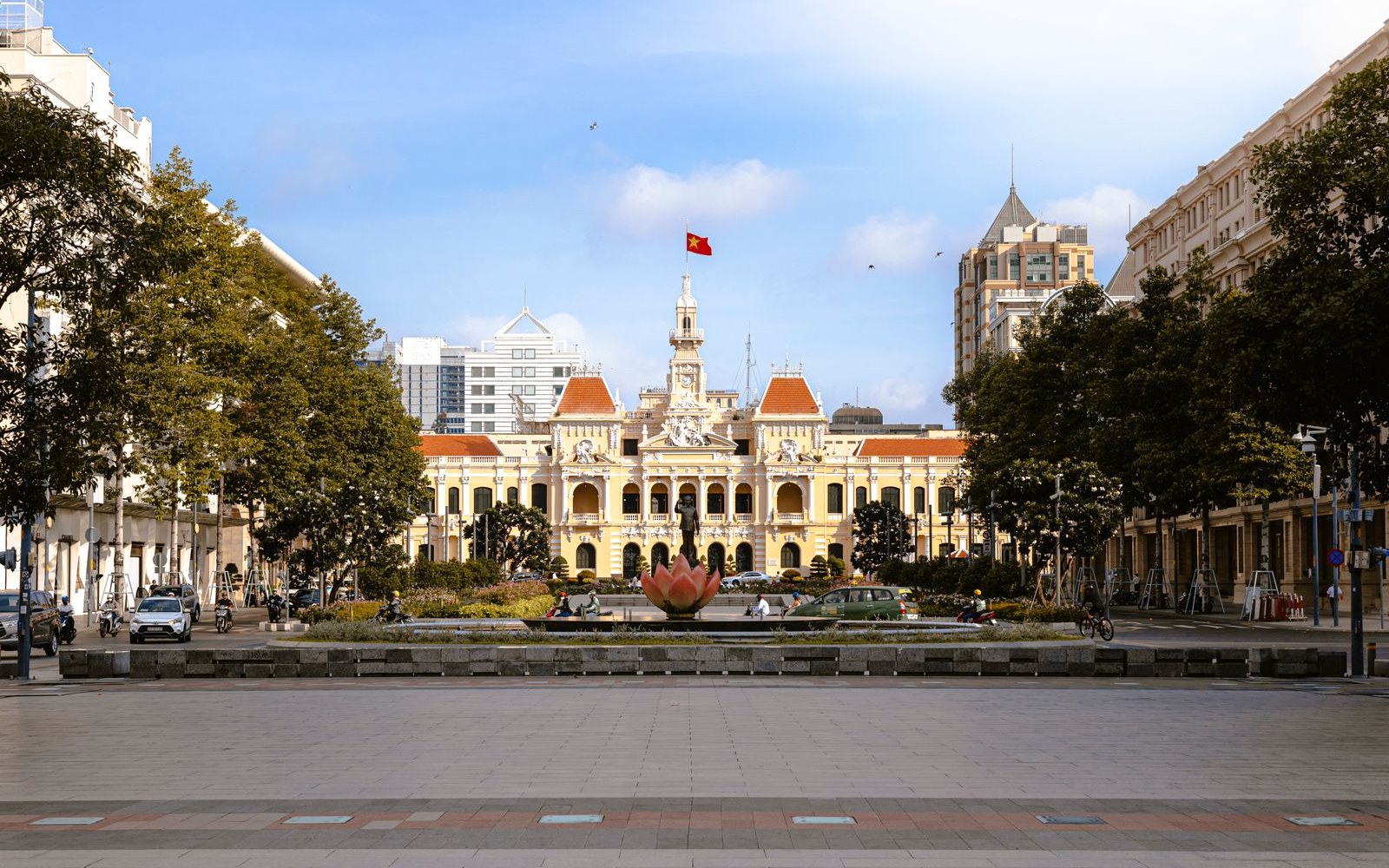
About four minutes from the hotel, Nguyễn Huệ opens up in front of you, so wide that it is hard to picture water here. There was, though. This was once a canal known as Kinh Lớn. The French filled it in 1887 to lay out a boulevard they named Charner, and it became Nguyễn Huệ in 1955. In 2015 the whole street was rebuilt as a pedestrian promenade 670 metres long and 64 metres wide. The full story is in the history of Nguyễn Huệ Boulevard, from canal to promenade.
Come early if you like it quiet. The street is empty, the sun is still low and nobody drifts into your photos. The Bạch Đằng riverside is a little further, about five minutes from the hotel. After dark both fill up; that evening walk is covered in an after-dark stroll from the riverside to Nguyễn Huệ.
The Opera House: seven minutes, and a façade worth a second look
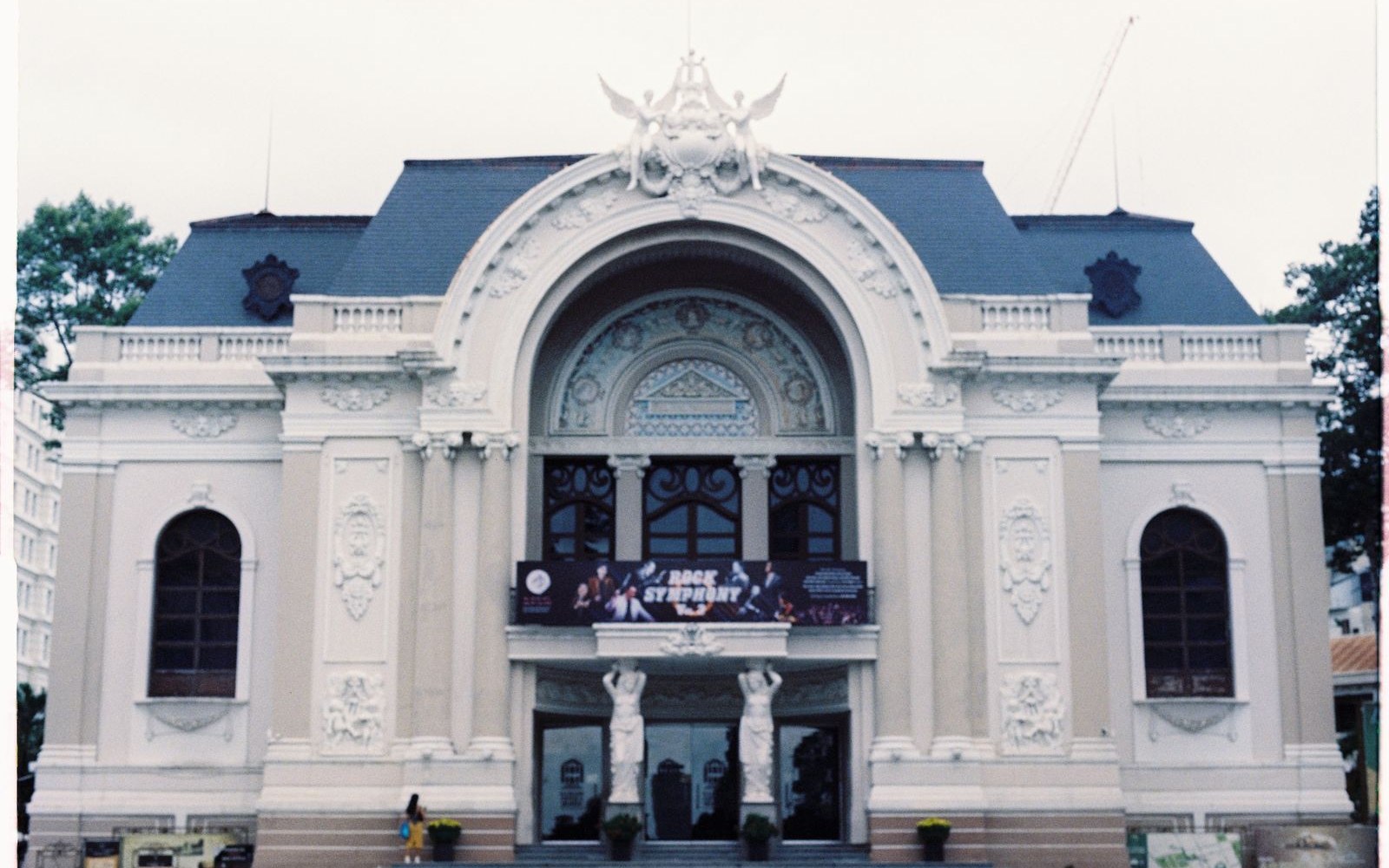
The Opera House stands at No. 7 Lam Sơn Square, facing Đồng Khởi, about seven minutes on foot. Construction began in 1898 and the doors opened on 1 January 1900. It was built in the Flamboyant style of the French Third Republic, hence a front thick with statues and lamps.
That façade has had an odd life. In 1943 its statues and decorations were stripped away. They came back only in 1998, restored for Saigon's 300th anniversary. So the figures you photograph today spent more than half a century missing.
Holding tickets for an evening performance? For somewhere to sit beforehand, see where to find coffee near the Opera House before a show.
A little further: the cathedral and the post office
Keep walking up Đồng Khởi past the Opera House until the street runs out, and you arrive at Paris Commune Square, where Notre-Dame Cathedral and the Central Post Office stand side by side.
The cathedral's first stone was laid on 7 October 1877, and it was blessed as complete on Easter Day, 11 April 1880. It is currently under restoration. Work began on 29 June 2017 and the latest estimate runs to 2027, so check opening arrangements before planning a visit inside.
Next door, the post office you see today went up between 1886 and 1891, replacing an earlier telegraph building. Step inside and look up: arched vaults resting on iron columns, with decorative ironwork almost everywhere. After a few days among the wrought-iron flower motifs at The Myst, it feels oddly familiar.
Bến Thành Market: the edge of the circle
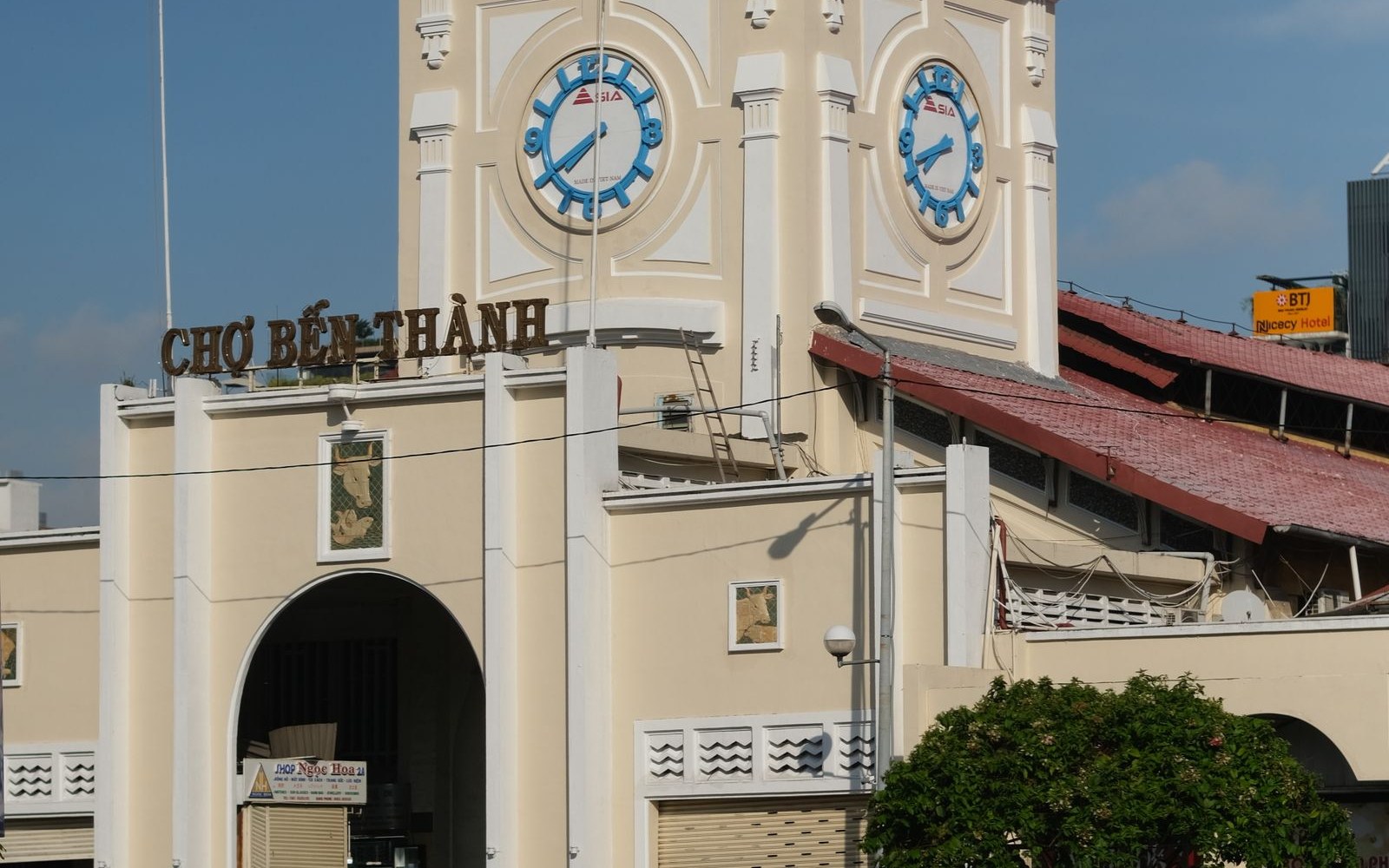
At 12 to 15 minutes, Bến Thành Market marks the outer edge of the walk. It was built between 1912 and 1914, and the clock tower over its south gate has become an unofficial emblem of the city. For more, read the century-old story of Bến Thành Market.
Fifteen minutes at seven in the morning is easy. Fifteen minutes at noon in April is another matter. If you leave late, walk to Opera House station and ride Line 1 one stop to Bến Thành station, beside the market. What to buy and how to bargain are covered in our practical guide to shopping at Bến Thành.
Two walks from the front door
Treat these as outlines. Linger wherever you like.
An early-morning loop
- Set off early. Walk along Hồ Huấn Nghiệp to Đồng Khởi, then turn so the river is at your back.
- The Opera House. About seven minutes in. Look at the façade while Lam Sơn Square is still empty.
- Cathedral and post office. Continue to the top of Đồng Khởi. If the post office has opened, go in for the vaulted hall.
- Back via Nguyễn Huệ. Follow the walking street down to Bạch Đằng.
- Breakfast. From the river it is about five minutes back. Head up to The Nest on the 12th floor for the breakfast buffet, or take a coffee at Bason Café on the ground floor.
Late afternoon into evening
- Swim first. The 24-metre infinity pool on the 15th floor is open until 7:00 pm.
- Metro to Bến Thành. One stop from Opera House station. Photograph the clock tower once the heat has eased.
- Walk back. Around 12 to 15 minutes to the hotel.
- Close the evening. ROOTY Bar on the 15th floor stays open until 1:00 am, or KL Spa, inside the hotel itself, is open until 10:00 pm for tired feet.
Walking in the Saigon heat
Saigon is warm all year. The average temperature is about 28 °C, and the highest ever recorded, 40 °C, came in April. The dry season runs from December to April, with plenty of sun and little rain. The rainy season usually lasts from May to November, and a downpour caught mid-walk will soak you in no time.
- Pick your hours. Go before 9:00 am or after 4:00 pm, and keep the middle of the day for the pool or a nap.
- Pack light. A wide-brimmed hat, water and sunscreen, plus a folding umbrella in the rainy months.
- Mind your shoes. Wear soft, worn-in soles. The morning loop adds up to a fair number of steps.
- Crossing the road. Use the crossings, keep a steady pace and never stop or run halfway; motorbikes will judge your line and ride around you.
- Take a break. Head back to the hotel, where the gym, sauna and steam room are open from 7:00 am to 8:00 pm. For aching feet, KL Spa offers Foot Reflexology; book on +84 909 375 438.
When the metro beats walking
Metro Line 1 opened on 22 December 2024. It runs for 19.7 km with 14 stations, and the first three, Bến Thành, Opera House and Ba Son, are underground.
Two situations call for it. One is a scorching midday when you still want to see Bến Thành. The other is a trip just outside the circle, to the old Ba Son shipyard for instance: about a kilometre, or 15 to 20 minutes on foot, against a single stop by train from Opera House station. The yard has gone, but two centuries of Ba Son shipyard history are worth reading first.
Frequently asked questions
How long is the walk from The Myst Dong Khoi to Nguyễn Huệ walking street?
Can you walk to Bến Thành Market from the hotel?
What is the nearest metro station to The Myst Dong Khoi?
When is the best time to walk around central Saigon?
Is Saigon's Notre-Dame Cathedral under restoration?
When was the Saigon Opera House built?
Stay a minute from Đồng Khởi
The Myst Dong Khoi is at 6-8 Hồ Huấn Nghiệp, Sài Gòn Ward. Walk to the cathedral in the morning, swim on the 15th floor at midday and watch the streets light up from ROOTY Bar at night, all without calling a car. Every room has a balcony for putting your feet up.
Curated by Silverland Hospitality.
Blog
In 2004, when a few damaged tiles were taken down from the roof of Notre-Dame Cathedral in Saigon, the words on their surface read "Wang-Tai Saigon". Not a French factory at all. Wang-Tai was a Chinese merchant in colonial Saigon with brick and tile works along the Bến Nghé creek, and some of the cathedral's tiles came from his kilns. Most of the rest had crossed the sea from France. Those were the Marseille roof tiles Saigon's cathedral was first covered with: flat terracotta tiles with ribs and grooves that lock into one another, a pattern developed around Marseille in the mid-nineteenth century. What follows is the tile's story, how to spot one around the old centre, and why The Myst Dong Khoi keeps a roof of them in its lobby.
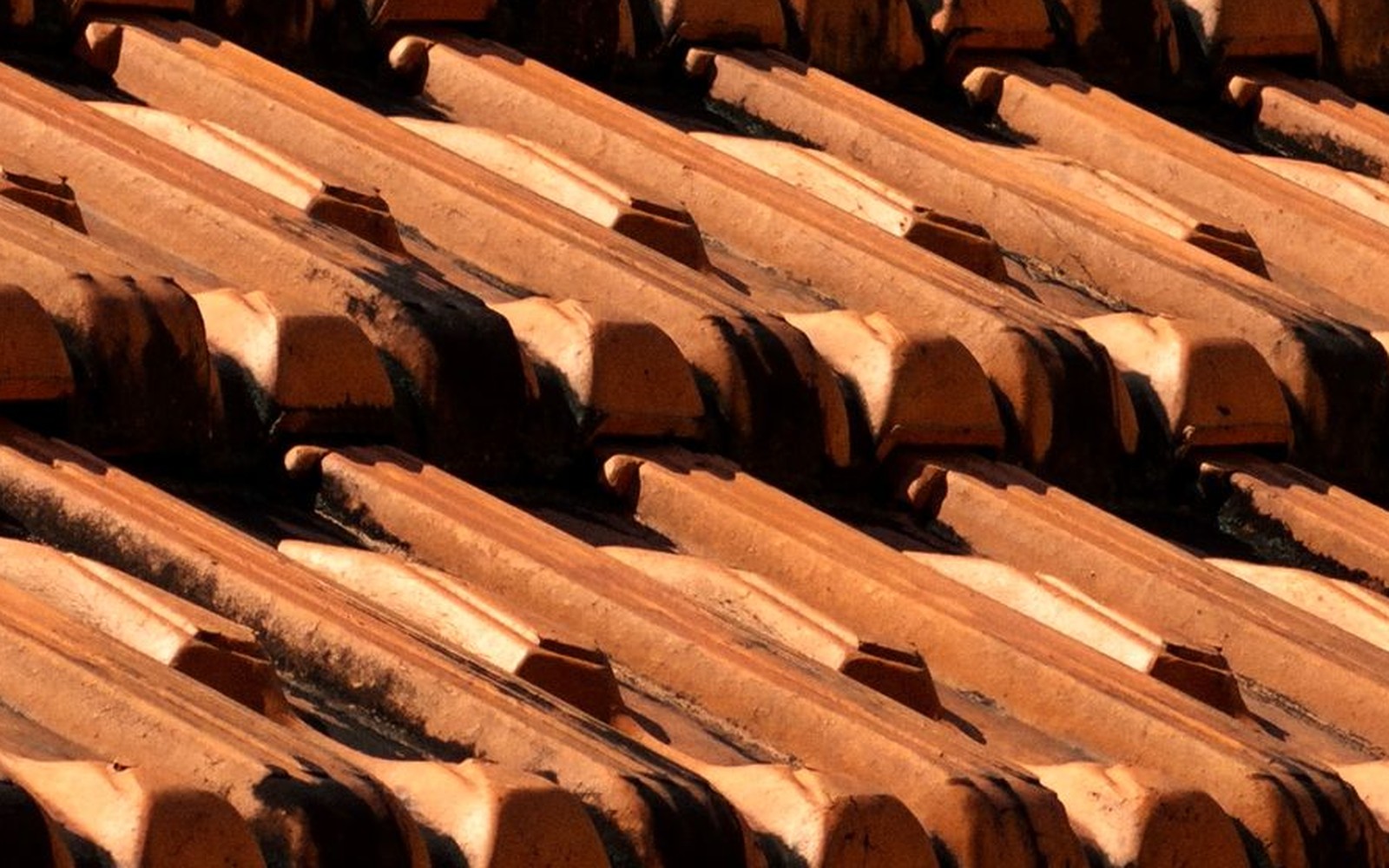
At a glance. A Marseille tile is an interlocking terracotta roof tile; in Vietnam it is often called ngói tây or ngói mũi tên. Saigon's Notre-Dame Cathedral, built between 1877 and 1880, has tiles stamped "Guichard Carvin, Marseille St André France". The restoration that began in 2017 re-covered its upper roof with 27,250 Monier arrow tiles. At The Myst Dong Khoi, the hotel's records describe the Marseille tiles in the lobby as salvaged from the Ba Son shipyard.
In this guide
What a Marseille tile actually is
Pick one up and the first surprise is the size. Half of a Marseilles-pattern tile in a University of Melbourne heritage collection still measures 425 millimetres long. The face is flat, ribbed and grooved. Lay two side by side and the rib of one sits in the groove of the next, so the tiles hold each other in place and keep the rain out.
The French call the family tuiles mécaniques, mechanical tiles, or tuiles à emboîtement, interlocking tiles. Vietnamese newspapers and restorers tend to say ngói tây, literally "Western tile", or ngói mũi tên.
The interlock pays off in numbers. According to French Wikipedia, a square metre of roof needs only 14 to 15 interlocking tiles, against 65 or 75 old-style flat ones. Each weighs around 2.8 kilograms, so the roof comes to roughly 38 kilograms per square metre instead of 65, and it needs four to five times fewer battens. Fewer tiles. Less timber. A lighter roof.
An Alsace patent and a Marseille pattern
The interlocking tile did not begin in Marseille. It began in Altkirch, in Alsace, home of the Gilardoni brothers. On 25 March 1841 François-Xavier Gilardoni patented his interlocking design, and in 1850 the brothers followed it with a double-interlocking tile that won a prize at the 1855 exhibition. Between 1845 and 1860 they licensed the patent to six other French manufacturers.
The Marseille pattern came soon after. The English Wikipedia article on the history of roof tiles credits the Martin brothers of Marseille with inventing it "as early as the 1860s", while Sydney's Powerhouse Museum dates its development in Marseille to the 1850s. The sources disagree by a decade. They agree on the city.
The Séon basin, a neighbourhood built on clay
Marseille's tile makers clustered on a bed of clay called the Séon basin, spread between the districts of l'Estaque, Saint-Henri and Saint-André. In 1805 it held 21 small tileries with 45 workers between them. By 1860 there were 150, employing around 800, and the population of Saint-Henri grew from 714 people in 1820 to 10,950 by 1930, most of them working in the tile yards.
At the industry's height, according to France 3, some 6,000 people worked for about fifty firms. Days ran to twelve hours before workers won a cut to ten.
The firms stamped their tiles. The Melbourne half-tile has "MARSEILLE ST HENRI" impressed on its underside beside a raised rooster. A tile at the Powerhouse Museum bears a bee, the mark of Guichard Carvin et Cie of Marseille St André, and dates from between 1890 and 1914. Remember that name. It turns up in Saigon.
A tile made to travel
Marseille tiles did not stay at home. English Wikipedia says they were widely exported, especially to European colonies in South and Central America, Africa and Australia, reaching Australia by 1886. One Sydney firm, Wunderlich, had shipped in about 75 million of them in 110 cargoes by 1914, according to the Powerhouse Museum.
So why Saigon? In truth, no source we found spells out why the French chose Marseille tiles for this city. What can be said is this. The tile was a major colonial export. It was lighter than older flat tiles and needed far fewer per square metre. And at Notre-Dame Cathedral, where the records are good, all building materials were imported from France. As for whether they once covered most of old Saigon, we found no figures to say so.
On the roof of Notre-Dame Cathedral
Bishop Isidore Colombert laid the cathedral's first stone on 7 October 1877, and the building was blessed on Easter Day, 11 April 1880. The English Wikipedia entry on Notre-Dame Cathedral Basilica of Saigon records that its tiles carry the words "Guichard Carvin, Marseille St André France", naming the district of Marseille where they were made. The same maker sits in a museum collection in Sydney and on a cathedral roof in Saigon.
The roof was never entirely French, though. Dr Nguyễn Đức Hiệp, who has published several books on old Saigon, wrote about the Wang-Tai tiles found in 2004: some of the cathedral's century-old red tiles came from Wang-Tai's works, while the majority were imported from France.
In December 2016, Thanh Niên newspaper reported that the cathedral's roofs held around 50,000 tiles. Alongside the original Marseille tiles were Indochinois and Phú Hữu tiles, neither of which is sold today.
The restoration and the hunt for arrow tiles
Full restoration work began on 29 June 2017. The late Archbishop Paul Bùi Văn Đọc decided to import materials from France, Belgium and Germany. Father Hồ Văn Xuân, then vicar general of the archdiocese, tracked the rare arrow tiles down at Monier, and said he was happier than he could describe to find ones identical to those the upper roof needed. The new roof breaks down like this.
| Tile | Maker | Quantity | Used on | Warranty |
|---|---|---|---|---|
| Arrow tile (Marseille tile) | Monier, France | 27,250 | Upper roof | 30 years |
| Fish-scale tile | Meyer-Holsen, Germany | 86,000 | Lower roofs and spires | 40 years |
| Yin-yang tile | Meyer-Holsen, Germany | 10,300 | Lower roofs and spires | 40 years |
Monier is also the name on the last tile works operating in Marseille, in Saint-André, which has run in its present form since 1965. In November 2025 the French broadcaster ICI reported that its owner, the BMI group, would close it by June 2026 at the latest and move production to Limoux, with 52 staff affected. If the plan held, 2026 was the year Marseille stopped firing Marseille tiles.
How to spot a Marseille tile on a walk
You do not need to be an architectural historian. A few clues are enough.
- Read the shape. Marseille tiles are large and flat, with ribs and grooves running down their length, so a finished roof shows neat, regular lines. Fish-scale tiles (ngói vảy cá) are small with rounded tails. Yin-yang tiles (ngói âm dương) are curved and laid in alternating face-up and face-down rows.
- Look underneath if you get the chance. Museum examples carry a Marseille district (St Henri, St André), a maker's name and an emblem such as a rooster or a bee. You will usually only see that side when tiles come down or go on display.
- Do not guess the age. One roof can mix French tiles, tiles made in Saigon, Indochinois and Phú Hữu tiles, and modern replacements. The Monier tiles laid on the cathedral since 2017 are Marseille tiles too, only new.
- Choose your light. Step back, zoom in with your phone, and go in the low sun of early morning or late afternoon, when the ribs throw clear shadows. The cathedral's restoration is scheduled to run until 2027, so enjoy it from outside the hoardings.
The cathedral is in the same central district as the hotel, formerly District 1; for walking times, see what you can reach on foot from The Myst in fifteen minutes.
The hotel's own Marseille tiles
A five-star hotel with a plain tiled roof in its lobby sounds odd, until you hear where the tiles came from. According to the hotel's own records, when the Ba Son shipyard was demolished in 2015, the owners bought back pieces of it: timber piles that had braced its foundations, steel trusses from Toulon, and Marseille tiles that had once roofed the yard, still marked with the word Marseille. The lobby was redesigned around them, so they are structure and exhibit at once; the stated aim was to keep a piece of the city's history for the next generation.
The lobby is called Bason and opens onto Bason Café. Next time you stop for a coffee, look up at the tiled roof. Those tiles share a home town with the originals on Notre-Dame Cathedral; they simply spent their working lives keeping the rain off a riverside shipyard.
For the yard itself, read two centuries of the Ba Son shipyard. The wrought-iron flowers, stained glass and planted balconies are covered in the old Saigon design details throughout the hotel.
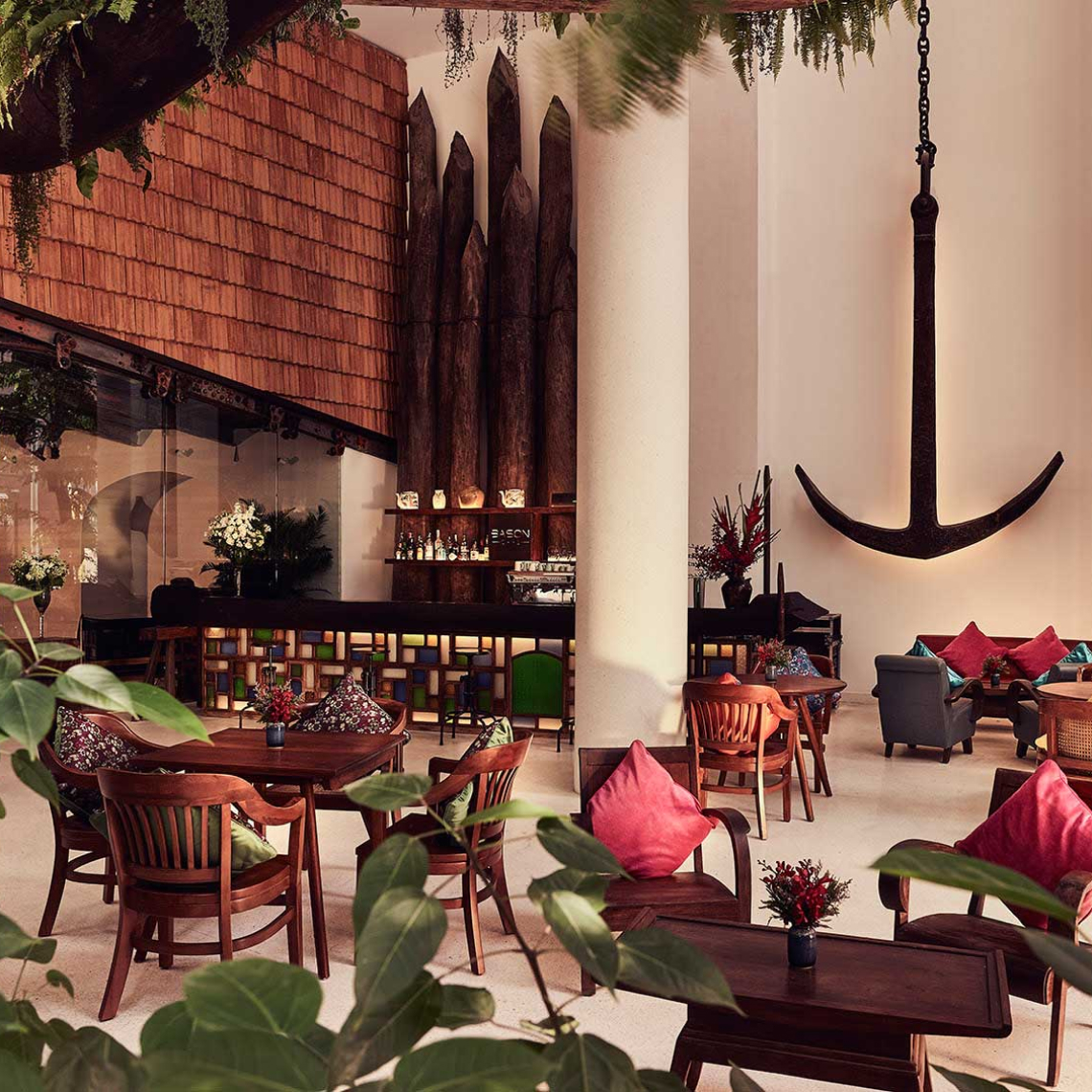
Frequently asked questions
What is a Marseille roof tile?
When were Marseille tiles invented?
Which buildings in Saigon have Marseille tiles?
How can you tell an old French Marseille tile from a new one?
Are Marseille tiles still made today?
Where do the Marseille tiles at The Myst Dong Khoi come from?
Coffee under a roof from Ba Son
Bason Café is on the ground floor of The Myst Dong Khoi, at 6-8 Hồ Huấn Nghiệp, Sài Gòn Ward. Drop in for coffee after looking up at the cathedral's roof, or stay a few nights and walk the old centre at your own pace.
→ See Bason Café and opening hours
→ Book your stay at The Myst Dong Khoi
Curated by Silverland Hospitality.
Blog
Ride Saigon's Metro Line 1 out of Opera House station and the next stop is called Ba Son. Most passengers read the sign and think nothing of it. For more than two hundred years, though, that stretch of riverbank was a shipyard, founded in 1788, when the city was still known as Gia Định. Hammers rang there through a lord's war, a colonial century, a famous strike and two more wars. In 2015 they stopped for good. This is the story of the Ba Son shipyard, and of why a hotel a kilometre down the road decided to keep a piece of it.
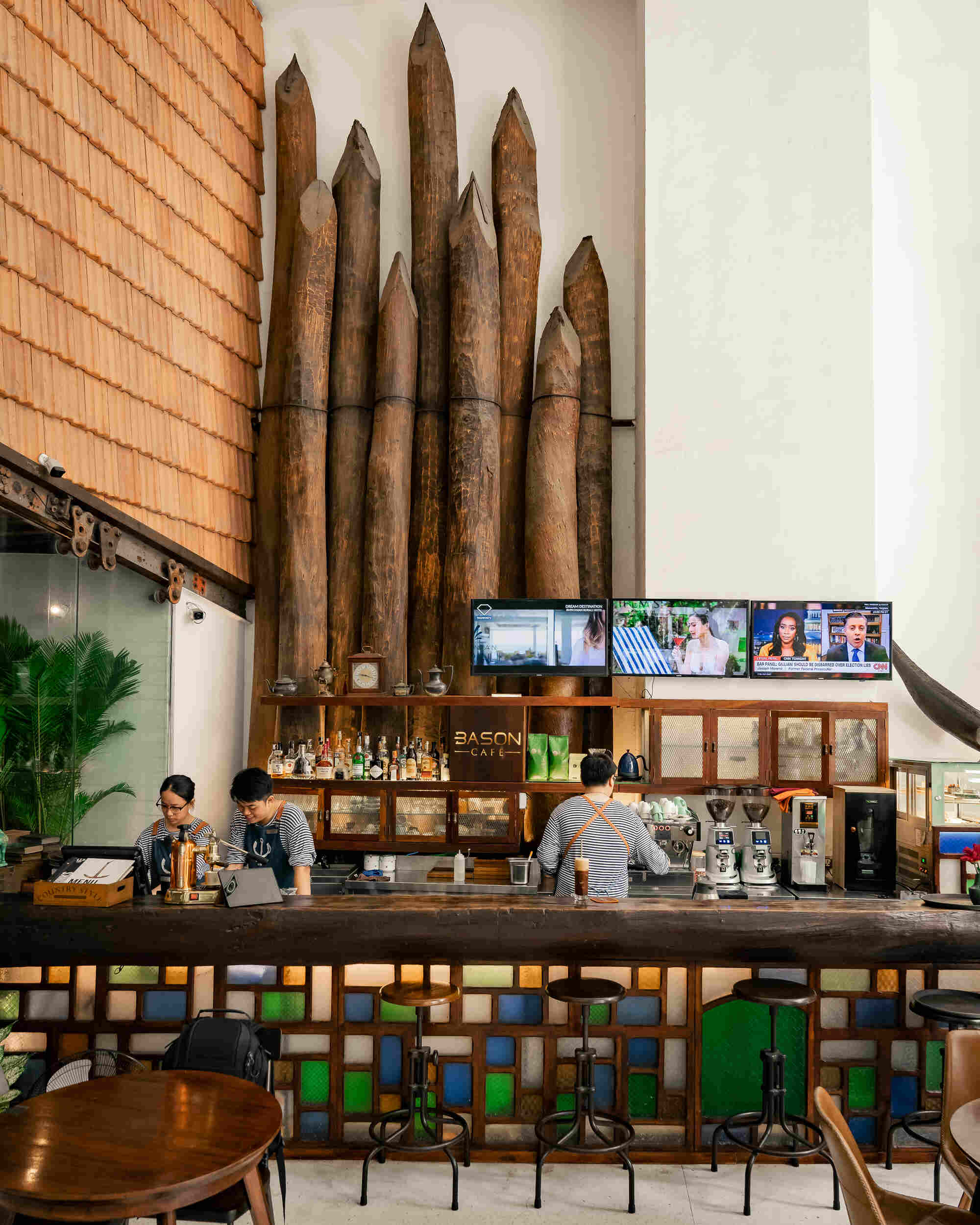
Key facts. Ba Son began around 1788 as the Chu Sư naval workshop, set up on the Saigon River by Lord Nguyễn Phúc Ánh. The French expanded it into a naval arsenal from 1864. Its workers went on strike for four months in 1925. The yard closed and was demolished in 2015. The Myst Dong Khoi, about a kilometre away, reuses reclaimed materials from Ba Son in its design and named its ground-floor café Bason Café after it.
In this guide
A boatyard built for a war
Ba Son was born out of necessity. In the late eighteenth century, Lord Nguyễn Phúc Ánh was based in Gia Định and locked in a long struggle with the Tây Sơn. He needed ships, and quickly. Around 1788 he set up a workshop on the riverbank to build them, known as Xưởng Chu Sư. French engineers are recorded as having helped, and the fleet that came out of it played a real part in the Nguyễn victories that followed.
Picture the setting. No boulevards yet, no red-brick cathedral. The riverfront was mostly landings and wooden boats. Yet the spot chosen that year proved so well suited that shipbuilders were still working the same ground more than two centuries later. The river was wide enough for large vessels and the site sat right at the edge of the growing city. Somebody picked well.
The French years: the Arsenal de Saigon
The French took Cochinchina in 1862 and had their eye on the riverside yard straight away. By 1864 they had turned the old Chu Sư workshop into a full naval arsenal, the Arsenal de Saigon, and the scale changed completely. A 168-metre dry dock was in place by 1888, big enough to lift warships out of the water for repair. In 1902 the yard became headquarters for the French naval forces in the Far East, responsible for 38 ships and more than 3,800 personnel.
By 1918 the yard could build ships of up to 3,500 tonnes. Behind that figure were thousands of workers bending steel, driving rivets and fitting engines, day after day, in the middle of a colonial city. A good deal of Saigon's mechanical know-how grew up around this yard, and more than a few local families can point to a grandfather or great-grandfather who once clocked in there. You can read the yard's full record on the Ba Son Shipyard history.
The 1925 strike, and a young mechanic called Tôn Đức Thắng
Any account of Ba Son has to stop at 1925. Among the yard's workers was a young man who had graduated from mechanical school with honours: Tôn Đức Thắng, who would later become President of Vietnam. From August to November that year, Ba Son's workers went on strike, aiming to delay repairs to the French flagship Jules Michelet, which was on its way to China. Four months of industrial action at a military yard was an extraordinary thing at the time.
It is only fair to add that historians still argue about it. Some, including the scholar Christoph Giebel, question whether the strike was really political and whether it held up the warship at all. However you read it, 1925 is the year that tied the name Ba Son to Saigon's labour history, and the road that runs past the old yard today carries Tôn Đức Thắng's name.
Ba Son at a glance
More than two centuries, in brief.
| Year | What happened |
|---|---|
| c. 1788 | Lord Nguyễn Phúc Ánh founds the Chu Sư workshop on the Saigon River to build ships. |
| 1864 | The French expand it into a naval arsenal, the Arsenal de Saigon. |
| 1888 | A 168-metre dry dock is in operation. |
| 1902 | Becomes headquarters of the French naval forces in the Far East: 38 ships, over 3,800 personnel. |
| Aug to Nov 1925 | A four-month workers' strike, linked to Tôn Đức Thắng. |
| 1955 | Formally renamed the Ba Son Shipyard. |
| 2015 | Closed, sold to a private developer and demolished. |
| Today | A riverside urban district with its own Ba Son station on Metro Line 1. |
2015: the cranes come down
Through the twentieth century Ba Son changed hands with the times but never stopped being a shipyard. It took the name Ba Son formally in 1955, and after 1975 it came under the Vietnam People's Navy. Then the city grew around it. Riverfront land in the centre became some of the most valuable in the country, and a working shipyard in the middle of town no longer made sense.
In 2015 the yard closed. The land was sold to a private developer and every workshop, crane and dock was taken down. Anyone who had grown used to that line of cranes on the river must have felt the gap. Today the site holds towers, a riverside promenade and a metro station. It is handsome and convenient, and almost nothing on the ground tells you that ships were built here for over two hundred years.
What the hotel kept
About a kilometre away, The Myst Dong Khoi chose to remember Ba Son with the real thing. When the yard came down, reclaimed timber and metal from the site found their way into the hotel's design. Put your hand on some of the surfaces and you feel it: grain that has dried and opened with age, metal edges worn smooth by use. That wear is decades of riverside work, now resting quietly inside a hotel.
The easiest place to see it is on the ground floor, at Bason Café, named for the yard itself. Sit down with a morning coffee among the old timber and ironwork and it becomes clear why someone wanted the name to live on somewhere besides a metro sign. There is more on how the whole building tells the story of old Saigon in the hotel's old Saigon design, detail by detail, and the café's hours and menu are on our dining page.
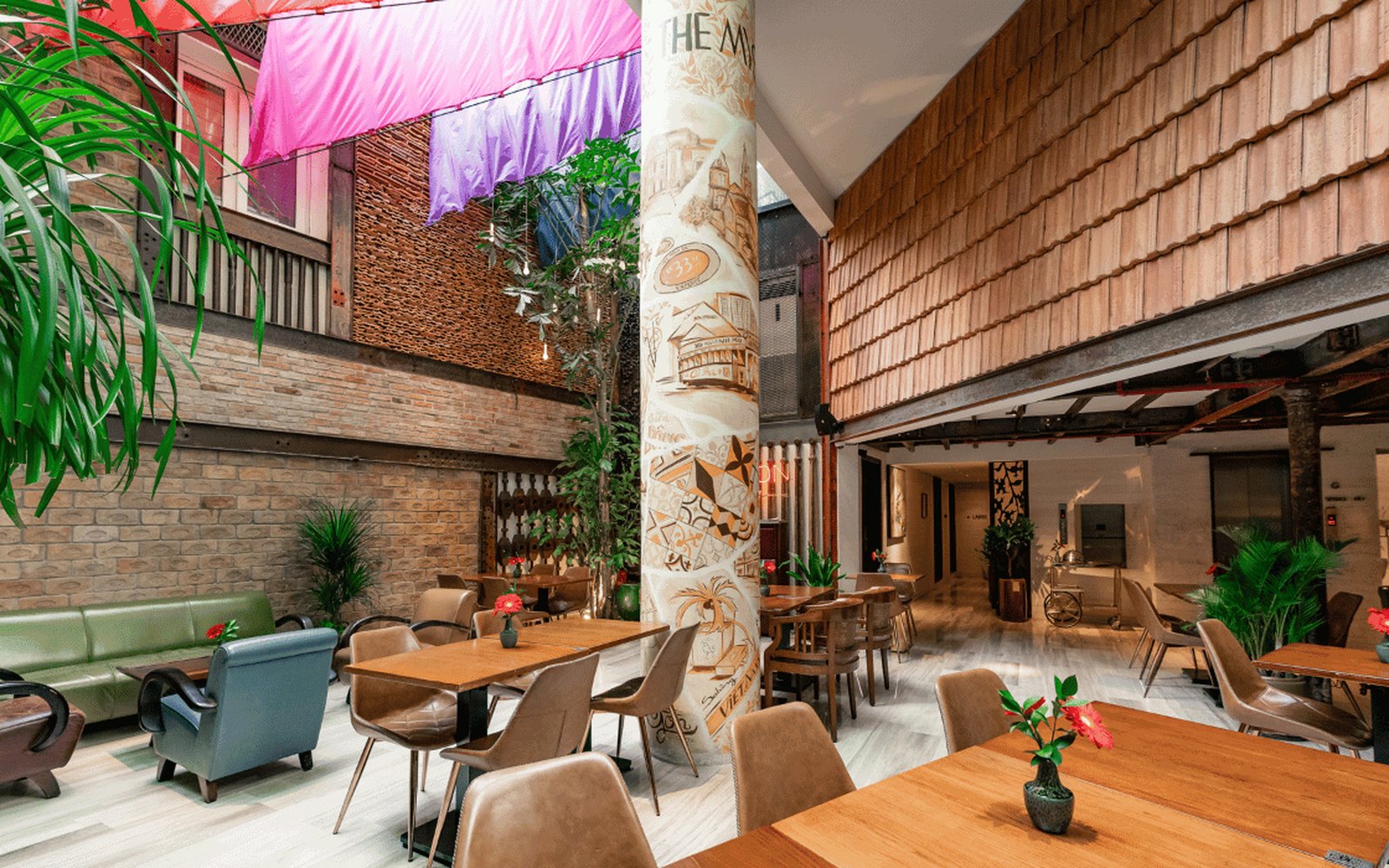
A Ba Son walk from the hotel
If old stories are your thing, give a morning to following the yard's trail. You will not need a guide or a car.
- Start at Bason Café. Coffee on the ground floor of the hotel, with the reclaimed timber and metal around you.
- Head down to the river. The Bạch Đằng waterfront is a few minutes from Hồ Huấn Nghiệp. Follow the riverbank, where the breeze is noticeably cooler than in the streets, and you are walking towards the old yard.
- Walk along Tôn Đức Thắng street. The road named after the young mechanic runs past the Ba Son site. Allow fifteen to twenty minutes, depending on how often you stop for photos.
- Take the metro back. From Ba Son station it is one stop to Opera House station, then a short walk to the hotel.
Go early in the morning or later in the afternoon to avoid the worst of the heat, and carry water. If you are walking with an older Saigonese friend or relative, let them talk. Their memories are often better than any information board.
Why a hotel would hold on to a shipyard
The easy route for a new hotel is to be beautiful and leave it there. The Myst Dong Khoi wanted guests to feel they were somewhere specific: a Saigon with age, with working people and with trades. Ba Son suits that better than any ornamental symbol could. It is unglamorous, rooted in ordinary working lives, and just up the road. That choice, alongside a design drawn from old Saigon, is part of what the World Luxury Hotel Awards recognised when they named the hotel Global Winner for Luxury Cultural Hotel in 2025.
Frequently asked questions
When was the Ba Son shipyard founded?
Where was the Ba Son shipyard?
What was the 1925 Ba Son strike?
When was Ba Son demolished?
How is The Myst Dong Khoi connected to Ba Son?
Can you still visit the Ba Son site?
Spend a morning at Bason Café
Bason Café sits on the ground floor of The Myst Dong Khoi, at 6-8 Hồ Huấn Nghiệp, a short walk from the river and the old yard. Drop in for a coffee among timber and ironwork from Ba Son, or stay a few nights and walk the old heart of Saigon at your own pace.
→ Discover Bason Café and our restaurants
→ Book direct for our best rate
Curated by Silverland Hospitality.