
The Ba Son Shipyard: Two Centuries on the Saigon River
Ride Saigon’s Metro Line 1 out of Opera House station and the next stop is called Ba Son. Most passengers read the sign and think nothing of it. For more than two hundred years, though, that stretch of riverbank was a shipyard, founded in 1788, when the city was still known as Gia Định. Hammers […]

Ride Saigon’s Metro Line 1 out of Opera House station and the next stop is called Ba Son. Most passengers read the sign and think nothing of it. For more than two hundred years, though, that stretch of riverbank was a shipyard, founded in 1788, when the city was still known as Gia Định. Hammers rang there through a lord’s war, a colonial century, a famous strike and two more wars. In 2015 they stopped for good. This is the story of the Ba Son shipyard, and of why a hotel a kilometre down the road decided to keep a piece of it.
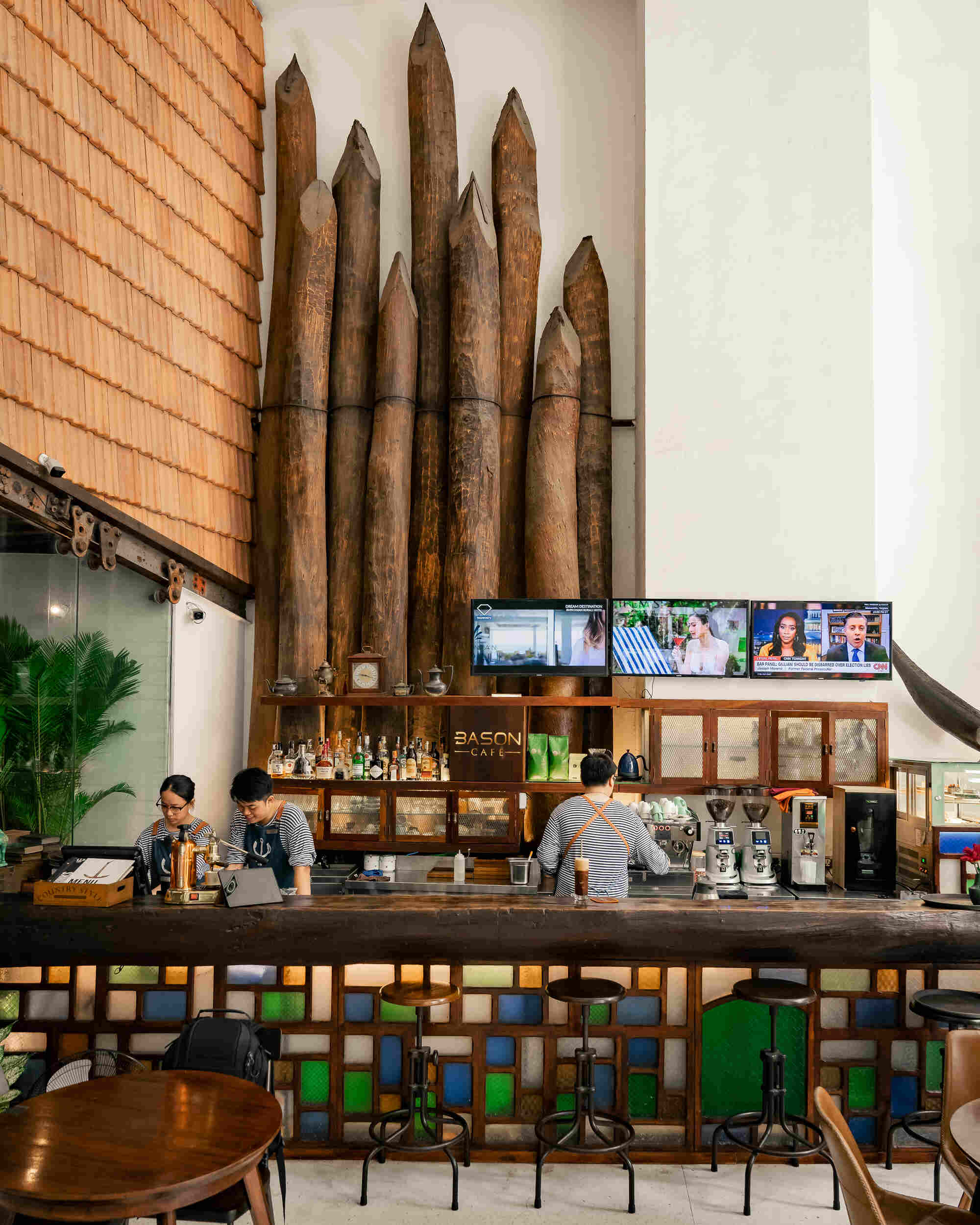
Key facts. Ba Son began around 1788 as the Chu Sư naval workshop, set up on the Saigon River by Lord Nguyễn Phúc Ánh. The French expanded it into a naval arsenal from 1864. Its workers went on strike for four months in 1925. The yard closed and was demolished in 2015. The Myst Dong Khoi, about a kilometre away, reuses reclaimed materials from Ba Son in its design and named its ground-floor café Bason Café after it.
In this guide
A boatyard built for a war
Ba Son was born out of necessity. In the late eighteenth century, Lord Nguyễn Phúc Ánh was based in Gia Định and locked in a long struggle with the Tây Sơn. He needed ships, and quickly. Around 1788 he set up a workshop on the riverbank to build them, known as Xưởng Chu Sư. French engineers are recorded as having helped, and the fleet that came out of it played a real part in the Nguyễn victories that followed.
Picture the setting. No boulevards yet, no red-brick cathedral. The riverfront was mostly landings and wooden boats. Yet the spot chosen that year proved so well suited that shipbuilders were still working the same ground more than two centuries later. The river was wide enough for large vessels and the site sat right at the edge of the growing city. Somebody picked well.
The French years: the Arsenal de Saigon
The French took Cochinchina in 1862 and had their eye on the riverside yard straight away. By 1864 they had turned the old Chu Sư workshop into a full naval arsenal, the Arsenal de Saigon, and the scale changed completely. A 168-metre dry dock was in place by 1888, big enough to lift warships out of the water for repair. In 1902 the yard became headquarters for the French naval forces in the Far East, responsible for 38 ships and more than 3,800 personnel.
By 1918 the yard could build ships of up to 3,500 tonnes. Behind that figure were thousands of workers bending steel, driving rivets and fitting engines, day after day, in the middle of a colonial city. A good deal of Saigon’s mechanical know-how grew up around this yard, and more than a few local families can point to a grandfather or great-grandfather who once clocked in there. You can read the yard’s full record on the Ba Son Shipyard history.
The 1925 strike, and a young mechanic called Tôn Đức Thắng
Any account of Ba Son has to stop at 1925. Among the yard’s workers was a young man who had graduated from mechanical school with honours: Tôn Đức Thắng, who would later become President of Vietnam. From August to November that year, Ba Son’s workers went on strike, aiming to delay repairs to the French flagship Jules Michelet, which was on its way to China. Four months of industrial action at a military yard was an extraordinary thing at the time.
It is only fair to add that historians still argue about it. Some, including the scholar Christoph Giebel, question whether the strike was really political and whether it held up the warship at all. However you read it, 1925 is the year that tied the name Ba Son to Saigon’s labour history, and the road that runs past the old yard today carries Tôn Đức Thắng’s name.
Ba Son at a glance
More than two centuries, in brief.
| Year | What happened |
|---|---|
| c. 1788 | Lord Nguyễn Phúc Ánh founds the Chu Sư workshop on the Saigon River to build ships. |
| 1864 | The French expand it into a naval arsenal, the Arsenal de Saigon. |
| 1888 | A 168-metre dry dock is in operation. |
| 1902 | Becomes headquarters of the French naval forces in the Far East: 38 ships, over 3,800 personnel. |
| Aug to Nov 1925 | A four-month workers’ strike, linked to Tôn Đức Thắng. |
| 1955 | Formally renamed the Ba Son Shipyard. |
| 2015 | Closed, sold to a private developer and demolished. |
| Today | A riverside urban district with its own Ba Son station on Metro Line 1. |
2015: the cranes come down
Through the twentieth century Ba Son changed hands with the times but never stopped being a shipyard. It took the name Ba Son formally in 1955, and after 1975 it came under the Vietnam People’s Navy. Then the city grew around it. Riverfront land in the centre became some of the most valuable in the country, and a working shipyard in the middle of town no longer made sense.
In 2015 the yard closed. The land was sold to a private developer and every workshop, crane and dock was taken down. Anyone who had grown used to that line of cranes on the river must have felt the gap. Today the site holds towers, a riverside promenade and a metro station. It is handsome and convenient, and almost nothing on the ground tells you that ships were built here for over two hundred years.
What the hotel kept
About a kilometre away, The Myst Dong Khoi chose to remember Ba Son with the real thing. When the yard came down, reclaimed timber and metal from the site found their way into the hotel’s design. Put your hand on some of the surfaces and you feel it: grain that has dried and opened with age, metal edges worn smooth by use. That wear is decades of riverside work, now resting quietly inside a hotel.
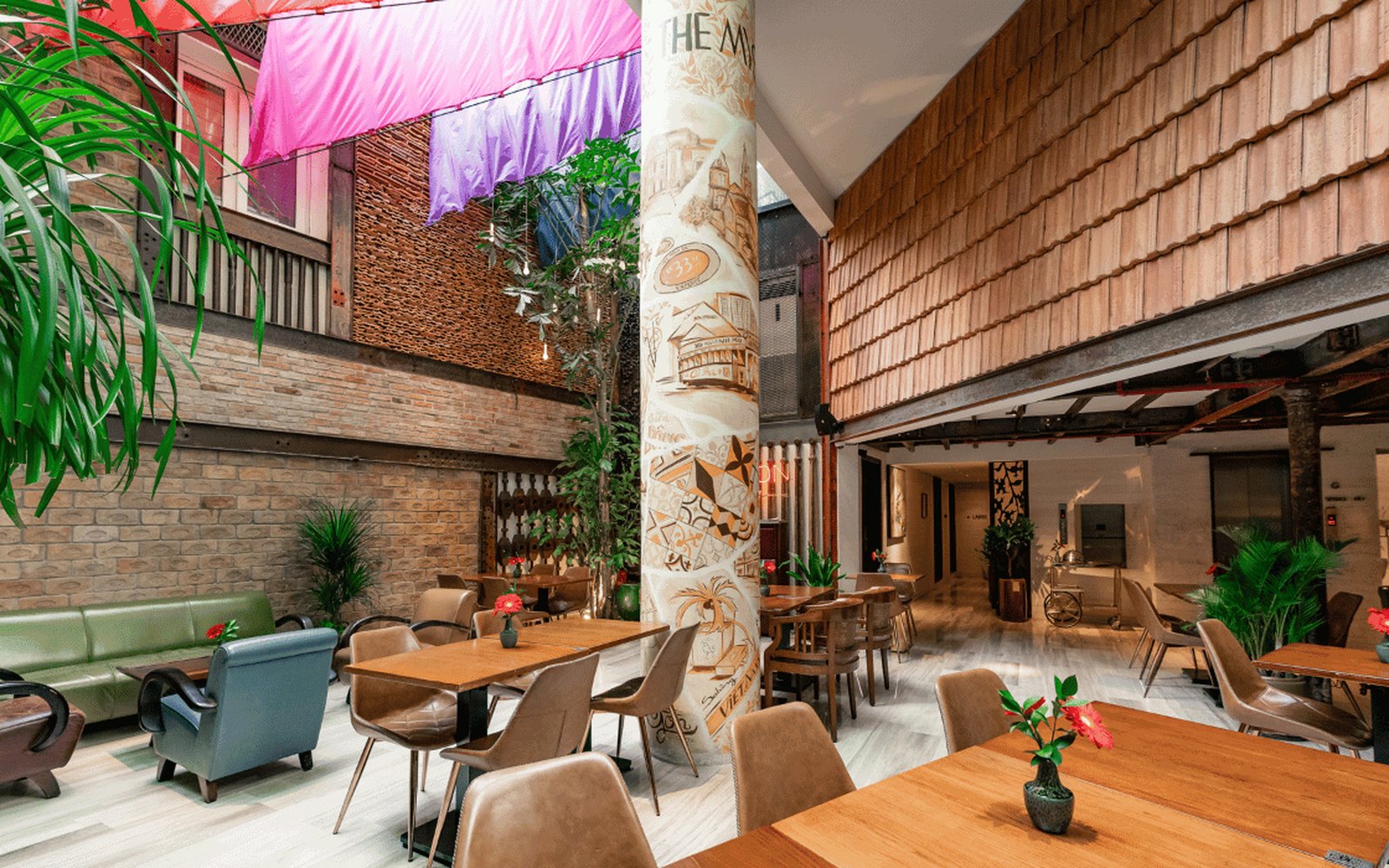
The easiest place to see it is on the ground floor, at Bason Café, named for the yard itself. Sit down with a morning coffee among the old timber and ironwork and it becomes clear why someone wanted the name to live on somewhere besides a metro sign. There is more on how the whole building tells the story of old Saigon in the hotel’s old Saigon design, detail by detail, and the café’s hours and menu are on our dining page.
A Ba Son walk from the hotel
If old stories are your thing, give a morning to following the yard’s trail. You will not need a guide or a car.
- Start at Bason Café. Coffee on the ground floor of the hotel, with the reclaimed timber and metal around you.
- Head down to the river. The Bạch Đằng waterfront is a few minutes from Hồ Huấn Nghiệp. Follow the riverbank, where the breeze is noticeably cooler than in the streets, and you are walking towards the old yard.
- Walk along Tôn Đức Thắng street. The road named after the young mechanic runs past the Ba Son site. Allow fifteen to twenty minutes, depending on how often you stop for photos.
- Take the metro back. From Ba Son station it is one stop to Opera House station, then a short walk to the hotel.
Go early in the morning or later in the afternoon to avoid the worst of the heat, and carry water. If you are walking with an older Saigonese friend or relative, let them talk. Their memories are often better than any information board.
Why a hotel would hold on to a shipyard
The easy route for a new hotel is to be beautiful and leave it there. The Myst Dong Khoi wanted guests to feel they were somewhere specific: a Saigon with age, with working people and with trades. Ba Son suits that better than any ornamental symbol could. It is unglamorous, rooted in ordinary working lives, and just up the road. That choice, alongside a design drawn from old Saigon, is part of what the World Luxury Hotel Awards recognised when they named the hotel Global Winner for Luxury Cultural Hotel in 2025.
Frequently asked questions
When was the Ba Son shipyard founded?
Ba Son dates back to around 1788, when Lord Nguyễn Phúc Ánh founded the Chu Sư naval workshop on the Saigon River to build ships for his war against the Tây Sơn. The French expanded it into a naval arsenal in 1864, and it was formally renamed the Ba Son Shipyard in 1955. It kept working for more than two centuries before closing in 2015.
Where was the Ba Son shipyard?
It stood on the Saigon River along what is now Tôn Đức Thắng street, in the city centre, formerly District 1. Since the yard was demolished in 2015, the site has become a riverside urban district with its own Ba Son station on Metro Line 1, one stop from Opera House station. It is roughly a fifteen to twenty minute walk from The Myst Dong Khoi.
What was the 1925 Ba Son strike?
From August to November 1925, workers at Ba Son went on strike, aiming to delay repairs to the French flagship Jules Michelet, which was bound for China. Tôn Đức Thắng, later President of Vietnam, was a mechanic at the yard at the time. Historians still debate how political the strike was and what it achieved, but it firmly links Ba Son with Saigon’s labour history.
When was Ba Son demolished?
The shipyard closed in 2015. The land was sold to a private developer, who then demolished all of the facilities. The site is now a district of high-rise buildings, a riverside promenade and a metro station. Some reclaimed timber and metal from the old yard were saved and reused in the design of The Myst Dong Khoi, about a kilometre away.
How is The Myst Dong Khoi connected to Ba Son?
The Ba Son story runs through the hotel’s design. The Myst Dong Khoi reuses reclaimed timber and metal from the old shipyard, and its ground-floor café is named Bason Café after the yard. Guests can sit among these materials, with their worn edges and aged grain, only about a kilometre from where the shipyard stood for more than two hundred years.
Can you still visit the Ba Son site?
The workshops have gone, so there is no dedicated heritage site to tour. You can still walk along the river and Tôn Đức Thắng street past the old grounds, ride the metro to Ba Son station, and then stop at Bason Café in The Myst Dong Khoi to see the reclaimed materials. The whole loop fits comfortably into a morning on foot.
Spend a morning at Bason Café
Bason Café sits on the ground floor of The Myst Dong Khoi, at 6-8 Hồ Huấn Nghiệp, a short walk from the river and the old yard. Drop in for a coffee among timber and ironwork from Ba Son, or stay a few nights and walk the old heart of Saigon at your own pace.
→ Discover Bason Café and our restaurants
→ Book direct for our best rate
Curated by Silverland Hospitality.
Others
Old Saigon, detail by detail: inside a cultural design hotel Saigon can call its own
Turn off Đồng Khởi into Hồ Huấn Nghiệp street and within a minute you reach a tall building with greenery...
Saigon through the five senses at The Myst Dong Khoi
Sometimes your nose knows you have arrived before your eyes do. Step in from the pavement on Hồ Huấn Nghiệp...
The Myst Dong Khoi awards: what each recognition tells you before you book
Stand on Hồ Huấn Nghiệp street in the early evening and look up. The windows and balconies of The Myst...

What Is a Cultural Luxury Hotel? How to Spot One Before You Book
It is eleven at night and you have seven booking tabs open for a trip to Saigon. Every hotel calls...

Wedding Color Palette 2026 and 2027: Six Schemes to Love
Color is the first decision that touches everything else. Before the flowers are chosen or the invitations are printed, a...

Wedding Trends 2026-2027: Where Celebrations Are Heading
Weddings are quietly changing shape. The five hundred guest banquet is no longer the default, the flower budget is being...