
What Is a Cultural Luxury Hotel? How to Spot One Before You Book
It is eleven at night and you have seven booking tabs open for a trip to Saigon. Every hotel calls itself “steeped in local culture”. Every gallery has the same lanterns, the same bamboo corner, the same lacquer painting. By tab five they blur. So what is a cultural luxury hotel? Put simply, it is […]

It is eleven at night and you have seven booking tabs open for a trip to Saigon. Every hotel calls itself “steeped in local culture”. Every gallery has the same lanterns, the same bamboo corner, the same lacquer painting. By tab five they blur. So what is a cultural luxury hotel? Put simply, it is a high-end hotel whose culture lives in things you can check: materials with a history, a story with dates and place names, food from the region, and a real tie to the streets outside. The quickest test is to imagine lifting the whole hotel and setting it down in another city. If the story still holds, it was only ever a theme.
At a glance. No official certification exists for a “cultural luxury hotel”. Since 2024 the Michelin Guide has assessed hotels on five criteria, one of them their contribution to the neighbourhood. The Myst Dong Khoi is a five-star boutique hotel with 108 rooms that reuses timber and metal from the Ba Son shipyard, and it was named Global Winner, Luxury Cultural Hotel, at the World Luxury Hotel Awards 2025.
In this guide
What the term actually means
A common misunderstanding first. No official body certifies anything as a “cultural luxury hotel”. Star ratings look mainly at rooms, facilities and service. The phrase does turn up in award names: the World Luxury Hotel Awards run a Luxury Cultural Hotel category, and in 2025 The Myst Dong Khoi was its Global Winner. Who judges, and on what, is in our piece on the hotel’s awards and recognition.
The term has two halves, and both have to hold up. “Luxury” is the part everyone expects from a high-end hotel: a generous room, a good bed, proper soundproofing, and service that is as sharp in March as it was in January. “Cultural” is harder, because it has to be specific. Where did that timber come from? What on the street does the pattern on the window frame echo? Drop the first half and you have a small museum where nobody sleeps well. Drop the second and you have a perfectly decent hotel where, on waking, you could be in Saigon or Singapore.
How it differs from a themed hotel
In photographs the two look alike. Both have antiques, a colour palette and a story. The difference lies in where the story comes from. A themed hotel picks an idea and builds around it, a Mediterranean village, say, and that idea would work just as well in Đà Nẵng or Phú Quốc. A cultural hotel goes the other way. It starts from the plot of land and the city around it, and only then thinks about decoration.
Try the relocation test again. Move a Mediterranean-themed hotel from Vũng Tàu to Quy Nhơn and nobody blinks. Move a hotel built with timber from a Saigon River shipyard to Hanoi and the story falls apart at once. Neither type is better. For a weekend with small children, a cheerful themed hotel may suit better.
| Point of comparison | Cultural luxury hotel | Themed hotel |
|---|---|---|
| Where the story starts | The site, the city and the people where the hotel stands | An idea chosen in advance, often from another place or era |
| Materials and objects | Origins you can trace: where from, and when | Bought as a set, attractive but without a past |
| Moved to another city | The story stops making sense | Works exactly as before |
| Food | Regional dishes on the everyday menu | A few dishes named after the theme |
| Relationship with the street | Sends guests out; keeps old place names and trades alive | Self-contained within the building |
Borrowing the Michelin Guide’s five criteria
You do not need to invent a yardstick. The Michelin Guide first appeared in 1900 as a handbook for French motorists, and since 2024 it has awarded “keys” to hotels following anonymous stays by its selection teams. It judges them on five criteria: architecture and interior design; quality and consistency of service; personality and character; value for the price; and contribution to the neighbourhood or setting. Look at that last one. The street outside the front door is part of the score.
You cannot stay anonymously for Michelin, but you can turn each criterion into a question. The Myst Dong Khoi appears in the Michelin Guide’s hotel selection, but the right-hand column below is only our own guest’s-eye reading, not a Michelin assessment.
| Michelin criterion | The question to ask | A test run at The Myst Dong Khoi |
|---|---|---|
| Architecture and interior design | Do the materials and motifs have names and origins? | Timber and metal from the Ba Son shipyard (demolished in 2015); wrought-iron flower motifs; Marseille tiles; stained glass |
| Consistent service | Do recent reviews praise the same thing month after month? | Read recent guest reviews; do not take the hotel’s word for it |
| Personality | With your eyes shut, could you guess the city? | Ngọc lan scent, a shiso welcome drink, corridors that bend like a hẻm |
| Value for the price | What does the smallest room type include? | Six room types from 40 to 70 m², each with a private balcony and a deep soaking tub |
| Contribution to the neighbourhood | What does the hotel give the street, and how easy is it to get out? | Planted balconies on every floor; about a minute on foot to Đồng Khởi |
Seven questions to ask before you book
Email or message the reservations team. How they answer, precise or vague, tells you a good deal.
- Where does this piece in the photo come from? Pick one detail, a window frame or a panel in the lobby, and ask. A hotel with a real story answers with names and dates.
- Does the culture reach the rooms? Some hotels pour everything into the lobby and leave the rooms blank. Ask for photos of the smallest room type.
- Is there local food on the menu every day? Or only on a themed night once a week.
- Where can I walk to in ten minutes? A hotel tied to its neighbourhood will reel off streets and markets.
- What do you arrange to get guests out into the city? Tours, evening outings, a list of favourite local cafés.
- What have guests said in the last few months? Read the complaints too, and look for praise that repeats.
- What exactly does the rate include? Breakfast, transfers, the pool: which come as standard and which cost extra. Get it in writing.
Warning signs of borrowed culture
A few things should make you pause before paying.
- A story with no dates, no names and no street. “Inspired by Asian culture” covers half the planet.
- The word “culture” in every line of the marketing, and nowhere on the menu.
- A simple question about one detail met with a vague reply, or silence.
One of these on its own proves little. All three together usually mean a themed hotel in cultural clothing.
A worked example: The Myst Dong Khoi
Enough theory. Take one real hotel. The Myst Dong Khoi is a five-star boutique hotel with 108 rooms at 6-8 Hồ Huấn Nghiệp, Sài Gòn Ward. From the hotel to Đồng Khởi street takes about a minute, and Nguyễn Huệ walking street is roughly four minutes away.
Ask where the materials came from and the answer has a proper name. In 2015 the Ba Son shipyard on the Saigon River closed and was demolished after more than two centuries of shipbuilding. Some of its timber and metal was reused in the hotel’s design, and the ground-floor café is named Bason Café after it. For its history, read how Ba Son went from a Nguyễn lord’s boatyard to demolition.
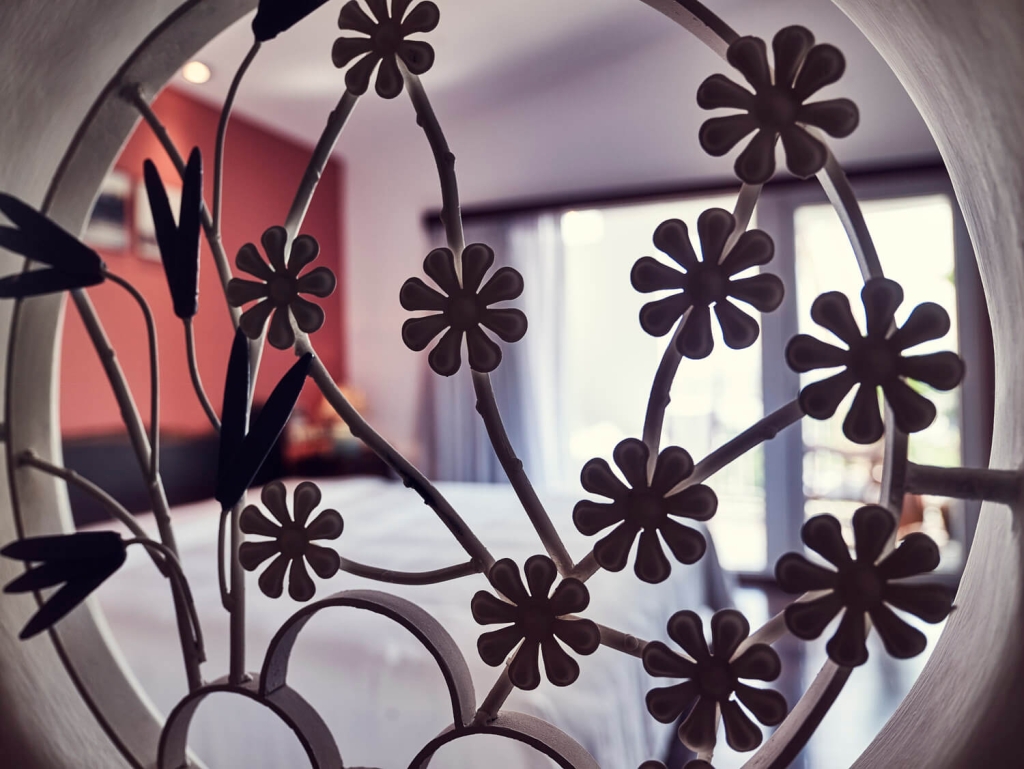
The motifs come in from the street. Wrought-iron flowers repeat across window frames and balcony rails, the roof is laid with Marseille tiles, and greenery spills over the balconies on every floor. Walking through the building feels like walking down a Saigon hẻm: the corridors to the rooms bend instead of running dead straight, and potted plants stand by the doors, as they do outside homes in a real alley. The rooms hold objects an old Saigon household would recognise, such as a wooden chest, a ván ngựa plank bed or an old-style mirror. Each detail’s origin is explained in a guide to the hotel’s old Saigon design.
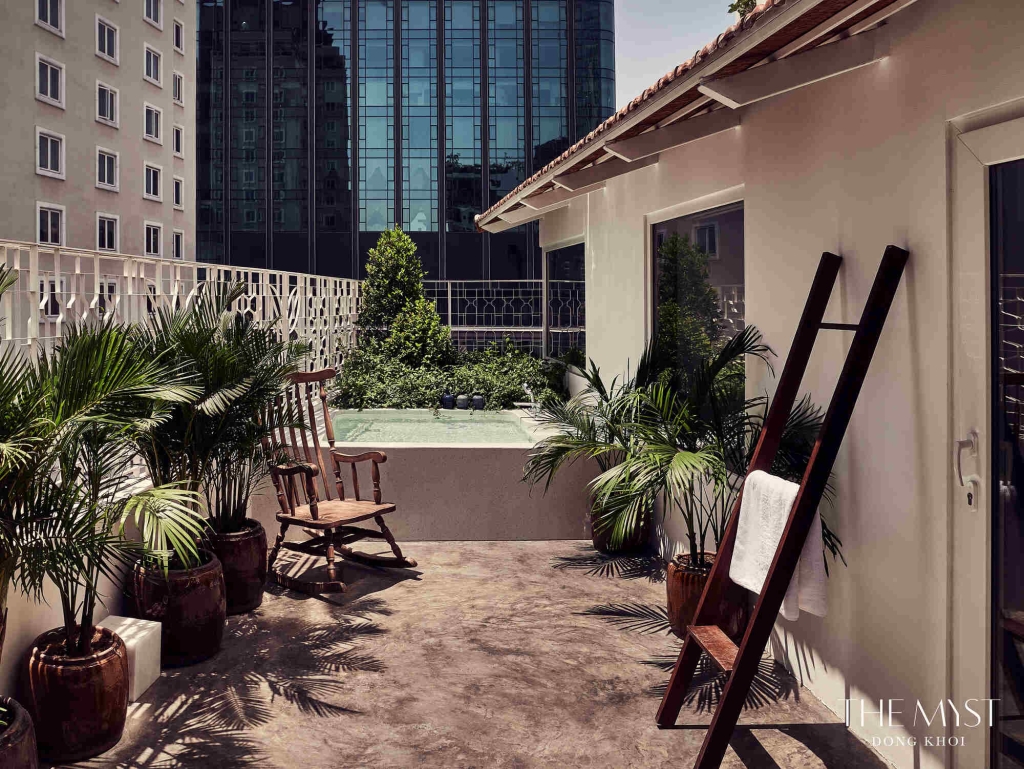
Personality is easiest to judge with your nose and your palate. The signature scent is ngọc lan, or ylang-ylang, and guests are welcomed with a shiso drink. On the 12th floor, The Nest restaurant takes its name from the swallow’s nest. Its buffet counter is a 9-metre wooden boat recalling the flower boats that come in to Bình Đông market before Tết, and the kitchen leans Vietnamese. As for the neighbourhood, the hotel left green space on its plot instead of building to every edge, and it arranges city tours, Mekong trips and night Vespa rides.
When this kind of hotel suits you
It suits travellers staying two nights or more who like to walk, enjoy old stories, and want to open the balcony door in the morning and know exactly where they are. It works nicely with older relatives too: a plank bed or wooden chest may be something they grew up with, and the stories follow.
It suits you less if you collect loyalty points with one chain, or want every city to feel the same. For how the two compare, see our comparison of design boutique and chain hotels in Saigon.
Frequently asked questions
What is a cultural luxury hotel?
A cultural luxury hotel is a high-end hotel whose design, materials, food and service are tied to the history and daily life of the place where it stands. Five-star comfort is the baseline. What sets it apart are details you can verify: objects with a known origin, a story with dates and names, and local dishes on the everyday menu.
How is a cultural hotel different from a themed hotel?
A themed hotel is built around an idea chosen in advance, such as a Mediterranean village, and that idea could sit in any city. A cultural hotel starts from its own plot of land and the city around it. Imagine moving the hotel: if the story still makes sense, you are looking at a theme; if it falls apart, the culture is real.
Is there an official certification for cultural luxury hotels?
No official certification carries that name, and star ratings focus mainly on rooms, facilities and service. The Michelin Guide, which has awarded keys to hotels since 2024, assesses personality and contribution to the neighbourhood alongside design, service and value, so its five criteria make a useful reference point when you compare hotels.
How can I check a hotel’s cultural credentials before booking?
Pick one specific detail from the hotel’s photos and ask the reservations team where it comes from. Ask for pictures of the smallest room type, to see whether the culture reaches the rooms. Check whether local dishes appear on the daily menu, and read several months of recent reviews for signs of consistent service.
Do cultural hotels still offer modern comforts?
They should, because comfort is half of the definition. At The Myst Dong Khoi, for example, all 108 rooms have a private balcony and a deep soaking tub, the 15th floor has a 24-metre infinity pool, and there is a gym, a sauna and a steam room, plus KL Spa with four treatment rooms.
How is The Myst Dong Khoi connected to Saigon’s culture?
The Myst Dong Khoi reuses timber and metal from the Ba Son shipyard, the Saigon River yard demolished in 2015. Its design draws on wrought-iron flower motifs and Marseille tiles. The signature scent is ngọc lan, or ylang-ylang, and The Nest restaurant on the 12th floor uses a 9-metre wooden boat as its buffet counter.
Test The Myst Dong Khoi against the five criteria
The surest way to check this article is to stay. Ask the team about any detail in the lobby, look at the old Ba Son timber in Bason Café, then walk out to Đồng Khởi and reach your own verdict.
→ See the facilities and spaces at The Myst Dong Khoi
→ Book direct and see for yourself
Curated by Silverland Hospitality.
Others

Wedding Color Palette 2026 and 2027: Six Schemes to Love
Color is the first decision that touches everything else. Before the flowers are chosen or the invitations are printed, a...
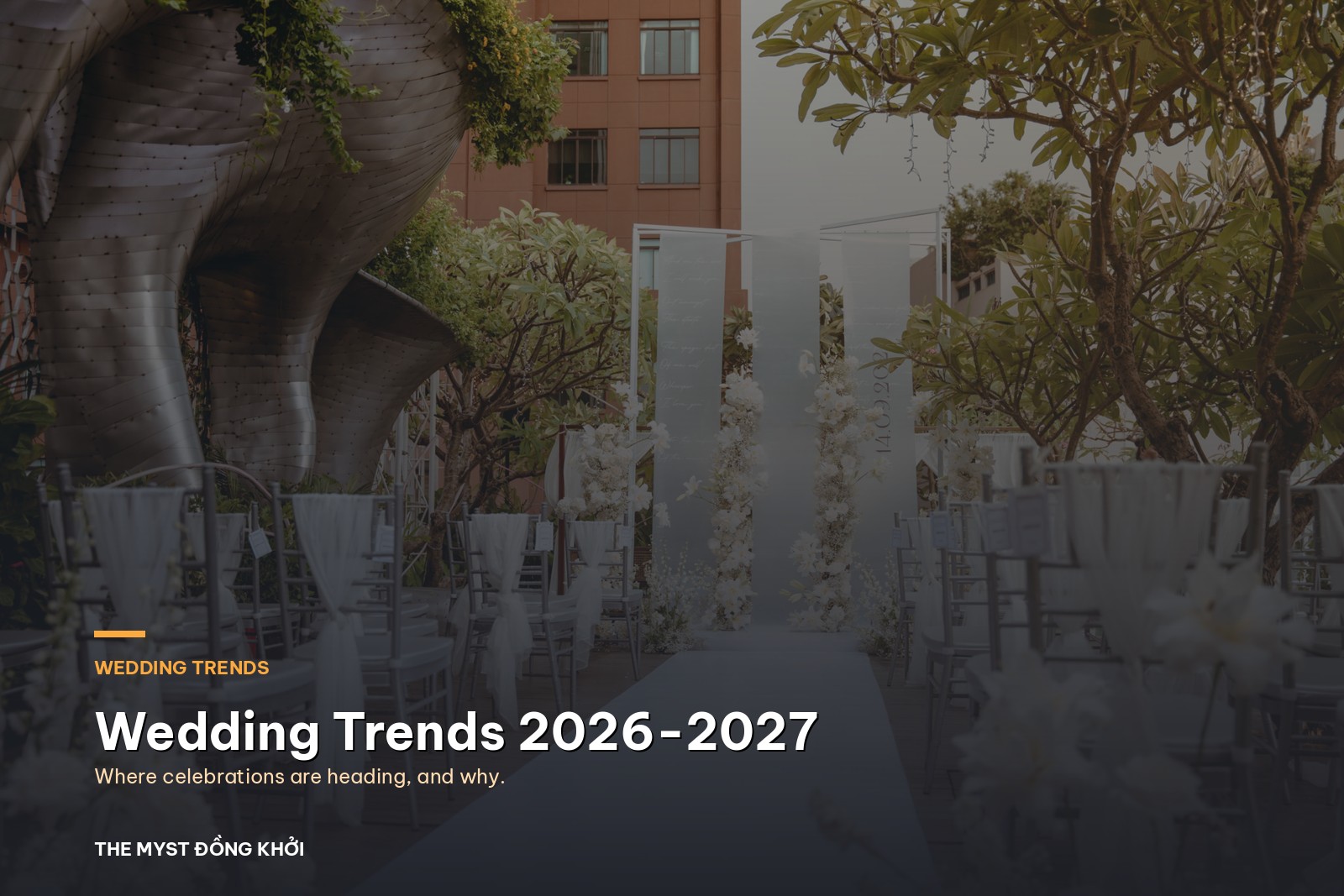
Wedding Trends 2026-2027: Where Celebrations Are Heading
Weddings are quietly changing shape. The five hundred guest banquet is no longer the default, the flower budget is being...
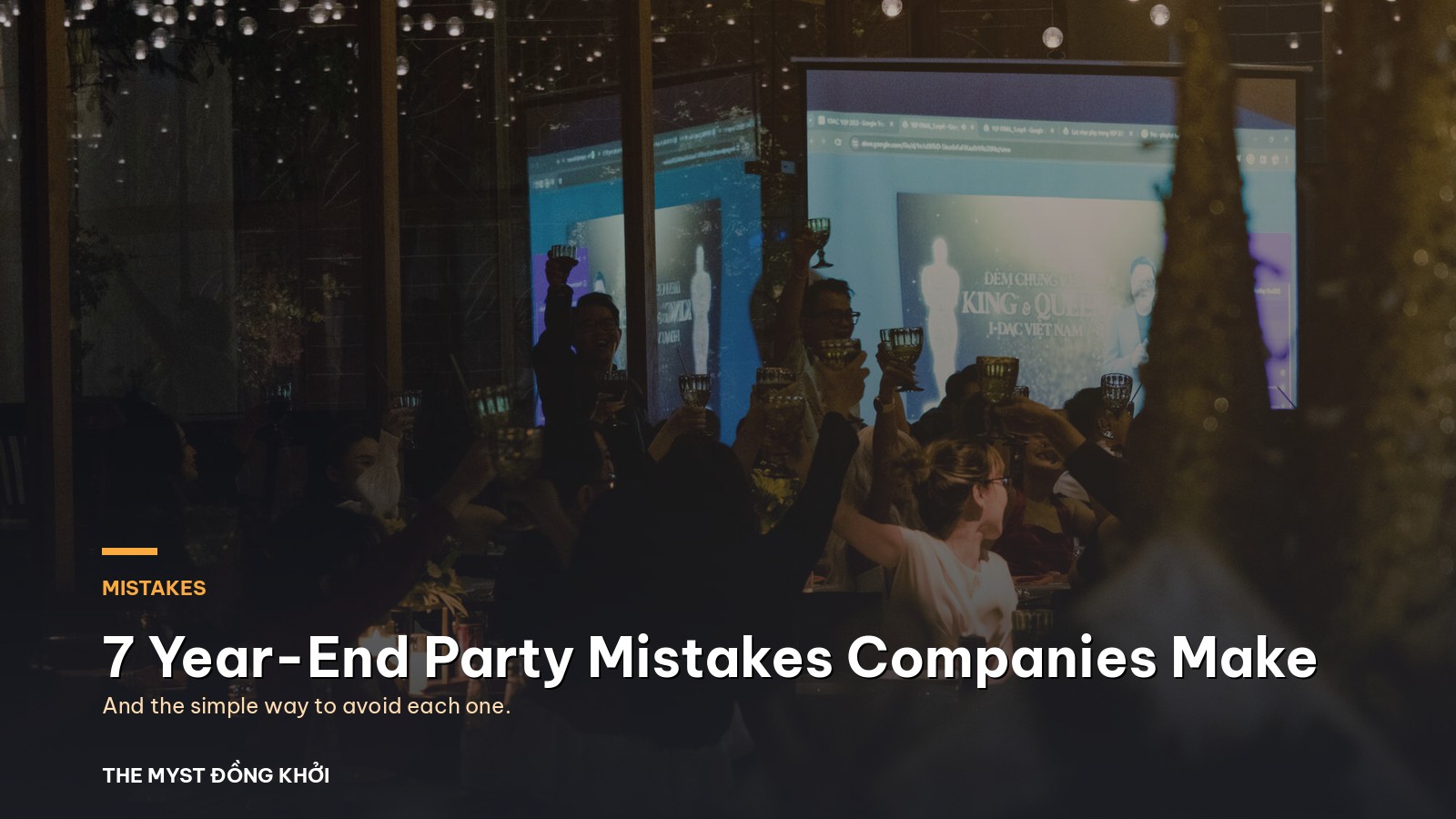
7 Year-End Party Mistakes Companies Make (and How to Avoid Them)
Every December, the same story plays out in offices across Saigon. The year-end party gets talked about in October, half-planned...
Year End Party Planning Timeline: A 90-Day Countdown
The year end party looks effortless only when the work behind it started early. Three months out, a good venue...
Year-End Party: Buffet or Set Menu? A Decision Guide
Once the venue and date are settled, one question tends to stall the whole plan: buffet or set menu? It...
Year End Party Venue: 5 Criteria for Choosing the Right Space in Saigon
The year end party is the one date the whole team actually looks forward to, and the venue decides most...