Blog
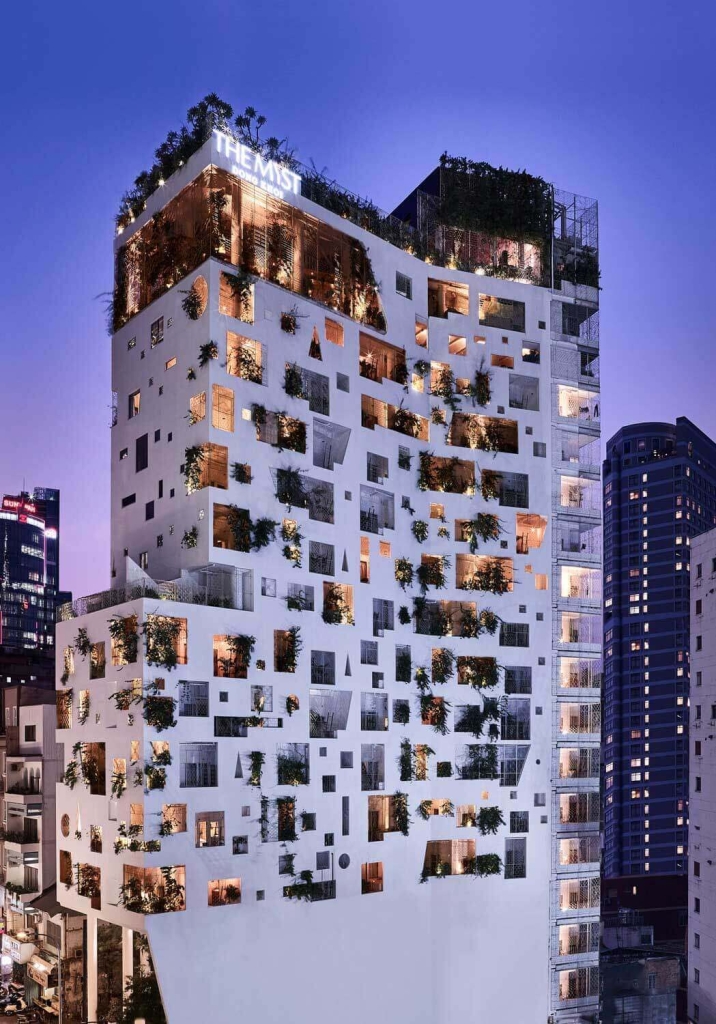
이른 저녁 Hồ Huấn Nghiệp 거리에 서서 위를 올려다보세요. The Myst Dong Khoi의 창과 발코니가 독특한 패턴으로 파사드에 흩어져 있고, 층마다 가장자리로 식물이 흘러넘칩니다. 미쉐린 가이드도 이 건물을 거의 같은 말로 묘사합니다. 간단히 말해 The Myst Dong Khoi의 수상 이력은 세 갈래입니다. World Luxury Hotel Awards 2025의 두 타이틀, 미쉐린 가이드 호텔 셀렉션 등재, 그리고 Tripadvisor Travelers’ Choice 2026입니다. 각각 심사하는 주체도, 방식도 다릅니다. 이 가이드에서는 하나씩 살펴보며, 예약 전에 각각이 무엇을 알려 주고 무엇은 알려 주지 못하는지 정리합니다.
한눈에 보기. World Luxury Hotel Awards 2025에서 호텔은 Best Luxury Cultural Hotel 부문 Global Winner, Best Luxury Art Boutique Hotel 부문 베트남 Country Winner로 선정되었습니다. 또한 미쉐린 가이드 호텔 셀렉션에 포함되어 있으며, 이 셀렉션은 2025년 10월 기준 전 세계 7,000곳이 넘는 숙소를 아우릅니다. Tripadvisor는 12개월간의 리뷰와 평점을 바탕으로 등록 숙소 상위 10%에 Travelers’ Choice를 수여합니다.
In this guide
세 종류의 심사자
가장 쉽게 구분하는 방법은 누가 펜을 쥐고 있는지 떠올려 보는 것입니다. World Luxury Hotel Awards는 공개 투표처럼 운영됩니다. 호텔이 부문에 참가하고, 누구나 온라인으로 투표할 수 있습니다. 미쉐린 가이드는 편집된 안내서에 가까워, 인스펙터가 직접 방문해 누가 실릴지를 정합니다. Travelers’ Choice는 투숙 후 게스트가 남긴 리뷰를 합산한 점수판에 가깝습니다.
세 가지는 서로를 보완합니다. 하지만 어느 객실이 나에게 맞을지는 어느 것도 알려 주지 않습니다.
World Luxury Hotel Awards 2025: 부문별 투표
World Luxury Hotel Awards는 2006년에 시작되었습니다. 주최 측에 따르면 럭셔리 호텔은 직접 후보로 나서거나 게스트, 여행사, 투어 운영사의 추천을 받을 수 있습니다. 투표 기간에는 누구나 온라인으로 투표할 수 있으며, 매년 30만 표 이상이 모입니다. 이메일 주소 하나당 호텔별로 한 표입니다.
주최 측은 서비스 제공, 럭셔리함, 프레젠테이션을 기준으로 심사한다고 설명합니다. 호텔은 국가, 지역, 대륙, 글로벌의 네 단계에서 같은 부문의 숙소하고만 경쟁하므로, 컬처럴 호텔이 사파리 로지나 프라이빗 빌라와 비교되는 일은 없습니다. 수상자는 갈라 시상식에서 발표됩니다.
자세한 절차는 World Luxury Hotel Awards 심사 절차 페이지에서 확인할 수 있습니다. The Myst Dong Khoi는 2025년 11월 17일에 2025년 수상 결과를 발표했습니다.
두 개의 타이틀, 서로 다른 의미
헤드라인만 훑어보면 같은 상을 두 번 받은 것처럼 보일 수 있습니다. 그렇지 않습니다. 서로 다른 두 부문, 서로 다른 두 단계의 수상입니다.
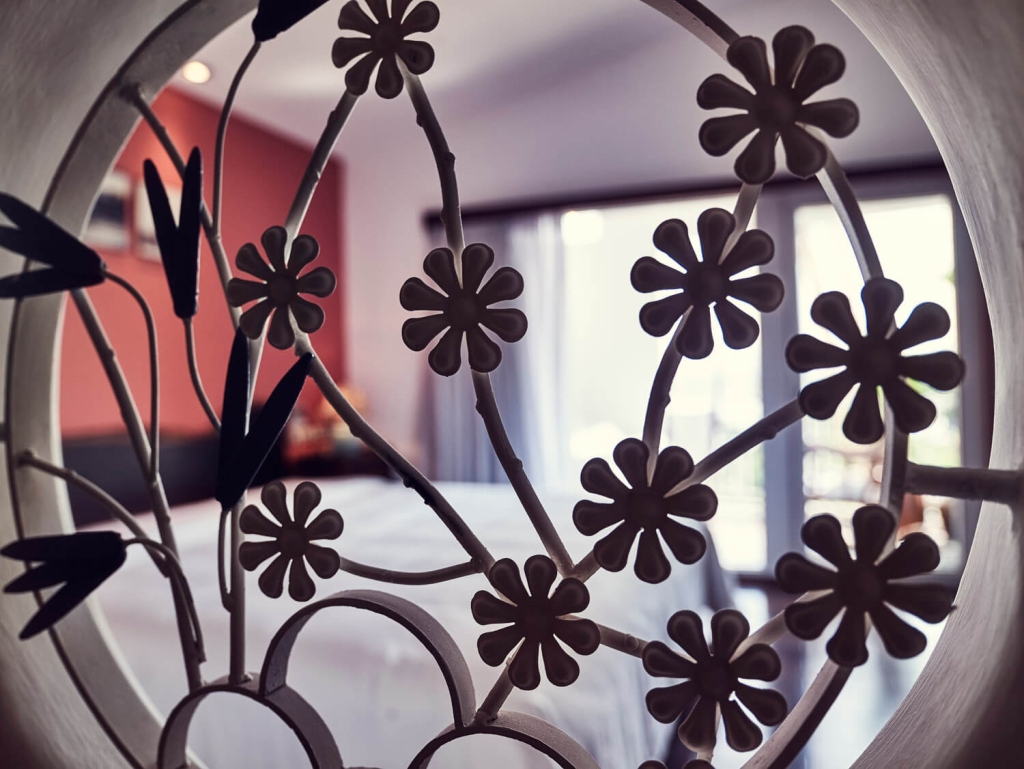
Best Luxury Cultural Hotel 부문 Global Winner는 네 단계 중 가장 높은 글로벌 타이틀입니다. 부문 이름이 대부분을 말해 줍니다. 문화를 중심에 둔 럭셔리 호텔이라는 뜻입니다. The Myst Dong Khoi에서는 그 문화를 손으로 직접 만져 볼 수 있습니다. 2015년에 철거된 바손 조선소에서 가져온 목재와 금속이 꽃무늬 철제 장식, 마르세유 기와, 스테인드글라스, 그리고 호텔의 시그니처 향인 ngọc lan(일랑일랑)과 어우러져 있습니다.
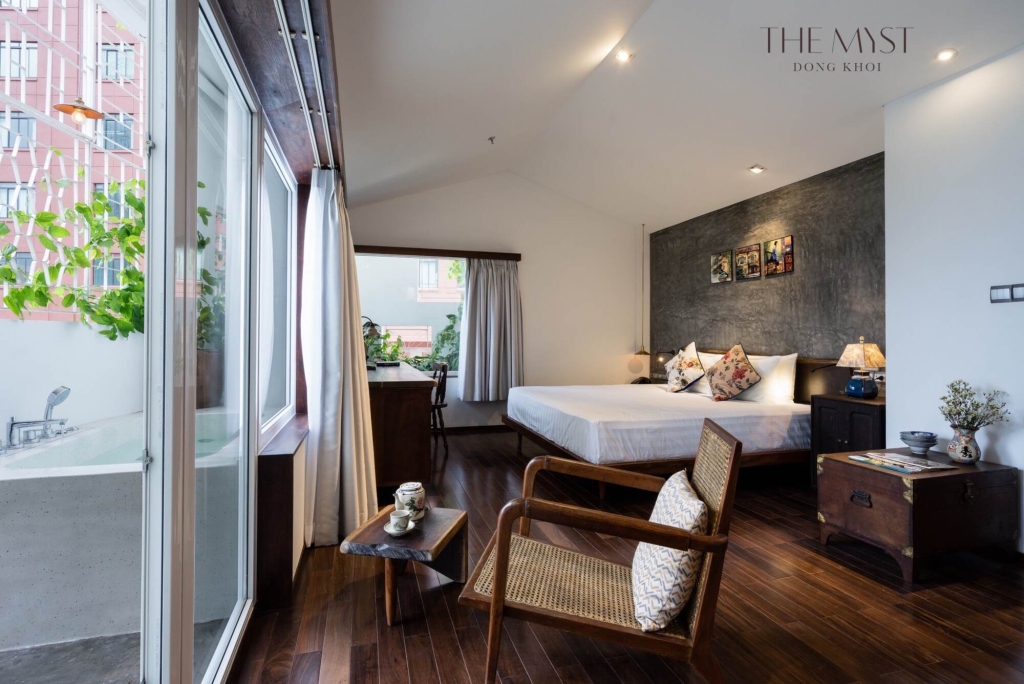
Best Luxury Art Boutique Hotel 부문 베트남 Country Winner는 국가 단위 타이틀로, 참가한 베트남 호텔 가운데 이 부문에서 1위를 했다는 뜻입니다. 호텔이 시상식을 위해 준비한 소개 자료에는 나무 바닥, 앤티크, 신화를 담은 그림, 티크 조각, 도자기 북, 철제 난간 등 사이공의 오래된 숍하우스를 떠올리게 하는 객실이 담겨 있습니다.
즉, 한 타이틀은 전 세계 컬처럴 호텔과, 다른 하나는 국내 아트 호텔과 견준 결과입니다. 바손 조선소의 소재와 철제 꽃 장식에 담긴 생각은 옛 사이공 디자인 디테일의 유래에서 읽어 보세요. 컬처럴 럭셔리 호텔이 테마 호텔과 어떻게 다른지에 관한 글도 따로 있습니다.
미쉐린 가이드: 셀렉션에 오른다는 것의 의미
미쉐린 가이드가 처음 나온 것은 1900년, 프랑스 도로를 달리는 자동차가 3,000대도 안 되던 시절입니다. 타이어를 만들던 앙드레와 에두아르 미쉐린 형제는 운전이 늘면 타이어도 더 팔릴 것이라 기대하며 운전자를 위해 이 책을 펴냈습니다. 레스토랑의 별은 누구나 알지만, 호텔 부문은 훨씬 덜 알려져 있습니다. 미쉐린 가이드의 역사는 위키백과에서 볼 수 있습니다.
2023년 10월, 미쉐린은 호텔만을 위한 고유의 평가인 ‘키’를 발표하고 2024년부터 수여하기 시작했습니다. 등급은 세 단계로, 1키는 ‘매우 특별한 숙박’, 2키는 ‘탁월한 숙박’, 3키는 ‘비범한 숙박’을 뜻합니다. 인스펙터는 건축과 인테리어 디자인, 서비스의 품질과 일관성, 개성과 특징, 가격 대비 가치, 주변 지역이나 환경에 대한 기여라는 다섯 가지 기준으로 호텔을 평가합니다.
셀렉션과 키는 서로 다른 층위입니다. 미쉐린의 2025년 10월 호텔 통계에 따르면 전 세계 셀렉션에는 7,000곳이 넘는 호텔이 있고, 그중 2,457곳이 키를 보유하고 있습니다(1키 1,742곳, 2키 572곳, 3키 143곳). 나머지 호텔도 키만 없을 뿐 미쉐린이 추천하는 곳이며, 셀렉션 등재에는 순위가 없습니다.
The Myst Dong Khoi는 미쉐린 가이드 호텔 셀렉션에 포함되어 있으며, 이 글에서 말하는 것은 거기까지입니다.
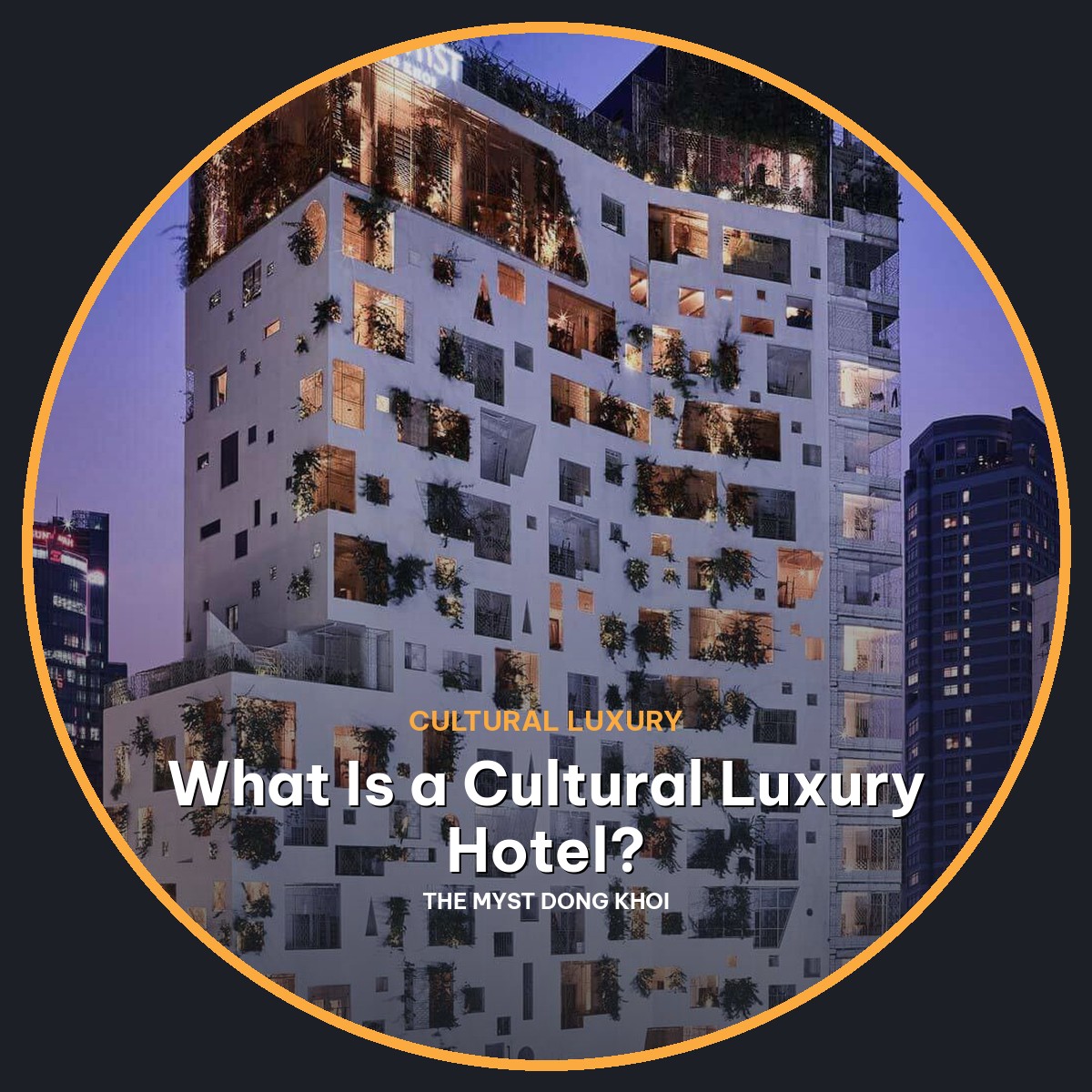
미쉐린은 이 건물을 ‘창과 발코니가 독특한 패턴으로 파사드에 박혀 있고, 무성한 식물이 터져 나오는 모더니즘 타워’라고 묘사합니다. 실내에 대해서는 현지 가옥에서 영감을 받은 객실의 오브제, 원목 바닥, 스테인드글라스, 철제 장식을 언급합니다. 전문은 미쉐린 가이드의 호텔 소개를 모은 페이지에서 볼 수 있습니다.
Tripadvisor Travelers’ Choice 2026: 게스트가 직접 매긴 점수
세 번째 평가는 또 다른 방식으로 이루어집니다. Tripadvisor는 12개월 동안 올라온 리뷰와 평점의 질과 양, 그리고 편집 검토를 바탕으로 Travelers’ Choice를 정합니다. 수상 숙소는 Tripadvisor 등록 숙소 상위 10%에 듭니다. Best of the Best는 상위 1%로 훨씬 좁은 그룹이므로, 배지에 적힌 이름을 꼭 확인하는 것이 좋습니다.
대상이 되려면 Tripadvisor에 12개월 이상 등록되어 있어야 하고, 기간 중 일정 수 이상의 리뷰를 받아야 하며, 최소 버블 평점을 유지해야 합니다. 심각한 안전 사고나 조작된 리뷰 등이 있으면 제외될 수 있습니다. 자세한 내용은 Travelers’ Choice 선정 방식에 대한 Tripadvisor의 설명에 있습니다.
The Myst Dong Khoi는 Travelers’ Choice 2026을 받았습니다. 이 배지의 가치는 숫자에 있습니다. 한 해 동안 서로 다른 시기에 많은 게스트가 호텔에 높은 점수를 줬다는 뜻입니다.
세 가지 평가 한눈에 비교
| 평가 | 누가 정하나 | 기준 | 범위 | 게스트에게 알려 주는 것 |
|---|---|---|---|---|
| World Luxury Hotel Awards 2025(2개 부문) | 온라인으로 투표하는 일반 대중 | 부문별 투표, 서비스 제공·럭셔리함·프레젠테이션으로 심사 | 네 단계: 국가, 지역, 대륙, 글로벌 | 그해 그 부문에서 두드러졌다 |
| 미쉐린 가이드(호텔 셀렉션) | 미쉐린 인스펙터 | 다섯 가지 기준: 디자인, 서비스, 개성, 가치, 지역 기여 | 7,000곳 이상 선정, 2,457곳이 키 보유(2025년 10월) | 전문가가 선택했다, 키는 별도의 층위 |
| Tripadvisor Travelers’ Choice 2026 | 리뷰를 남긴 과거 게스트와 편집 검토 | 12개월간 리뷰의 질과 양 | 등록 숙소 상위 10%, Best of the Best는 상위 1% | 지난 1년간 많은 게스트가 높이 평가했다 |
수상이 알려 주는 것과 알려 주지 못하는 것
모두 의미가 있습니다. 동시에 저마다 사각지대도 있습니다.
World Luxury Hotel Awards는 투표로 정해지므로 누가 투표에 참여했는지에 따라 결과가 달라지고, 타이틀은 호텔이 참가한 부문과 그해에 대해서만 말해 줍니다. 2025년 컬처럴 부문 타이틀은 많은 투표자가 호텔의 문화적 면모를 높이 샀다는 뜻이지, 수영장이나 조식에 대해서는 아무것도 말해 주지 않습니다.
미쉐린 가이드는 인스펙터가 평가한 시점의 판단을 반영합니다. 선정되었다는 것은 전문가가 보고 골랐다는 뜻이지만, 셀렉션은 호텔끼리 순위를 매기지 않습니다.
Travelers’ Choice는 지난 12개월 동안 모인 수많은 취향의 평균으로, 과거를 돌아보는 지표입니다. 실제 숙박은 계절, 객실, 혼자인지 가족과 함께인지에 따라 달라지며, 내가 잠귀가 밝은지까지 평균이 알려 주지는 않습니다.
예약하는 날의 요금, 남아 있는 객실, 조식 포함 여부는 세 가지 모두 알려 주지 않습니다.
예약할 때 수상 이력 활용법
수상 이력은 필터로 쓸 때 가장 유용합니다. 그다음에는 몇 가지를 직접 확인하세요.
- 연도와 정식 타이틀을 확인하세요. Global Winner와 Country Winner는 다르며, 타이틀은 각각 한 해에 속합니다. 부문의 정식 이름을 보면 무엇으로 수상했는지 알 수 있습니다.
- 원래 출처를 찾아보세요. 미쉐린은 셀렉션에 오른 호텔마다 페이지를 두고 있고, 나머지 두 곳도 수상 숙소를 공개합니다.
- 나에게 중요한 점에 대한 최근 리뷰를 읽어 보세요. 출장이라면 Wi-Fi와 체크아웃 시간을, 휴가라면 수영장, 욕조, 객실이 얼마나 조용한지를 찾아보세요.
- 수상 이력이 답해 주지 못하는 것은 예약팀에 물어보세요. The Myst Dong Khoi에는 40~70m² 규모의 객실 카테고리 6가지가 있으며, 모두 전용 발코니와 야외 자쿠지를 갖추고 있습니다. 조식 포함 여부는 요금제에 따라 다르므로 예약할 때 확인하세요. 먼저 6가지 객실 카테고리의 크기와 특징을 살펴보세요.
- 내 필요와 맞춰 보세요. 게스트들이 The Myst Dong Khoi에서 실제로 느끼는 점으로는 편안함과 조용함이 있습니다.
자주 묻는 질문
The Myst Dong Khoi는 어떤 상을 받았나요?
World Luxury Hotel Awards 수상자는 어떻게 선정되나요?
Global Winner와 Country Winner는 무엇이 다른가요?
미쉐린 가이드에 실린 것과 미쉐린 키를 받은 것은 같은 건가요?
Tripadvisor는 Travelers’ Choice 2026을 어떻게 정하나요?
수상 이력만 보고 호텔을 골라도 될까요?
직접 경험해 보세요
수상 이력은 이야기의 일부일 뿐입니다. 나머지는 초록이 우거진 발코니, 하루 종일 걸은 뒤의 느긋한 목욕, 1층 Bason Café에서 마시는 아침 커피 속에 있습니다. 6-8 Hồ Huấn Nghiệp에서 Nguyễn Huệ 보행자 거리까지는 걸어서 약 4분입니다.
→ The Myst Dong Khoi의 수상 내역과 언론 보도 모두 보기
→ 미쉐린 가이드가 소개하는 The Myst Dong Khoi 읽기
Silverland Hospitality가 큐레이션한 곳
Blog
밤 11시, 사이공 여행을 앞두고 예약 탭을 일곱 개나 열어 두었습니다. 호텔마다 “현지 문화가 깊이 배어 있다”고 말합니다. 사진 갤러리마다 같은 등불, 같은 대나무 코너, 같은 옻칠화가 보입니다. 다섯 번째 탭쯤 되면 모두 뒤섞여 보입니다. 그렇다면 컬처럴 럭셔리 호텔이란 무엇일까요? 간단히 말해, 그 문화가 직접 확인할 수 있는 것들 속에 살아 있는 고급 호텔입니다. 역사가 있는 자재, 날짜와 지명이 담긴 이야기, 그 지역의 음식, 그리고 바깥 거리와의 실제 연결이 그것입니다. 가장 빠른 테스트는 호텔 전체를 들어 다른 도시에 옮겨 놓았다고 상상해 보는 것입니다. 그래도 이야기가 성립한다면, 그것은 처음부터 테마에 불과했던 것입니다.
한눈에 보기. “컬처럴 럭셔리 호텔”에 대한 공식 인증은 존재하지 않습니다. 미쉐린 가이드는 2024년부터 다섯 가지 기준으로 호텔을 평가하고 있으며, 그중 하나가 주변 지역에 대한 기여입니다. The Myst Dong Khoi는 객실 108개를 갖춘 5성급 부티크 호텔로, 바손 조선소의 목재와 금속을 재활용했으며, World Luxury Hotel Awards 2025(월드 럭셔리 호텔 어워드 2025)에서 Best Luxury Cultural Hotel 부문 Global Winner로 선정되었습니다.
이 글의 내용
이 용어의 실제 의미
먼저 흔한 오해부터 짚어 보겠습니다. 어떤 공식 기관도 “컬처럴 럭셔리 호텔”을 인증하지 않습니다. 성급 등급은 주로 객실, 시설, 서비스를 봅니다. 다만 이 표현은 어워드 이름에 등장하기도 합니다. World Luxury Hotel Awards에는 Best Luxury Cultural Hotel 부문이 있으며, 2025년 The Myst Dong Khoi가 이 부문의 Global Winner가 되었습니다. 누가 무엇을 기준으로 심사하는지는 호텔의 수상 및 인증 내역에서 확인하실 수 있습니다.
이 용어는 두 부분으로 이루어져 있으며, 둘 다 제 몫을 해야 합니다. “럭셔리”는 누구나 고급 호텔에 기대하는 부분입니다. 넉넉한 객실, 좋은 침대, 제대로 된 방음, 그리고 1월과 다름없이 3월에도 빈틈없는 서비스입니다. “컬처럴”은 더 어렵습니다. 구체적이어야 하기 때문입니다. 저 목재는 어디에서 왔을까요? 창틀의 문양은 거리의 무엇을 닮았을까요? 앞의 절반을 빼면 아무도 편히 잠들지 못하는 작은 박물관이 되고, 뒤의 절반을 빼면 아침에 눈을 떴을 때 사이공인지 싱가포르인지 알 수 없는, 그저 무난한 호텔이 됩니다.
테마 호텔과 무엇이 다른가
사진으로 보면 둘은 비슷해 보입니다. 둘 다 앤티크 소품과 컬러 팔레트, 그리고 이야기를 갖추고 있습니다. 차이는 그 이야기가 어디에서 오느냐에 있습니다. 테마 호텔은 예컨대 지중해 마을 같은 아이디어 하나를 골라 그 주위에 호텔을 짓는데, 그 아이디어는 다낭(Đà Nẵng)이나 푸꾸옥(Phú Quốc)에서도 똑같이 통합니다. 컬처럴 호텔은 반대 방향으로 갑니다. 호텔이 들어선 땅과 그 주변 도시에서 출발하고, 장식은 그다음에야 생각합니다.
다시 한번 ‘옮기기 테스트’를 해 보겠습니다. 지중해 테마 호텔을 붕따우(Vũng Tàu)에서 꾸이년(Quy Nhơn)으로 옮겨도 아무도 놀라지 않습니다. 사이공강 조선소에서 나온 목재로 지은 호텔을 하노이로 옮기면 이야기는 곧바로 무너집니다. 어느 쪽이 더 낫다는 뜻은 아닙니다. 어린 자녀와 함께하는 주말이라면 밝고 경쾌한 테마 호텔이 더 잘 맞을 수도 있습니다.
| 비교 항목 | 컬처럴 럭셔리 호텔 | 테마 호텔 |
|---|---|---|
| 이야기의 출발점 | 호텔이 자리한 땅, 도시, 그리고 사람들 | 미리 정해 둔 아이디어, 흔히 다른 장소나 시대에서 빌려 온 것 |
| 자재와 소품 | 추적할 수 있는 내력: 어디에서, 언제 왔는지 | 세트로 구입한 것, 보기 좋지만 과거가 없음 |
| 다른 도시로 옮긴다면 | 이야기가 더 이상 말이 되지 않음 | 이전과 똑같이 통함 |
| 음식 | 일상 메뉴에 오르는 지역 요리 | 테마 이름을 붙인 요리 몇 가지 |
| 거리와의 관계 | 투숙객을 거리로 내보내고, 옛 지명과 생업을 이어 감 | 건물 안에서 모든 것이 완결됨 |
미쉐린 가이드의 다섯 가지 기준 빌려 쓰기
잣대를 새로 만들 필요는 없습니다. 미쉐린 가이드는 1900년 프랑스 운전자를 위한 안내서로 처음 나왔고, 2024년부터는 선정팀의 익명 숙박을 거쳐 호텔에 “키(Key)”를 수여하고 있습니다. 평가 기준은 다섯 가지입니다. 건축과 인테리어 디자인, 서비스의 품질과 일관성, 개성과 특색, 가격 대비 가치, 그리고 주변 지역이나 환경에 대한 기여입니다. 마지막 항목을 눈여겨보세요. 호텔 정문 밖의 거리도 점수에 들어갑니다.
미쉐린처럼 익명으로 묵을 수는 없지만, 각 기준을 질문으로 바꿀 수는 있습니다. The Myst Dong Khoi는 미쉐린 가이드 호텔 셀렉션에 소개되어 있지만, 아래 표의 오른쪽 열은 투숙객의 시선으로 본 저희의 자체 해석일 뿐 미쉐린의 평가가 아닙니다.
| 미쉐린 기준 | 던져 볼 질문 | The Myst Dong Khoi에서 해 본 테스트 |
|---|---|---|
| 건축과 인테리어 디자인 | 자재와 문양에 이름과 출처가 있는가? | 바손 조선소(2015년 철거)에서 나온 목재와 금속, 연철 꽃문양, 마르세유 기와, 스테인드글라스 |
| 일관된 서비스 | 최근 후기가 달마다 같은 점을 칭찬하는가? | 최근 투숙객 후기를 읽어 보세요. 호텔의 말만 믿지 마세요 |
| 개성 | 눈을 감아도 어느 도시인지 짐작할 수 있는가? | 응옥란(ngọc lan) 향, 시소 웰컴 드링크, 헴(골목)처럼 굽어지는 복도 |
| 가격 대비 가치 | 가장 작은 객실 타입에는 무엇이 포함되는가? | 40~70m²의 객실 타입 6가지, 모든 타입에 전용 발코니와 야외 자쿠지 |
| 주변 지역에 대한 기여 | 호텔은 거리에 무엇을 돌려주며, 밖으로 나가기는 얼마나 쉬운가? | 층마다 식물을 심은 발코니, 동커이(Đồng Khởi)까지 도보 약 1분 |
예약 전에 물어볼 일곱 가지 질문
예약팀에 이메일이나 메시지를 보내 보세요. 정확하게 답하는지, 두루뭉술하게 답하는지에서 많은 것을 알 수 있습니다.
- 사진 속 이 물건은 어디에서 왔나요? 창틀이나 로비의 패널처럼 디테일 하나를 골라 물어보세요. 진짜 이야기가 있는 호텔은 이름과 날짜로 답합니다.
- 문화가 객실까지 이어지나요? 어떤 호텔은 로비에 모든 것을 쏟아붓고 객실은 밋밋하게 남겨 둡니다. 가장 작은 객실 타입의 사진을 요청해 보세요.
- 현지 음식이 매일 메뉴에 오르나요? 아니면 일주일에 한 번, 테마 나이트에만 나오나요?
- 걸어서 10분 안에 어디까지 갈 수 있나요? 동네와 이어진 호텔이라면 거리와 시장 이름을 줄줄이 댈 것입니다.
- 투숙객이 도시로 나가도록 무엇을 마련해 두었나요? 투어, 저녁 나들이, 즐겨 찾는 동네 카페 목록 같은 것들입니다.
- 최근 몇 달 동안 투숙객들은 어떤 평가를 남겼나요? 불만도 함께 읽고, 반복해서 나오는 칭찬을 찾아보세요.
- 요금에 정확히 무엇이 포함되나요? 조식, 공항 이동, 수영장 가운데 무엇이 기본이고 무엇이 추가 비용인지 확인하세요. 서면으로 받아 두세요.
빌려 온 문화의 경고 신호
결제하기 전에 잠시 멈춰야 할 신호가 몇 가지 있습니다.
- 날짜도, 이름도, 거리도 없는 이야기. “아시아 문화에서 영감을 받았다”는 말은 지구의 절반을 아우릅니다.
- 마케팅 문구 한 줄 한 줄마다 “문화”라는 말이 들어 있는데, 메뉴에는 어디에도 없는 경우.
- 디테일 하나에 대한 간단한 질문에 모호한 답이 돌아오거나, 아예 답이 없는 경우.
하나만으로는 그다지 증명되는 것이 없습니다. 세 가지가 모두 보인다면 대개 문화의 옷을 입은 테마 호텔입니다.
실제 사례: The Myst Dong Khoi
이론은 이 정도면 충분합니다. 실제 호텔 하나를 살펴보겠습니다. The Myst Dong Khoi는 6-8 Hồ Huấn Nghiệp, Phường Sài Gòn에 자리한 객실 108개의 5성급 부티크 호텔입니다. 호텔에서 동커이(Đồng Khởi) 거리까지는 약 1분, 응우옌후에(Nguyễn Huệ) 보행자 거리까지는 약 4분 거리입니다.
자재가 어디에서 왔는지 물으면, 답에는 고유한 이름이 붙어 있습니다. 2015년, 사이공강의 바손 조선소는 2세기가 넘는 선박 건조의 역사를 뒤로하고 문을 닫았고 철거되었습니다. 그 목재와 금속 일부가 호텔 디자인에 재활용되었고, 1층 카페의 이름도 여기에서 따와 Bason Café가 되었습니다. 그 역사는 응우옌 군주의 선박 작업장에서 철거에 이르기까지, 바손의 이야기에서 읽어 보세요.
문양은 거리에서 들어왔습니다. 연철 꽃문양이 창틀과 발코니 난간에 반복되고, 지붕에는 마르세유 기와가 덮여 있으며, 층마다 발코니 너머로 초록 식물이 흘러넘칩니다. 건물 안을 걷다 보면 사이공의 헴(hẻm, 골목)을 걷는 듯합니다. 객실로 이어지는 복도는 곧게 뻗지 않고 굽어 있고, 실제 골목의 집 앞처럼 문 옆에 화분이 놓여 있습니다. 객실에는 나무 궤짝, 반응으아(ván ngựa) 평상, 옛날식 거울처럼 옛 사이공 가정이라면 금세 알아볼 물건들이 놓여 있습니다. 각 디테일의 내력은 호텔의 옛 사이공 디자인을 소개하는 안내 글에서 설명합니다.
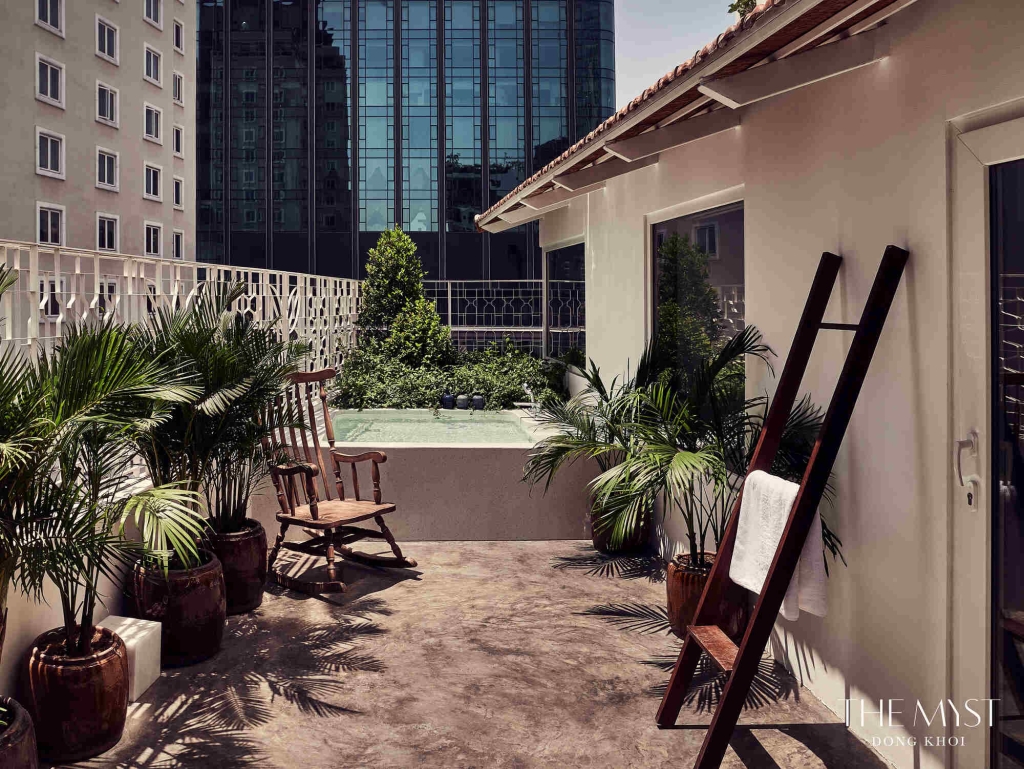
개성은 코와 혀로 판단하는 것이 가장 쉽습니다. 시그니처 향은 응옥란(ngọc lan), 즉 일랑일랑이며, 투숙객은 시소 음료로 환영을 받습니다. 12층의 The Nest 레스토랑은 제비 둥지에서 이름을 따왔습니다. 뷔페 카운터는 뗏(Tết, 음력 설)을 앞두고 빈동(Bình Đông) 시장으로 들어오던 꽃배를 떠올리게 하는 9미터 길이의 나무배이며, 주방은 베트남 요리에 무게를 둡니다. 주변 지역과의 관계를 보면, 호텔은 부지 끝까지 건물을 채우지 않고 녹지를 남겨 두었으며, 시티 투어와 메콩 투어, 야간 베스파 투어를 마련하고 있습니다.
이런 호텔이 잘 맞는 경우
두 밤 이상 머물며 걷기를 좋아하고, 오래된 이야기를 즐기며, 아침에 발코니 문을 열었을 때 내가 어디에 있는지 분명히 느끼고 싶은 여행자에게 잘 맞습니다. 연세 드신 가족과 함께하기에도 좋습니다. 평상이나 나무 궤짝은 그분들이 어린 시절 곁에 두고 자란 물건일 수 있고, 그러면 이야기가 자연스럽게 이어집니다.
한 체인의 포인트를 모으고 있거나, 어느 도시에서든 같은 느낌을 원한다면 덜 맞습니다. 두 유형의 차이는 사이공의 디자인 부티크 호텔과 체인 호텔을 비교한 글을 참고하세요.
자주 묻는 질문
컬처럴 럭셔리 호텔이란 무엇인가요?
컬처럴 호텔은 테마 호텔과 어떻게 다른가요?
컬처럴 럭셔리 호텔에 대한 공식 인증이 있나요?
예약 전에 호텔의 문화적 진정성을 어떻게 확인할 수 있나요?
컬처럴 호텔에서도 현대적인 편의를 누릴 수 있나요?
The Myst Dong Khoi는 사이공의 문화와 어떻게 연결되어 있나요?
다섯 가지 기준으로 The Myst Dong Khoi를 직접 검증해 보세요
이 글을 가장 확실하게 검증하는 방법은 직접 묵어 보는 것입니다. 로비의 어떤 디테일이든 직원에게 물어보고, Bason Café에서 바손 조선소의 옛 목재를 살펴본 다음, 동커이 거리로 걸어 나가 스스로 판단해 보세요.
→ The Myst Dong Khoi의 시설과 공간 보기
Silverland Hospitality가 큐레이션한 곳.
Blog, Blog
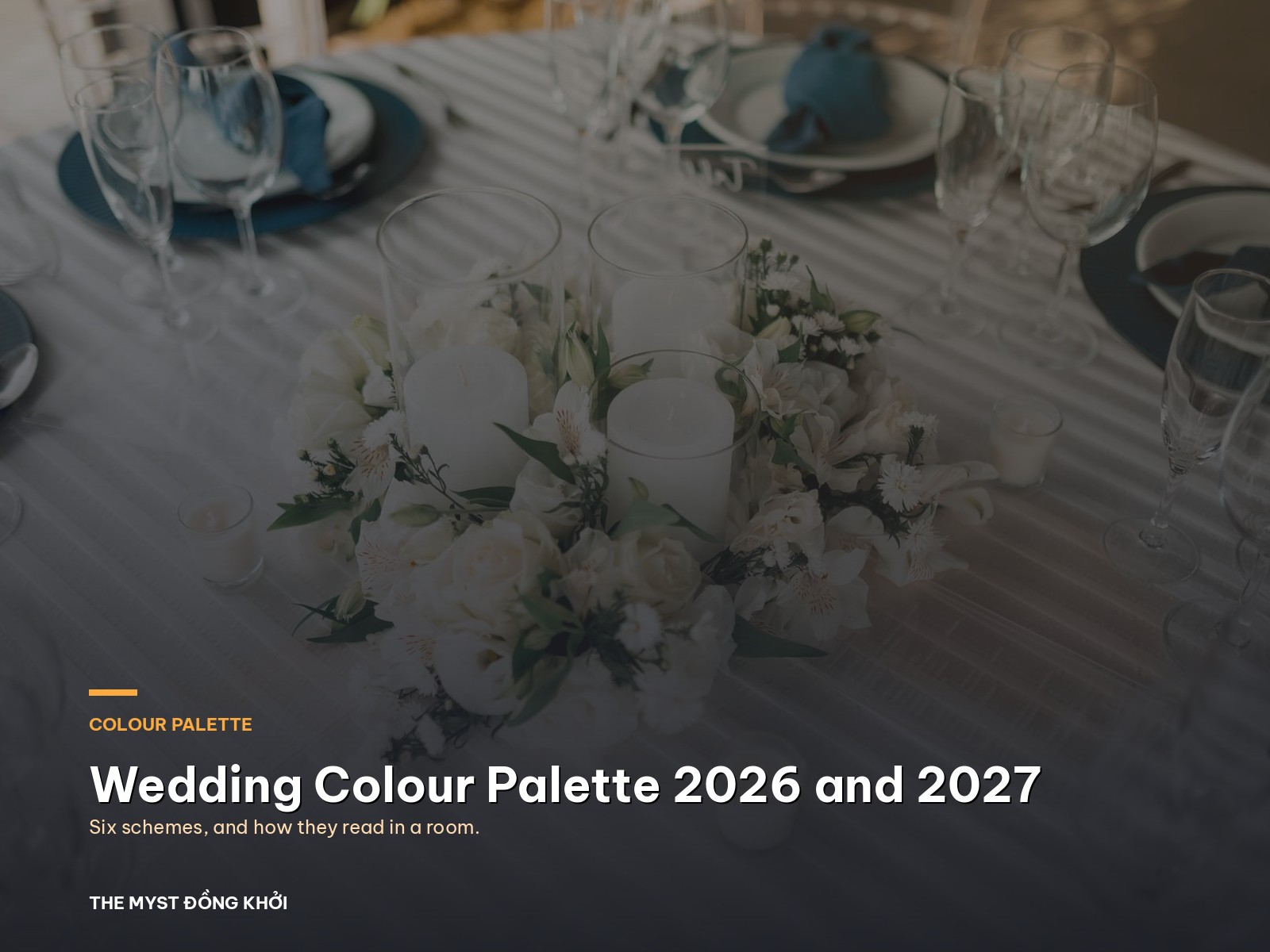
Color is the first decision that touches everything else. Before the flowers are chosen or the invitations are printed, a couple settles on a mood, and that mood is almost always a color. It shows up on the save the date, in the bridesmaids' dresses, on the napkins folded at each place, in the light that pools on the tables at dusk.
Get the palette right and the whole day feels of a piece. This guide walks through six wedding color palettes for the 2026 and 2027 season, what each one feels like, the season and setting it flatters, and how to carry it from paper to plate to what everyone wears.
At a glance. A wedding color palette is usually two or three lead shades plus a metallic or neutral to hold them together. For 2026 and 2027 the mood is warm and grounded: soft neutrals, sage and terracotta, dusty blue, burgundy and gold, blush and copper, deep emerald. Choose yours around your venue, your season, the quality of the light, and the two of you. The rest, from florals to table settings, follows from there.
Table of Contents
How a wedding color palette holds the day together
A palette is not decoration for its own sake. It is the thread that runs through a day made of dozens of small pieces, most of them ordered from different people at different times. The stationer, the florist, the tailor, the cake maker and the venue team rarely sit in the same room, yet their work has to look like it belongs together. A clear palette is what makes that happen. When everyone is working from the same two or three shades, a room that was assembled in parts reads as one considered whole.
The strongest palettes are simple. One or two lead colors carry the mood, a softer shade supports them, and a metallic or a neutral, gold, cream, ivory, ties everything off. Trends move slowly here, and the season ahead leans warm and natural rather than bright and graphic. Below are six schemes worth living with, each with the feeling it creates and the practical ways to wear it through the day.
1. Soft neutrals and cream
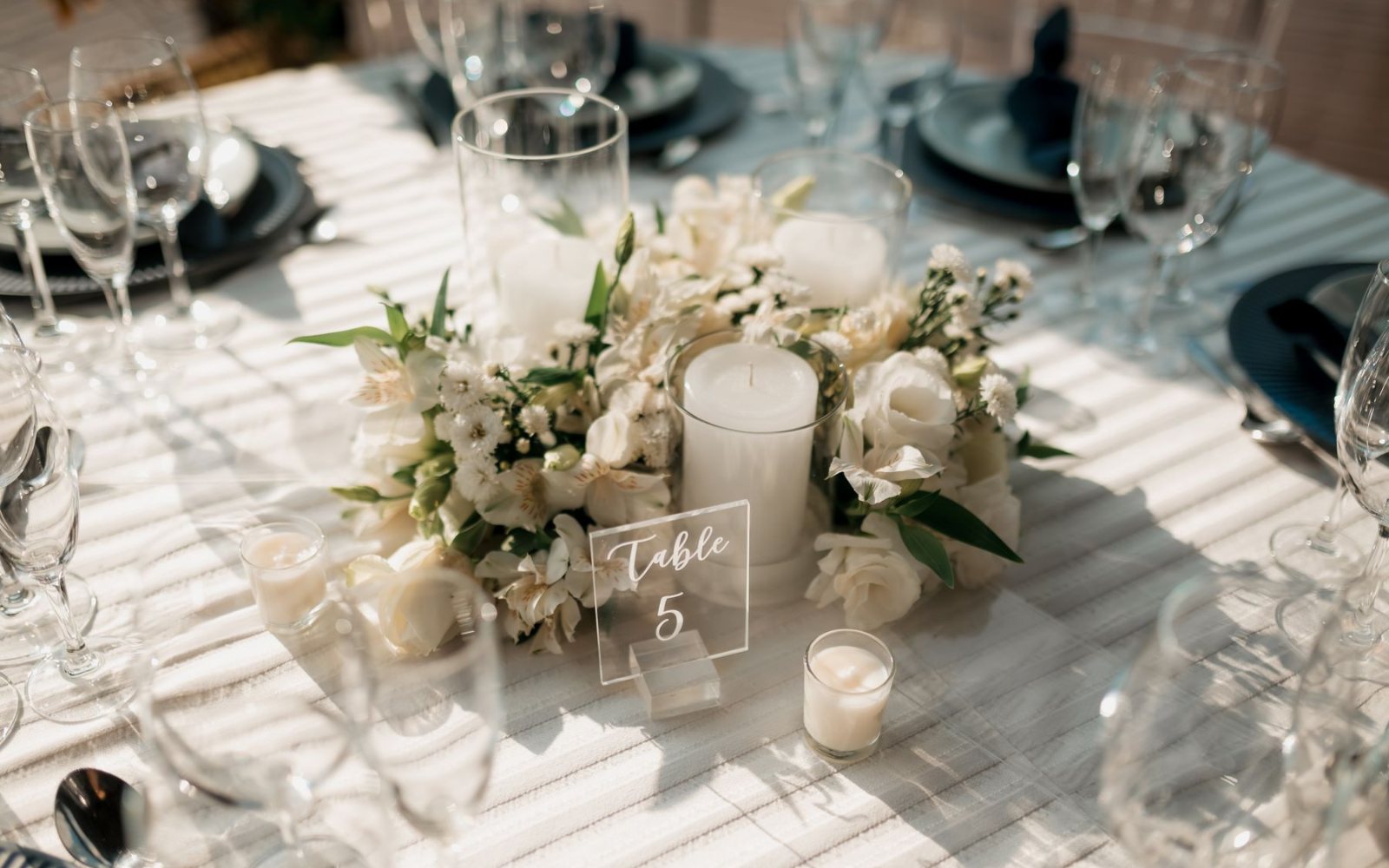
This is the quietest palette on the list and, for many couples, the most enduring. Think oat, sand, greige, oyster and warm white, layered so the difference between them is felt more than seen. Nothing shouts. The effect is calm, timeless and quietly luxurious, the kind of room that photographs as beautifully in ten years as it does on the day.
It suits a light-filled celebration best, a morning ceremony or an early afternoon reception where daylight can do the work, and it flatters almost any setting, from a pared-back modern space to a heritage room with character of its own. On paper, choose thick cream stock with soft taupe ink and perhaps a single pressed detail.
Florals stay textural rather than colorful: cream roses, ranunculus, dried grasses, a little foliage for depth. Dress the tables in linen with unpolished ceramics and clear glass. For attire, undyed and champagne tones keep the party in the same gentle key. If you worry it reads too plain, let texture be your color, raw silk, rattan, candle wax, wood.
2. Sage green and terracotta
Sage and terracotta are the palette of a long lunch that runs into evening. Muted green meets warm clay, an earthy pairing that feels relaxed and grounded without tipping into rustic. It is one of the most versatile schemes of the season because it borrows from nature, and nature rarely clashes.
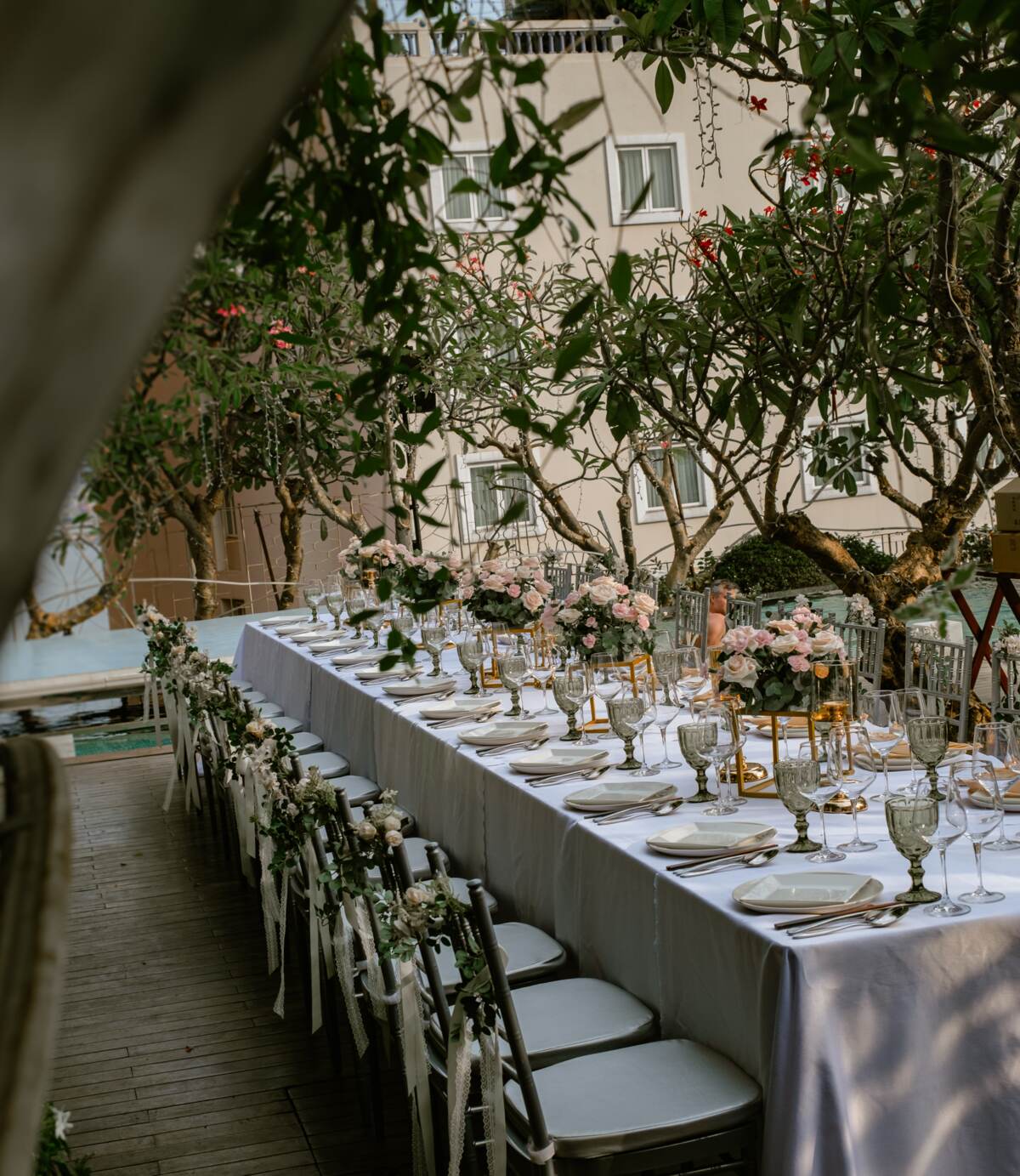
This one loves an outdoor or half-outdoor setting and the warmer months, a garden ceremony, a terrace dinner, a rooftop as the heat softens. Terracotta gives it enough warmth for the golden hour; sage keeps it fresh. For stationery, pair a sage envelope with terracotta ink or a clay-toned seal. Florals are where it sings: olive and eucalyptus foliage, dusty pink and rust blooms, the odd dried element. On the table, mix terracotta candles and amber glass with green-tinged linen. Bridesmaids in sage, groomsmen with a terracotta pocket square or tie, and the two colors carry effortlessly across the party.
3. Dusty blue and champagne
Dusty blue is a soft, greyed-down blue that reads as calm rather than cool, and champagne warms it just enough to keep it from feeling formal or wintry. Together they are elegant and a little romantic, a palette for a couple who want something classic without the expected navy-and-white.
It works beautifully across seasons and leans towards an indoor celebration, a ballroom, an evening reception, anywhere candlelight and a little sparkle belong. Champagne is a gift here because it doubles as your metallic, so glassware, chargers and stationery accents all pull in the same direction. Print invitations in soft blue on cream, or reverse it. Choose florals in white, pale blue and cream with silver-green foliage, delphinium, hydrangea, dusty miller. Set the table with champagne linen, gold or antique-silver flatware and blue glass water goblets. Dress the party in dusty blue for a scheme that flatters a wide range of complexions and photographs cleanly under warm light.
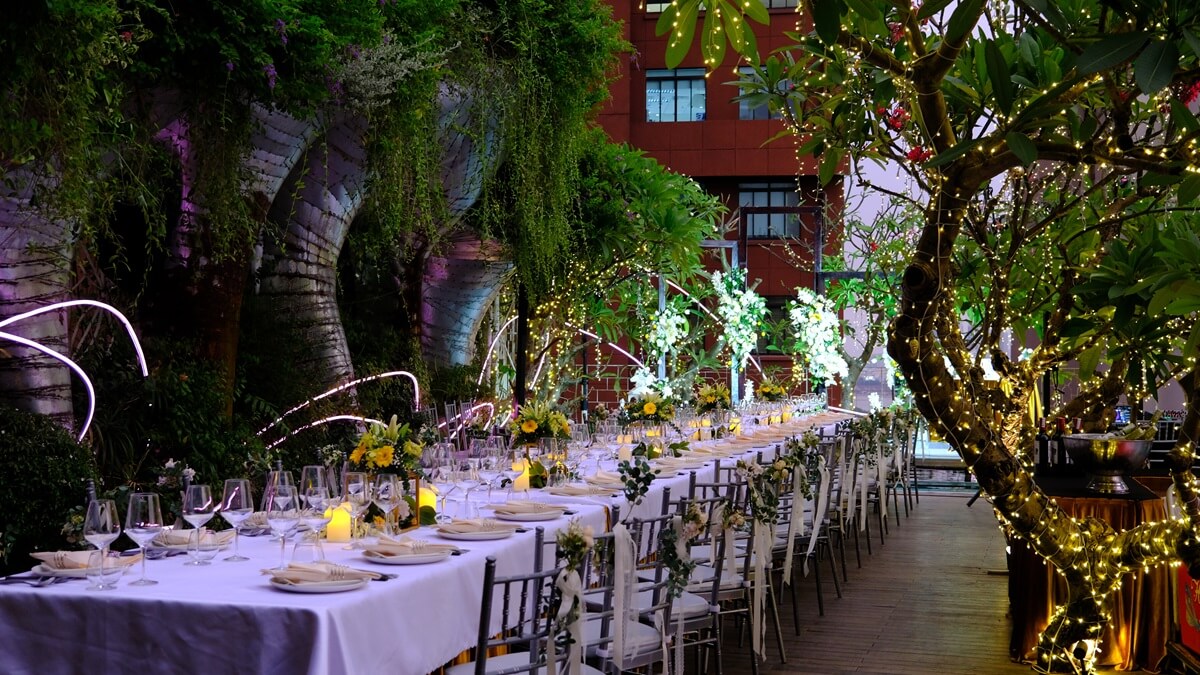
4. Burgundy and gold for a warm evening
When the celebration belongs to the evening, few palettes carry candlelight like burgundy and gold. Deep wine red with warm metallic gold is rich, grown-up and unmistakably festive, a scheme built for a room after dark. It has real drama, so it rewards restraint: let burgundy lead and gold accent, not the other way around.
This is a cooler-months and evening palette, well suited to a late-year wedding or a reception that flows into the night, and it belongs indoors or on a covered rooftop where lighting can be controlled. It also sits naturally alongside a year-end celebration mood, the same warmth you would want at a festive gathering. Print on ivory with burgundy and gold foil. Florals go deep and lush: burgundy dahlias and roses, dark berries, gold-brushed foliage. Dress the tables in burgundy runners over ivory, gold-rimmed glassware and plenty of tapers. Groomsmen in charcoal or deep green, bridesmaids in burgundy, and the whole room glows once the candles are lit.
5. Blush and copper
Blush and copper is the warm cousin of the old blush-and-rose-gold pairing, a touch earthier and a touch more modern. Soft pink meets a burnished metallic that has more depth than gold and more warmth than silver. The result is romantic without being sweet, which is exactly why it has aged so well.
It suits an autumn celebration or a warm evening indoors, and it flatters low, warm lighting, copper practically comes alive by candle. Stationery works in blush with copper foil or a copper wax seal. Keep florals soft and abundant: blush and peach roses, dahlias, a little dusty foliage, with copper carried through in the vessels rather than the blooms. On the table, copper candlesticks, amber or smoked glass, and blush linen or napkins. Dress bridesmaids in blush and let copper appear in the details, a belt, a cuff, the stem of every glass. It is a gentle palette that still feels current heading into 2027.
6. Deep emerald and ivory
Emerald and ivory is the boldest scheme here and the most classic at the same time. A jewel-deep green against soft ivory is striking, confident and a little regal, a palette with heritage in its bones. Emerald carries weight, so ivory is essential to let it breathe.
It works year round and suits a formal, indoor celebration, a ballroom, an evening reception, a room with architecture worth answering. There is something naturally at home about deep green in a space with heritage detail, dark wood, ironwork, tall windows. Print on ivory with emerald and a whisper of gold. Florals lean lush and green with white blooms: white roses, greenery, a few gold touches. Dress the tables in emerald over ivory with gold flatware and crystal. Groomsmen in emerald velvet or dark suiting, bridesmaids in emerald, and the palette does all the work, no other color required.
How to choose your palette
Six schemes, and every one of them can be beautiful. The question is which is right for your day, and four things decide it.
- Your venue. Look at the room before you fall for a palette. A space with strong character, heritage detail, colored walls, a view, already has a color story, and the best palettes answer it rather than fight it. Bring a swatch and hold it up in the actual light.
- Your season. Warm months carry sage, terracotta, dusty blue and blush; cooler months and the year-end stretch suit burgundy, gold and emerald. The season also sets what your florist can source at their best.
- Your light. A daytime celebration in natural light flatters soft neutrals and pastels; an evening lit by candle and warm bulbs brings the deeper, metallic palettes to life. Decide when your day peaks, then choose for that hour.
- The two of you. A palette should feel like you, not like a trend you will tire of. If neither of you would wear a color, be cautious about wrapping a whole day in it. The schemes that endure are the ones a couple actually loves.
For where these palettes sit within the wider picture of the season, our guide to wedding trends for 2026 and 2027 is a good companion read. And if your celebration falls at the close of the year, the same warm, candlelit mood runs through our guide to year-end events.
A word on setting
A palette needs a room to live in, and the room shapes the palette as much as the other way round. At The Myst Dong Khoi, a boutique heritage hotel in the heart of District 1, the settings do some of the work for you: a rooftop that catches the golden hour, the twelfth-floor calm of The Nest, and a ballroom that holds candlelight well.
Deep emerald finds its match in heritage detail; burgundy and gold warm to an evening on the rooftop; soft neutrals glow in daylight. Whichever scheme you land on, the events team can help you carry it through the day, and shape a boutique wedding around it.
Frequently asked questions
What is the most popular wedding color palette for 2026?
How many colors should a wedding palette have?
How do I choose a wedding color palette?
What wedding colors work best for an evening reception?
Are dusty blue and sage green still in for 2026 and 2027?
Can The Myst Dong Khoi help me plan a wedding around a palette?
Talk to us about your wedding
The Myst Dong Khoi is a boutique heritage hotel in the heart of District 1, with a rooftop, the twelfth-floor Nest and a ballroom for celebrations. Whatever palette you have fallen for, our events team is glad to help you shape a wedding around it, from the setting to the smallest detail.
→ Talk to our events team about a boutique wedding
→ [email protected] · +84 28 3520 3040
→ Read our guide to wedding trends for 2026 and 2027
Curated by Silverland Hospitality.
Blog, Blog
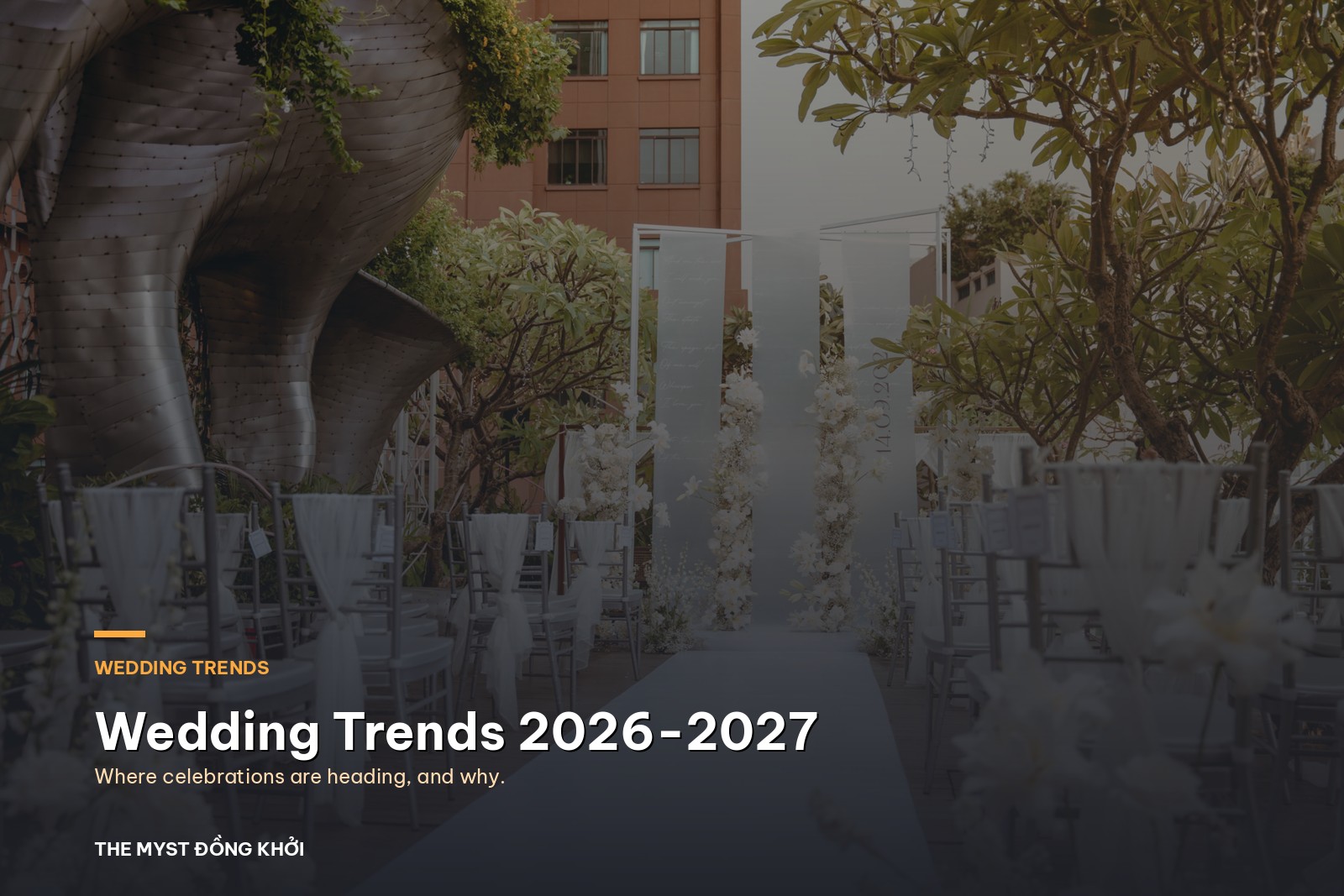
Weddings are quietly changing shape. The five hundred guest banquet is no longer the default, the flower budget is being spent with more thought, and couples are asking a simple question of every choice on the plan: does this actually feel like us? This is an editorial look at the wedding trends taking hold across 2026 and 2027, set out as concrete, named ideas rather than vague predictions. Read it as inspiration for your own celebration, whatever its size, and take from it only the parts that fit your story.
At a glance. The clearest wedding trends for 2026 and 2027 point in one direction: smaller, more personal and more considered. Couples are choosing intimate boutique celebrations over vast banquets, telling their own story through the details, sourcing locally and wasting less, treating dinner as an experience, and favouring city and rooftop venues that let a single day unfold across several spaces. This is an inspiration piece, not a rulebook, so borrow what suits you and leave the rest.
Table of Contents
Intimate and boutique celebrations over huge banquets
The biggest shift of all is one of scale. For years the measure of a wedding was the guest count, and a full banquet hall was the goal. That logic has softened. More couples now want the fifty or eighty people who genuinely matter to them, gathered in one warm room, rather than a crowd of near strangers filling a space too large to feel personal. A smaller list is not a smaller celebration. It simply moves the money and the attention away from sheer numbers and toward the things guests actually remember: the food, the setting, the time spent together.
A boutique venue suits this instinct because it was never built for the crowd in the first place. A heritage building in the centre of the city, a rooftop, an intimate ballroom that seats a wedding party without swallowing it. If you are drawn to this idea, the practical move is to fix your real guest list early, then choose a room that fits it snugly rather than one you have to fill. The Myst Dong Khoi is a boutique heritage venue in District 1, and this is exactly the kind of celebration its spaces are shaped around.
Personalisation and storytelling
The second trend runs through everything else. Couples want their wedding to read as theirs and no one else's, which means the day is increasingly built around a story rather than a template. That story shows up in the small decisions: a signature cocktail named after the street where you first met, a menu that nods to the dish from an early date, a playlist that is genuinely yours instead of the standard reception rotation, place cards that say something true about each guest.
The useful way to work with this is to start from your own history before you look at a single inspiration board. Write down the moments, places and flavours that belong to the two of you, then let the planning grow from that list outward. Colour is one of the easiest places to make a wedding feel personal and coherent, and it is worth thinking through early; our guide to wedding colour palettes for 2026 and 2027 is a good place to begin.
Sustainability, done quietly
Sustainability has moved from a talking point to a design principle, and the version that is taking hold for 2026 and 2027 is refreshingly practical rather than preachy. The clearest example is flowers. Instead of blooms flown in out of season from the other side of the world, couples are working with what grows locally and close to the date, which reads as more honest, costs less to move and often looks more alive on the day. Fewer imported stems, more seasonal foliage, more reusable installations that do not end the night in a skip.
The same thinking extends across the day. Local sourcing for the menu, portions planned to cut waste, decor that is hired or repurposed rather than bought and binned, favours guests will actually use. None of this asks a couple to compromise on beauty. It asks them to make choices with a little more intent. A simple starting point is to ask any venue or planner one question early: where does this come from, and where does it go afterwards. The answers tell you a great deal.
Experiential dining and interactive stations
Dinner is no longer just something served to seated guests. Increasingly it is part of the entertainment. Interactive stations, chefs finishing a dish in front of you, a raw bar or a dessert counter that people gather around, a cocktail being built to order rather than poured from a jug. The point is to give guests something to do and somewhere to move, turning the meal into a reason to mingle instead of a stretch of sitting still between speeches.
If this appeals, think about the flow of the evening as much as the flavours. One or two well placed live stations create a natural gathering point and take the pressure off a rigid seating plan. This experiential instinct is not unique to weddings; it runs through the way good celebrations are catered now, from tasting menus to the kind of hosted evenings we cover in our guide to year end parties and events. The lesson carries straight across to a wedding reception.
City and rooftop venues: the wedding trends shaping 2026
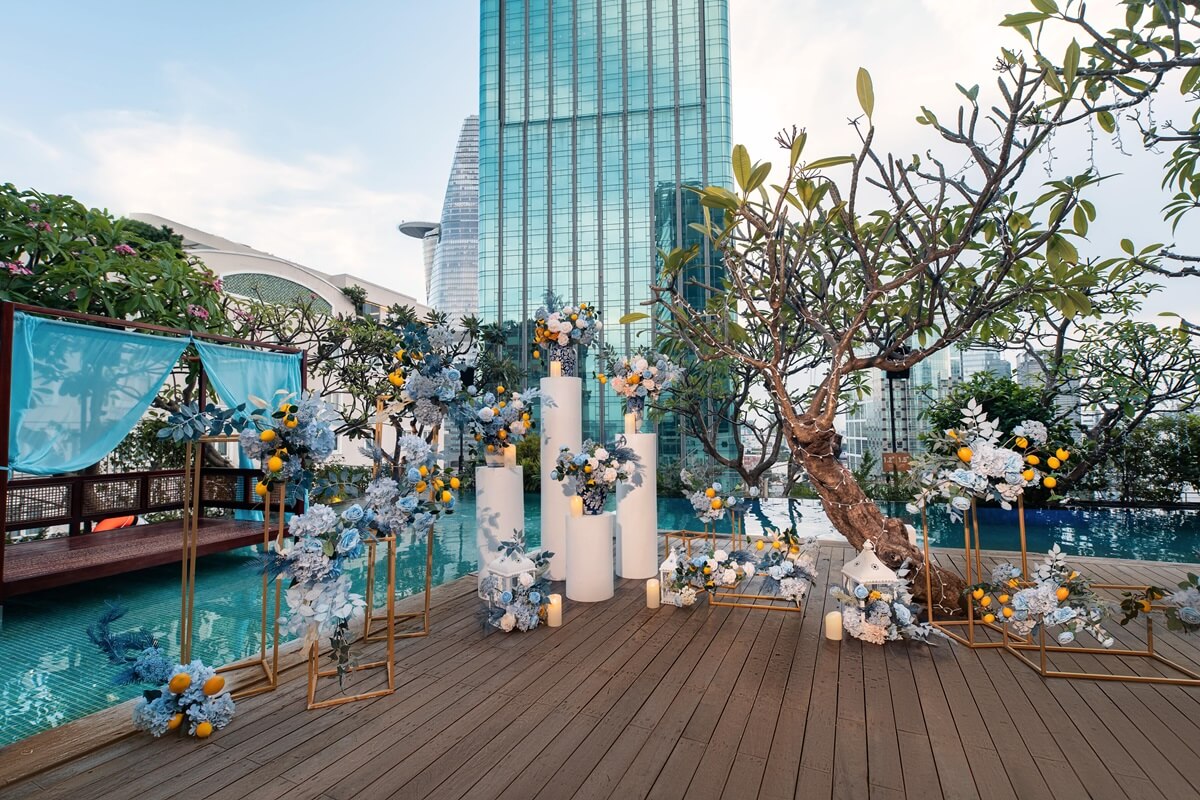
The destination wedding is being quietly rivalled by the city wedding. A central location is easy for guests to reach, close to hotels and the airport, and it lets a wedding lean on the character of the place rather than a blank marquee in a field. Rooftops in particular have become a signature of the 2026 and 2027 look. There is a reason: an open sky, a skyline that lights up as the evening turns, and a ceremony or cocktail hour that needs almost no decoration because the view is doing the work.
A rooftop suits the golden hour especially well, which is worth planning your timeline around if you choose one. The Myst Dong Khoi has its own rooftop, ROOTY, high above District 1, and if you would like a sense of how a space like this feels after dark, our note on the rooftop bar in Saigon gives a flavour of the outlook and the mood. For a city celebration, the venue and the view become part of the storytelling rather than a backdrop you have to dress.
A relaxed, multi-part day
One of the more liberating trends is the move away from a single fixed room for the whole event. Instead, couples are letting the day travel. A ceremony in one space, cocktails and canapes in another, dinner somewhere different again, each part with its own light and mood. The shift feels less like a rigid programme and more like a good evening out with the people you love, unfolding at an easy pace.
This is where a venue with several distinct spaces earns its place. A rooftop for the vows and the golden hour, a restaurant floor for dinner, a ballroom for the later celebration. The practical benefit is rhythm: guests are never stuck in one seat for five hours, and the natural change of scene keeps the energy up without anyone forcing it. If you are planning this way, map the transitions carefully so each move feels like an occasion rather than a queue, and give guests a drink in hand as they walk between spaces.
Documentary-style photography
Finally, the way weddings are remembered is changing. The stiff, posed album is giving way to documentary-style photography that catches the day as it actually happened. Real laughter, the quiet moment before the ceremony, a grandmother wiping her eyes, the dance floor at midnight. Fewer lined up group shots, more of the story told honestly. The same instinct is pushing couples toward unfiltered, film-inspired and candid imagery over heavily retouched perfection.
To make the most of this, brief your photographer on the moments and the people that matter to you rather than a shot list of formal set pieces, and build a little unhurried time into the schedule so those real moments have room to happen. It ties back to the first trend on this list: a wedding built around a genuine story photographs as one, and the pictures you keep are the ones that feel true.
Frequently asked questions
What are the biggest wedding trends for 2026?
Are small weddings still a trend in 2027?
What does a sustainable wedding actually involve?
Why are rooftop weddings so popular now?
How do I make my wedding feel personal?
Is a boutique venue suitable for a wedding?
Planning a boutique wedding? Talk to our events team
The Myst Dong Khoi is a boutique heritage venue in the heart of District 1, with a rooftop, a twelfth floor restaurant and a ballroom, and an events team that shapes each wedding around the couple. If any of these ideas feel like yours, we would be glad to talk them through and tailor a celebration to your story, your guest list and your date.
→ Plan your wedding with our events team
Or reach us directly at [email protected] or +84 28 3520 3040.
→ Next, explore wedding colour palettes for 2026-2027
Curated by Silverland Hospitality.
Blog, Blog
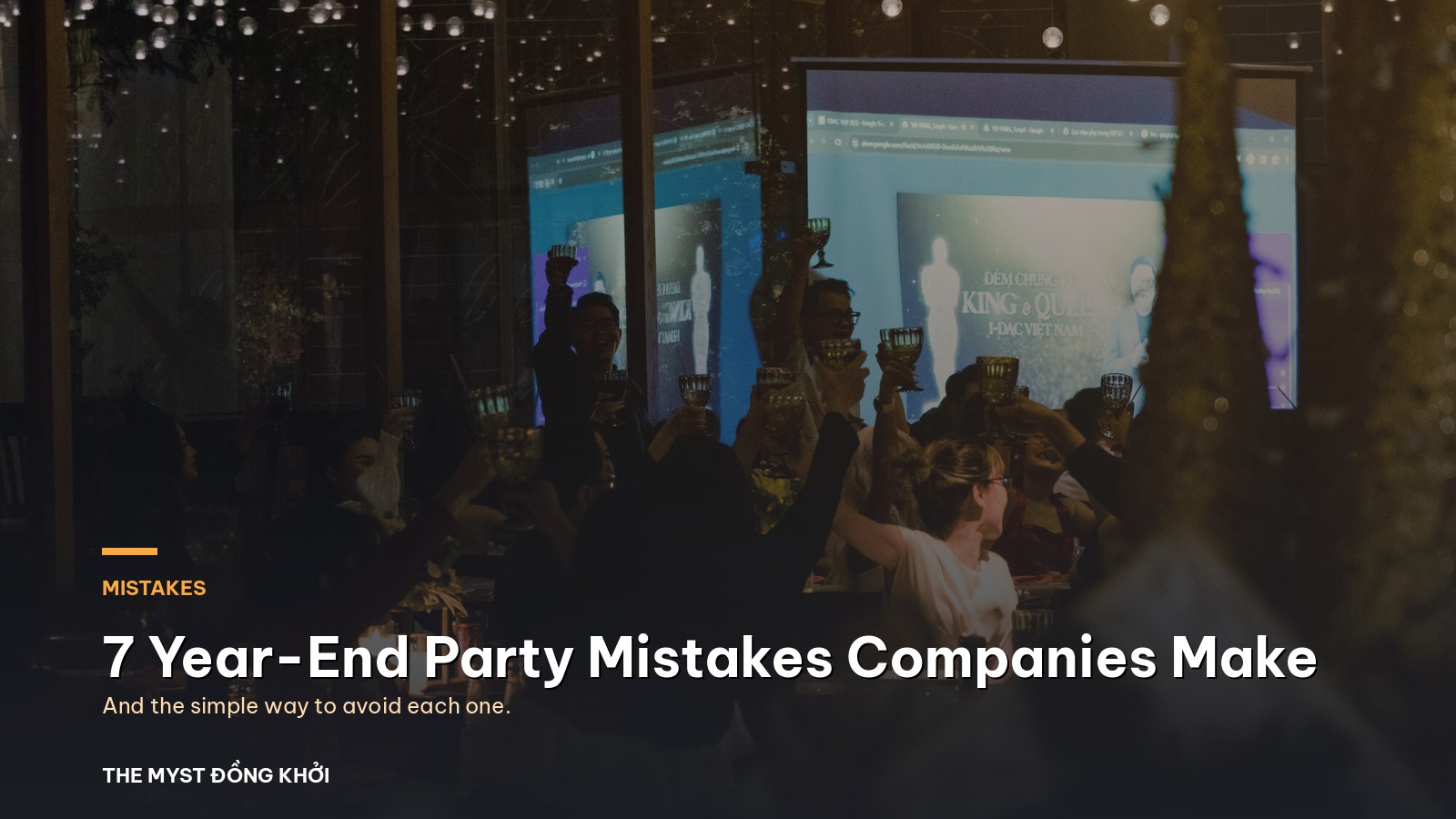
Every December, the same story plays out in offices across Saigon. The year-end party gets talked about in October, half-planned in November, and scrambled together in the last fortnight before the date. Most of what goes wrong on the night was actually decided weeks earlier, in a booking that came too late or a headcount nobody pinned down. This guide walks through the seven year end party mistakes that come up again and again, why each one hurts, and the simple move that avoids it.
At a glance. Most year-end party problems trace back to seven avoidable mistakes: booking the venue too late, guessing the headcount, running a weak or unscripted programme, picking the wrong food format, ignoring what staff actually want, underestimating the AV and stage, and having no plan B. Almost all of them are cheaper to fix in planning than on the night. A venue with a real events team catches most of them before they reach you.
Table of Contents
Mistake 1: Booking the venue too late
This is the one that starts all the others. December is the single busiest month for event spaces in District 1, and the good rooms on the good Fridays are spoken for long before most companies pick up the phone. A team decides in mid-November to hold their party on the third Saturday of December, calls around, and finds every suitable room already booked. Now they are choosing between a date nobody likes and a venue that was never right.
Why it hurts. Late booking quietly removes all your best options. You lose the date, then you lose the room, then you start compromising on everything downstream because the calendar is driving the decision instead of you.
How to avoid it. Lock the venue and the date first, before the menu, before the theme, before anything. For a December party, that means reaching out in September or October. If you want a sense of how the whole run of tasks sequences, our 90-day year-end party planning timeline lays it out week by week.
Mistake 2: Getting the headcount wrong
Headcount is the number every other number leans on, and it is the one companies are loosest with. Two failures show up. Some teams over-promise, book for 200, and 140 turn up because the date clashed with three other parties and a long weekend. The room looks empty and the catering is wasted. Others do the reverse, quietly assume "about a hundred," never confirm plus-ones, and forty extra partners arrive to a room with no seats for them.
Why it hurts. A soft headcount inflates cost when it runs high and creates a visible, awkward shortfall when it runs low. Either way, guests notice.
How to avoid it. Run a real RSVP with a hard deadline, decide the plus-one policy in writing up front, and give the venue a confirmed number with a small buffer rather than a hopeful one. A good events team will tell you how a given count actually sits in a given room, which is exactly the sort of judgement covered in our guide to choosing a year-end party venue in Saigon.
Mistake 3: No clear programme, or a weak MC
A year-end party is not a dinner that happens to have a stage. It is a show with a shape, and when that shape is missing the night sags. Picture the version everyone has sat through: guests eat within forty minutes, the awards were never rehearsed so they run long and flat, the playlist is whatever someone queued on their phone, and by half past eight the room has thinned out because there was nothing holding it together.
Why it hurts. Without a run sheet the evening has no momentum. A weak or under-briefed MC makes it worse, because the person meant to carry the energy is instead reading names off a crumpled list.
How to avoid it. Build a minute-by-minute run sheet: welcome, first course, the speech, awards, the performance or lucky draw, then open floor. Brief the MC properly and give them the full sheet. Decide in advance where the energy peaks and protect that moment.
Mistake 4: The wrong food format for the group
Buffet or set menu is not a coin toss, it is a decision about how you want the room to behave. A formal set menu keeps everyone seated for speeches and awards, which is right for a company that wants a dignified, structured evening. A buffet gets people up, mingling and moving between tables, which suits a younger crowd that came to socialise. The mistake is choosing the format for the wrong reason, usually cost alone, and then fighting the room all night.
Why it hurts. A set menu forced on a crowd that wanted to mingle feels stiff and slow. A buffet dropped into an evening built around a long awards ceremony leaves half the room queuing while the MC is mid-speech.
How to avoid it. Match the format to the group and the programme. Talk it through with the kitchen, ask about dietary needs early, and let the food service and the run sheet be designed together rather than in separate rooms. The Myst runs both buffet and set menu across its event spaces precisely so the format follows the party, not the other way round.
Mistake 5: Ignoring what staff actually want
Year-end parties are planned by a committee of three and attended by two hundred, and the gap between what the committee assumes and what the room wants can be wide. The classic misses: an 18:00 start that strands parents who need to collect children, no plus-ones for a team full of people who would rather bring a partner, a menu with nothing for the vegetarians and no-pork colleagues, and a playlist pitched for the organisers' taste rather than the crowd's.
Why it hurts. When people feel the night was not built with them in mind, they leave early or do not come at all, and the party that was meant to say thank you lands flat.
How to avoid it. Ask before you plan. A two-minute poll on start time, plus-ones, dietary needs and music tells you more than a committee guess ever will. Then hold the venue to those answers.
Mistake 6: Underestimating AV, stage and sound
The part guests remember most vividly when it fails is the technical one. A speech no one at the back can hear. A lucky-draw slide that will not load because nobody tested the laptop against the projector. A band that turns up to find the stage is half the size their kit needs. These are not bad-luck stories, they are unrehearsed ones.
Why it hurts. AV failure happens in front of everyone, at the exact moment the room is paying attention. A dead microphone during the CEO's toast is the kind of thing people still mention next year.
How to avoid it. Treat the stage, screen and sound as first-class items in planning, not an afterthought. Confirm what the venue provides, what you bring, and who runs it on the night. Do a real technical run-through before doors open, with the actual laptop, the actual slides and a live microphone check.
Mistake 7: No plan B, and loose budgeting
The last mistake is assuming everything goes to plan, because it rarely does. Rain arrives and the outdoor cocktail hour has nowhere to go. Thirty confirmed guests do not show and the seating chart collapses. The programme overruns and the venue is chasing you out at eleven. Underneath all of it sits a budget with no line for the extras that always appear: overtime, a bigger cake, the surprise gift, the taxis home.
Why it hurts. Without contingencies, one ordinary hiccup becomes the story of the night. Loose budgeting turns small surprises into awkward, on-the-spot decisions in front of guests.
How to avoid it. Ask every plan a simple question: what if this does not happen as expected? Have a wet-weather fallback, a seating plan that flexes for no-shows, a clear finish time with the venue, and a budget with a genuine buffer line. A venue that runs events week in and week out will have seen every one of these and will walk you through the contingencies before you have to think of them.
The reassuring part
Read as a list, seven mistakes sound daunting. In practice, almost every one is prevented by two decisions made early: choosing a venue with a real events team, and starting the conversation in good time rather than in December. The team that has run parties every year already knows how a headcount sits in a room, how a run sheet flows, which format suits which crowd, and what breaks when it rains. Their job is to catch these before they reach you. The bigger picture, from first idea to the night itself, is laid out in our complete guide to planning a year-end party.
Frequently asked questions
What is the most common year-end party mistake?
How far in advance should we book a year-end party venue?
Buffet or set menu for a company year-end party?
How do we get the headcount right?
Why does a year-end party need a run sheet and an MC?
What should be in a year-end party plan B?
Plan a year-end party that avoids all seven
The Myst Dong Khoi hosts year-end parties across the ERY Ballroom, Galaxy Ballroom, The Nest and Rooty Hall, in the heart of District 1, with buffet or set menu and an events team that has seen every one of these pitfalls. Tell us your date, your headcount and the kind of night you want, and we will help you sidestep the rest.
→ Enquire about meetings & events at The Myst Dong Khoi
→ Email [email protected] or call +84 28 3520 3040
→ Read the complete year-end party planning guide
Curated by Silverland Hospitality.
Blog, Blog
The year end party looks effortless only when the work behind it started early. Three months out, a good venue in central Saigon still has December dates open and your budget is still a blank page you can shape. Leave it to November and you are choosing from what nobody else wanted. This is a milestone-by-milestone countdown, from ninety days before the night to the morning after, with the reason each deadline matters so nothing slips through.
At a glance. Start roughly ninety days out. Lock goals, budget and headcount first, then secure the venue and date before December fills. Confirm catering and the programme around T-60, send invitations and build the run-of-show by T-45 to T-30, take final numbers at T-14, brief everyone at T-7, then run the day and close the accounts after. The Myst Dong Khoi hosts year-end parties in District 1 across the ERY Ballroom, Galaxy Ballroom, The Nest and Rooty Hall, buffet or set menu. Events: [email protected], +84 28 3520 3040.
Table of Contents
T-90 days: lock the goals, budget, headcount and venue
Everything downstream depends on four decisions you make now. What is the party for, who is coming, what can you spend, and where does it happen. Skip these and you spend the next two months guessing.
Start with the purpose, because it quietly settles a dozen later arguments. A night to thank a team that ground through a hard year is not the same event as a client-facing showcase or a family day with children in the room. Once you know the intent, put a headcount range on it. Not an exact number, that comes later, but a floor and a ceiling, because eighty guests and one hundred and sixty guests are different venues, different budgets, different rooms.
Then the budget. Set a total, then split it into venue and food, drinks, programme and entertainment, decor and printing, gifts and awards, and a genuine contingency of around ten percent for the things you cannot see yet. A budget with no slack is a budget that breaks in week eleven.
Now secure the venue and the date, and do it first, not last. This is the single most time-sensitive task on the whole list. In District 1 the good rooms for the second half of December book out well before the month arrives, and once your preferred Friday or Saturday is gone, it is gone. Shortlist two or three venues, visit them, and confirm one in writing.
At The Myst Dong Khoi that choice also shapes the mood: the ERY Ballroom for a full sit-down gala, the Galaxy Ballroom for something more social, The Nest on the twelfth floor for a smaller group with the city below, Rooty Hall for a relaxed rooftop feel. If you want the wider picture before you commit, our complete year end party guide walks through venue types and formats.
T-60 days: confirm catering, programme and vendors
With the room held, the party takes shape. Around two months out you turn a booking into an actual event.
Settle the catering format first, because it drives the floor plan and the timing of the whole night. A buffet keeps people moving and mixing and suits a larger, livelier crowd; a set menu paced in courses suits a seated programme with speeches and awards. A venue that does both, as The Myst does, lets you match the food to the kind of evening you are building rather than the other way round. Confirm the format, then hold a tasting if you can and flag dietary needs early, since vegetarian, halal and allergy requirements are far easier to solve now than in the final week.
This is also the window to book everyone whose calendar fills fast. An MC or host, a band or DJ, a photographer and videographer, and any performers. The best of them are reserved for December weekends months ahead, so a name you want at T-60 may already be unavailable at T-30. Lock your theme too, because it steers decor, invitation design, dress code and the small run of props and printing that follow.
T-45 to T-30 days: invitations, run-of-show, AV and awards
Six to four weeks out, the plan meets your guests and your production crew. Two jobs run in parallel here.
Send the invitations and open RSVPs. Give people a real deadline, usually around T-14, and make it easy to reply, because a headcount you can trust is what everything downstream is costed against. Chase the quiet ones; a name that never replies is a place setting you either waste or scramble to fill.
At the same time, build the run-of-show. This is the minute-by-minute spine of the night: doors and welcome drinks, seating, opening words, the first course or the buffet call, speeches, the awards, performances, any games or lucky draw, and the close. Write it as a timed document and share it with the venue and every vendor, because when the MC, the kitchen and the AV team are all reading the same sheet, the evening flows without anyone visibly steering it.
Alongside it, agree the AV and stage plan with the venue, the microphones, screen, lighting and sound, and where the stage sits relative to the tables. If you are giving out awards, finalise the list now and order any trophies or certificates, since engraving and printing both take real lead time. A printable year end party checklist is a useful way to keep these parallel threads from tangling.
T-14 days: final numbers, seating and menu
Two weeks out, the loose plan becomes fixed. RSVPs are in, so confirm the final headcount with the venue; this is the figure the kitchen cooks to and you are billed on, so get it right rather than early. Build the seating plan around who should sit with whom, where the leadership table goes, and how guests with children or accessibility needs are placed. Confirm the final menu including every dietary variation, and reconfirm the timings with your MC and entertainment so nobody assumes an old version of the schedule.
T-7 days: confirm vendors, brief the team, print materials
The last week is for tightening, not inventing. Reconfirm every vendor in writing with arrival and setup times, contact numbers and exactly what each is delivering. Brief your internal team so each person owns a slice, someone on guest welcome, someone shadowing the AV, someone on gifts and the lucky draw, so on the night you are not the only one who knows how it all fits.
Get the printed materials done and delivered: name cards, table numbers, the programme, signage, and any menus. Small pieces, but the ones people notice when they are missing. A quiet read of the most common year end party mistakes this week is worth the time, since most of them are avoidable with one more check.
Day-of: setup, sound check and coordination
Arrive early, well before guests. Walk the room against the floor plan, check tables, place cards and stage, then run a full sound and light check with the band or DJ and the MC while there is still time to fix a dead microphone. Confirm the kitchen timings one last time. Hand every vendor and team member the run-of-show and swap phone numbers, then name one coordinator, a person from your team or the venue's events lead, who holds the schedule and makes the small calls so the night keeps moving. Once doors open, your job is to step back and let it run.
After the party: thank-yous, photos, feedback and accounts
The event is not finished when the lights come up. Within a few days, send thank-yous to your team, your guests and your vendors. Gather and share the photos and video while the night is still warm in everyone's memory. Ask for honest feedback, a two-minute survey is plenty, because this year's notes are next year's head start. Then settle the final accounts against the budget you set at T-90 and file what you learned. The gap between your plan and what actually happened is the most useful planning document you will have next December.
Frequently asked questions
When should I start planning a year end party?
What is the most important milestone in a year end party timeline?
How far ahead should I confirm the final headcount?
Can a hotel help coordinate the run-of-show?
Buffet or set menu for a year end party?
What should I do after the party?
Plan your year end party at The Myst Dong Khoi
The Myst Dong Khoi hosts year-end parties in the heart of District 1, across the ERY Ballroom, the Galaxy Ballroom, The Nest on the twelfth floor and Rooty Hall on the rooftop, with buffet or set menu to suit the evening you have in mind. Our events team is glad to hold a date, walk you through the room options and help shape the run-of-show.
→ Enquire about meetings & events at The Myst Dong Khoi
→ Events: [email protected] · +84 28 3520 3040
→ Read the complete year end party guide
Curated by Silverland Hospitality.
Blog, Blog
Once the venue and date are settled, one question tends to stall the whole plan: buffet or set menu? It sounds like a catering detail, but it quietly shapes everything else, how the room is laid out, how much the awards run overtime, whether people mingle or stay put, and how tightly you can hold the budget per head. This guide walks through what each format does well, where each one strains, and how to choose between them by headcount, formality, budget and the shape of your programme.
At a glance. A buffet suits larger, mixed groups who value variety and mingling and can flow around a relaxed evening. A set menu suits a seated, paced programme with speeches or awards, an accurate headcount and firmer cost control per head. Many year-end parties land in between, a set menu with a few live buffet stations. At The Myst Dong Khoi, the events team tailors either format across the ERY Ballroom, Galaxy Ballroom, The Nest and Rooty Hall spaces in District 1.
Table of Contents
The real question behind buffet or set menu
People often argue about the food first. The food matters less than you think. What you are really choosing is how the evening moves. A buffet lets guests get up, wander, refill and drift between tables, so the room stays loose and social. A set menu keeps everyone seated while courses arrive in sequence, so the room has a rhythm you can steer from the stage. One format spreads people out. The other holds them together. Nearly every trade-off below flows from that single difference.
So before comparing dishes, pin down four things about your party: how many people are coming, how formal it needs to feel, how firm the budget is per head, and whether there is a programme to run, a year in review, a few awards, a speech from the director. Once those four are clear, the answer usually picks itself. If you are still settling the venue too, our guide to choosing a year-end party venue in Saigon covers the room side of the decision, and the broader year-end party planning guide ties the whole evening together.
What a buffet does well, and where it strains
A buffet earns its keep on variety. One line can carry Vietnamese favourites, a Western corner, a noodle or pho station, a carving board and a run of desserts, so a mixed crowd all find something they want. That range matters when the guest list spans junior staff, senior partners, a few vegetarians and someone who will not touch seafood. Nobody is stuck with a plate they did not choose.
The bigger win is movement. People stand, queue a little, bump into a colleague from another floor, and end up in conversations a seating plan would never have made. For a company that wants its year-end night to feel warm and social rather than ceremonial, that easy mingling is the whole point. A buffet also forgives a soft headcount. If five extra guests turn up, the line absorbs them.
Where does it strain? Timing. A buffet is hard to run to a clock, and if you have speeches or an awards segment, herding a standing, grazing crowd back to attention takes effort. Queues form at peak, especially past a certain headcount, so popular stations need doubling up. And for all its warmth, a buffet reads as less formal, which is either exactly what you want or not quite the register for a milestone anniversary.
What a set menu does well, and where it strains
A set menu buys you control. Courses land on a schedule, so you can slot the year-in-review between the appetiser and the main, run the awards over dessert, and keep the evening moving without ever asking people to leave their seats. For any party built around a programme, that pacing is worth a great deal. The room stays seated, attention stays where the stage is, and the night has a clear arc from welcome to close.
It also reads as more polished. A plated dinner, brought to the table course by course, carries a formality that suits an awards night, a big anniversary or a party where clients and partners are in the room. Seated networking has its own value, people actually talk to the eight around their table rather than circulating for two minutes at a time. And a set menu is easier on the budget in one specific way: cost is fixed per head, so you know the catering total the moment the headcount is confirmed.
The trade-offs are real too. Choice narrows to what the set menu offers, so dietary needs must be flagged in advance and handled as alternates. A set menu also needs an accurate headcount, since every seat is a plated cover, and a wrong number costs either money or empty places. And the seated format, lovely as it is, keeps people in their chairs, which is less lively if your team really just wants to move around and let off steam after a long year.
Choose buffet if, choose set menu if
Here is the short version, sorted by the four things that actually decide it.
By headcount
Buffet tends to suit larger parties, and mixed groups where tastes vary widely, because the range keeps everyone fed and the format absorbs a loose final number. Set menu suits smaller to mid-sized groups where you have a firm headcount and want every guest seated and served.
By formality
Buffet for a relaxed, social, celebratory night where mingling matters more than ceremony. Set menu for a formal evening, an awards night, a milestone anniversary, or any party with clients and partners where a plated dinner sets the right tone.
By budget
Set menu gives the firmest control, since cost is fixed per head and the total is known once numbers are locked. Buffet can be very good value across a big crowd, though consumption is harder to predict, so it pays to agree the station plan clearly with the venue.
By programme
Set menu whenever there is a real programme to run, speeches, a year in review, awards, because the seated pacing carries it. Buffet when the evening is loose and the entertainment is a band, a DJ or simply the crowd itself.
The middle path: a set menu with buffet stations
Most year-end parties do not sit cleanly in one camp, and the format that suits them borrows from both. The common hybrid is a seated set menu for the core courses, so you keep the pacing for speeches and awards, paired with one or two live buffet stations off to the side, a carving board, a noodle counter, a dessert table, so guests still have a reason to get up and mingle between courses. You get the structure of a plated dinner and a little of the movement and variety of a buffet.
There are other blends worth knowing. A shared or family-style service, where dishes come to the centre of each table, sits between the two and feels generous while staying seated. A cocktail-style reception with roaming canapés before a shorter seated dinner works well when networking is the priority. The right mix depends on your room, your headcount and how much of the night is programme versus party, which is exactly the kind of thing an events team shapes with you rather than off a fixed template.
How The Myst handles it
At The Myst Dong Khoi, year-end parties run as buffet or set menu, tailored by the events team to the group and the evening rather than dropped from a standard package. The catering is built around your headcount, your programme and the tone you are after, whether that is a relaxed buffet night or a seated awards dinner, or the hybrid in between.
The format also follows the space. The hotel hosts year-end events across several settings in District 1, the ERY Ballroom for a larger seated or buffet party, the Galaxy Ballroom, The Nest on the twelfth floor, and Rooty Hall on the rooftop, each suiting a different headcount and mood. The simplest way to land on buffet, set menu or a mix is to talk the group through with the team, who will map the food format to the room and the run of the night.
For how to weigh the room itself, our guide to choosing a year-end party venue in Saigon is a good companion, and the full year-end party planning guide covers the rest of the evening.
Frequently asked questions
Is a buffet or set menu better for a year-end party?
Which is more cost-effective, buffet or set menu?
Can we combine a set menu with a buffet?
Does a set menu work better for a company party with awards?
How many guests before a buffet makes more sense?
Can dietary needs be handled with a set menu?
Plan your year-end party at The Myst
The Myst Đồng Khởi hosts year-end parties across the ERY Ballroom, Galaxy Ballroom, The Nest and Rooty Hall spaces in the heart of District 1, buffet, set menu or a hybrid of the two, tailored by our events team to your group and your programme. Tell us your headcount and the shape of the evening, and we will map the right format to the right room.
→ Enquire about meetings & events at The Myst Dong Khoi
Events team: [email protected] · +84 28 3520 3040
→ Read the full year-end party planning guide
Curated by Silverland Hospitality.
Blog, Blog
The year end party is the one date the whole team actually looks forward to, and the venue decides most of how it feels. Get the room right and the evening runs itself: people arrive easily, the food keeps coming, the speeches are heard, the dance floor fills. Get it wrong and you spend the night apologising for the parking or shouting over the sound. This guide sets out five practical criteria for choosing a year end party venue in central Saigon, each with concrete things to check before you sign, plus a note on why December fills up faster than most planners expect.
At a glance. Choosing a year end party venue comes down to five things: capacity and layout for your headcount and format, location and access for staff, catering quality and flexibility, space and AV for your programme, and the balance of ambience, service and budget. Book early, since District 1 rooms go quickly through December. At The Myst Dong Khoi in central District 1, venues run from the 235 m² ERY ballroom, which seats up to 200 theatre style, down to smaller rooms and a rooftop, with buffet or set menus tailored to the group.
Before comparing rooms, pin down two numbers and one word: how many people, what date, and what kind of night you want. A stand up cocktail reception, a seated gala dinner and an awards ceremony with a full stage all want different rooms, even at the same headcount. Once those are clear, the five criteria below turn a long shortlist into a short one quickly. For the bigger picture of planning the whole event, our year end party planning guide walks through the full timeline.
Table of Contents
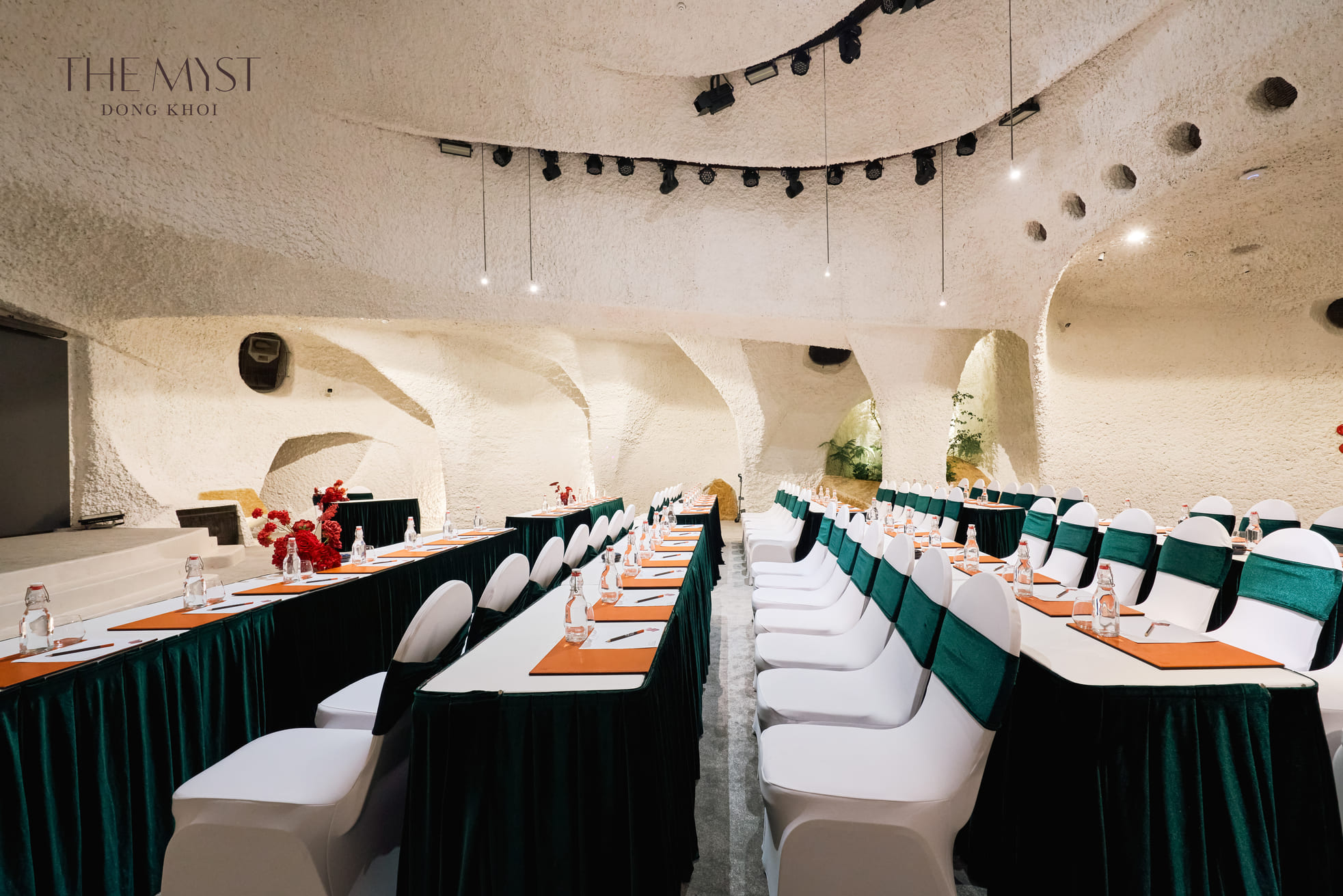
1. Capacity and layout that fit your headcount and format
Capacity is the first filter, but the printed number on a venue's fact sheet only tells half the story. A room rated for 100 theatre style seats will hold far fewer once you add round dinner tables, a buffet line, a stage and room to walk between them. Always ask for the capacity in the exact format you are running, whether that is banquet rounds, a standing cocktail, or theatre seating for a presentation. Ask to see it laid out, not just quoted.
Layout matters as much as the raw count. A single clear span with no pillars lets everyone see the stage; an L shaped room hides half the guests from the action. Think about flow too: where people queue for the buffet, where the bar sits, whether the entrance gives you space for a welcome drink and a photo wall before the doors open. A good rule is to book a room that seats your expected number comfortably with a little air around the edges, rather than one you fill to the last chair. Crowded looks busy in photos and feels tight all night.
2. Location, access and parking for your staff
Your team is coming from offices and homes all over the city, often straight from work, often at rush hour. A central venue that everyone can name and find takes a whole category of stress off the table. District 1 is the natural choice for a company party because it sits at the middle of the map, is easy to reach by taxi or ride hailing, and gives late leavers plenty of options to get home.
Walk through the practical access questions before you commit. Is there parking for those who drive, or a clear drop off point for cars and bikes? How close is the nearest main road, and can a taxi actually pull up at the door? For guests staying over or coming from out of town, a venue inside a hotel solves the journey home entirely. A central address also lets people carry on nearby afterwards, which matters more than planners admit. At The Myst Dong Khoi on Hồ Huấn Nghiệp, the location is walkable for anyone already in the centre and a short ride for everyone else.
3. Catering quality and flexibility
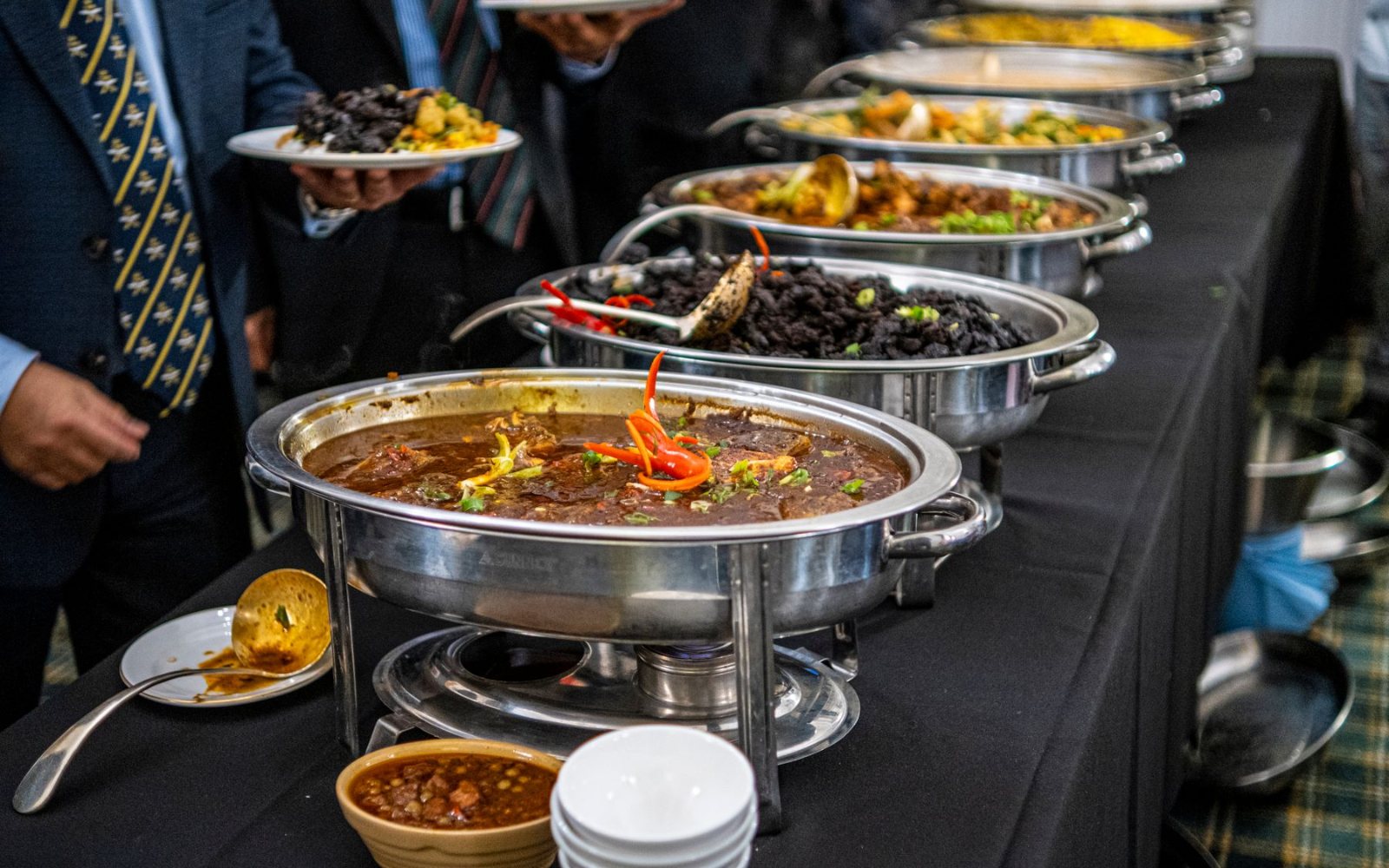
Food is what people remember and complain about, so treat catering as a make or break criterion rather than a detail to settle later. The first question is format: buffet or set menu. A buffet keeps the room social, moves people around and suits a mixed crowd with different appetites; a set menu feels more formal, paces the evening around the courses and works well when there is a programme to keep on schedule. Neither is better in the abstract, they simply fit different nights. We compare the two in depth in our note on buffet or set menu for a year end party.
Whichever you choose, press on flexibility. Can the kitchen handle vegetarian, halal or allergy needs without a fuss? Can you preview or taste the menu before the night? What does the drinks arrangement look like, and can it flex to your budget rather than a fixed package you cannot move? Ask how the food is served and kept hot, especially for a buffet, and how many staff will be on the floor for your headcount. A venue that answers these openly is one that has run plenty of parties before.
4. Space and AV for your programme
Most year end parties are not just dinners. There are speeches, an awards segment, a slideshow of the year, a lucky draw, maybe a live band or a team performance. Every one of those needs the room to support it, and this is where venues quietly differ. Ask what the space gives you before you build a run of show around it.
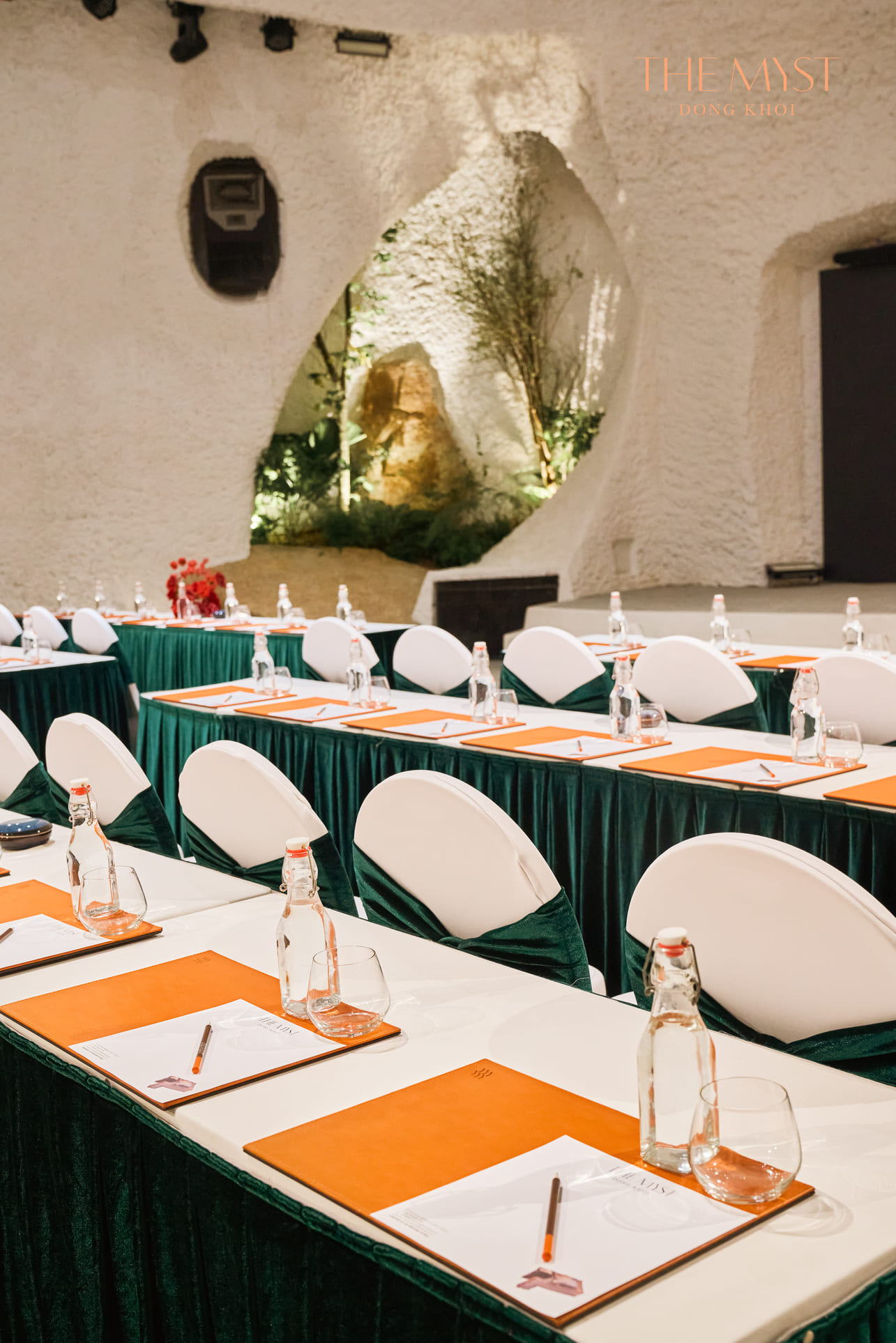
Run through the technical checklist. Is there a stage, or room to set one, with a sightline from every table? Is there a screen big enough to read from the back, or a projector and a clear wall? What sound system is included, how many microphones, and is the room soundproofed enough for music without a complaint from the floor above? Is there space for people to actually get up and move, or does the seating pin everyone in? A venue with a built in screen and a proper sound rig saves you hiring gear and cuts a whole layer of risk on the night.
When you map your programme against a room, our year end party checklist is a useful thing to run down.
5. Ambience, service and how it fits the budget
The last criterion is the one that turns a functional room into a night people talk about. Ambience is the feel of the place before you have added a single decoration: the ceiling height, the lighting, the finish of the space, the view from the windows. A venue with character does half your styling for you. A blank hall means you are paying to dress it up from scratch.
Service sits alongside it. The team behind the venue is who you actually deal with, from the first quote to the last guest leaving. Responsiveness while you are still planning tells you a lot about the night itself. And all of this has to land inside a budget, which is why a venue that offers tailored packages rather than one fixed price is worth seeking out: it lets you spend where it counts for your group and trim where it does not. Weigh the whole picture together, since the cheapest room that needs a truckload of hired extras is rarely the best value once everything is added up.
Book early, because December fills up
One practical warning sits above all five criteria: timing. The last few weeks of the year are peak season for every good venue in the city, and the best rooms on the best dates go months ahead. Companies that leave it to November often find their first, second and third choices all taken, and end up compromising on the room, the date or both.
If you have a target week, start enquiring early, hold the date provisionally as soon as you can, and confirm the headcount range even before the final list is locked. Early booking also gives you room to taste the menu, walk the space and plan the programme without a rush.
How the venues at The Myst fit different sizes
To make the criteria concrete, here is how the spaces at The Myst Dong Khoi tend to suit different groups. Sizes are a guide, and the team will lay out the right room for your exact format and headcount.
- Up to 200, a full company party. The ERY Ballroom on the ground floor runs to 235 square metres and seats up to 200 theatre style, 160 to 192 at round tables or 220 standing, which makes it the natural choice for a larger year end dinner or an awards night with a stage.
- Up to 120, with a screen for the programme. The Galaxy Ballroom on the mezzanine, 136 square metres, seats up to 120 theatre style or 80 at tables under a starry sky ceiling, with a 320 inch screen already built in, which suits a party built around a slideshow, a video or a presentation.
- Up to 40, a smaller rooftop room. Rooty Hall's indoor room, 53 square metres, takes up to 30 at round tables or 40 standing, a cosy space for a smaller team.
- Up to 80 seated or 120 standing, up on floor 12. The Nest on the twelfth floor holds up to 80 at long tables or 120 standing, with the city and river beyond the windows for a party that wants a view.
- A rooftop finish. Rooty Hall's 90 square metre outdoor terrace takes up to 120 standing, for a cocktail reception or an after party under the open sky.
All of it comes with buffet or set menus and packages tailored to the group, in a central District 1 address that your team can find without a map. To talk through dates and numbers, write to [email protected] or call +84 28 3520 3040.
Frequently asked questions
What is the most important criterion for choosing a year end party venue?
How far in advance should I book a year end party venue in Saigon?
Is a buffet or a set menu better for a year end party?
What makes District 1 a good area for a corporate party?
What AV should a year end party venue provide?
Can a venue tailor the package to our budget?
Plan your year end party at The Myst
The Myst Dong Khoi is a boutique heritage hotel in the heart of District 1, with venues from the ERY Ballroom to the rooftop, buffet or set menus, and packages tailored to your group. Tell us your date and headcount and our events team will suggest the right space and walk you through the options. Write to [email protected] or call +84 28 3520 3040.
→ Explore meetings and events at The Myst Dong Khoi
→ Read the full year end party planning guide
Curated by Silverland Hospitality.
Blog, Blog
A year-end party looks simple from the outside: a room, a meal, a few speeches. Behind it sit a hundred small decisions, and most of them depend on one another. Miss the venue deposit and the date slips. Forget the microphone count and the awards moment falls flat. This is a working checklist, grouped by the order you actually need to do things, so nothing important waits until the last week. Follow it phase by phase and the night runs itself while you enjoy it.
At a glance. A good year-end party plan moves through nine phases: fix your goals, budget and headcount first; then lock the date and venue; then catering, programme, invitations and AV; then build a run-of-show and a day-of plan; and close the loop afterwards. Start eight to twelve weeks out for a mid-sized company. Everything downstream gets easier once the first three phases are settled.
Table of Contents
Phase 1. Goals, budget and headcount
Before you look at a single venue, agree what the party is for. A reward for a hard year, a thank-you to clients, a team that has just doubled in size: each points to a different room, a different budget and a different tone. Settle this with whoever signs off, then the rest of the decisions have something to lean on.
- Purpose. One line everyone agrees on, for example "thank the team and hand out the annual awards".
- Headcount range. A working number with a margin, say 70 to 90, not a single guess. The venue and catering both hinge on it.
- Budget per head and total. Split it early into venue, food and drink, entertainment, printing and a ten percent buffer for the things you forget.
- Decision owners. Who approves spend, who signs the contract, who runs the night. Name them now.
- Must-haves versus nice-to-haves. A live band might be optional; a working microphone for the CEO is not.
Phase 2. Date and venue
December fills up fast in central Saigon, so this is the phase to move on quickly. Shortlist two or three dates, then hold the room before you announce anything. A venue that matches your headcount and format saves you fighting the space all night. For a fuller breakdown of what to look for, our guide on choosing a year-end party venue in Saigon walks through the criteria in detail.
- Two or three candidate dates, checked against payroll dates, public holidays and any big client deadlines.
- Room that fits the format. A seated dinner for 90 needs more floor than a standing reception for the same number.
- Capacity confirmed in writing, theatre style, banquet rounds or standing, whichever you are using.
- Location and access, easy for guests to reach and to leave late, with parking or a taxi rank nearby.
- Deposit, cancellation terms and what the room rate includes before you sign anything.
At The Myst Dong Khoi, on 6-8 Hồ Huấn Nghiệp, Sài Gòn Ward, the choice runs from the ground-floor ERY Ballroom, 235 square metres, which seats up to 200 theatre style or 220 standing, to the Galaxy Ballroom on the mezzanine, 136 square metres, for up to 120 under a starry-sky ceiling with a 320-inch screen, The Nest on the twelfth floor for up to 80 at long tables or 120 standing, and Rooty Hall on the rooftop, up to 120 standing outdoors, for a party that spills into the open air.
Phase 3. Catering and drinks
Food sets the mood more than most people expect. The first fork in the road is buffet or set menu, and it shapes both the flow of the evening and the room layout. Decide it here, then let the kitchen build around it.
- Buffet or set menu. A buffet keeps people moving and mingling; a set menu suits a seated programme with speeches between courses.
- Dietary needs collected in advance, vegetarian, allergies, anyone who does not drink.
- Drinks plan. Welcome drink, what is included, whether there is a bar tab or a cash bar, and a clear cut-off time.
- Timing of service mapped against the programme, so the awards do not clash with the main course.
- Final headcount deadline for the kitchen, usually a few days out, and who confirms it.
Phase 4. Programme, MC, awards and entertainment
This is the part guests remember. A loose plan here is where evenings drift, so give every segment a length and an owner. Keep speeches short and the energy moving.
- An MC briefed with names, titles and running order, and told how to pronounce anything tricky.
- Speeches capped, ideally one main address kept under ten minutes, plus any short thank-yous.
- Awards and recognition, with the list finalised, trophies or certificates on site, and a photographer ready for each handover.
- Entertainment, band, DJ or performers booked, with their own sound needs noted and a sound check time.
- Games or a lucky draw, prizes bought, rules written, and someone to run it so it does not stall.
Phase 5. Invitations and internal communications
People cannot come to a party they have not heard about clearly. Send the details early, then remind them, and make it easy to say yes.
- A save-the-date as soon as the date is locked, even before the full details are ready.
- The formal invitation with date, time, venue, dress code and an RSVP method that you can actually track.
- A dress code stated plainly, so nobody arrives over or underdressed.
- Reminders at one week and one day, with the address and start time repeated.
- Plus-ones and guests clarified up front, since they change the headcount and the catering.
Phase 6. Logistics and AV
The technical layer is invisible when it works and impossible to hide when it fails. Walk the room in advance and confirm every piece, especially anything the programme depends on. If your timeline is tight, our 90-day year-end party planning timeline shows when each of these should be locked.
- Stage and podium placed so the whole room has a sightline, with the screen visible from the back tables.
- Sound, enough microphones for the format, wireless handhelds for awards, and a tested feed for music.
- Screen and slides, the deck loaded and run through, with a backup copy on a second device.
- Seating plan, table numbers, a guest list at the door and reserved seats for leadership and special guests.
- Lighting, signage and a coat or bag area, plus power for the band and any photo booth.
Phase 7. The run-of-show for the night
A run-of-show is a single timed document that turns all the pieces above into a minute-by-minute plan. Everyone who has a job on the night should hold a copy.
- A timeline with clock times, from guest arrival and welcome drinks through to the last song and close.
- Each segment owned by name, so it is clear who cues the MC, who starts the music, who brings out the trophies.
- Cues written down, when the lights dim, when a video rolls, when dinner is served.
- Buffer time built in, because speeches always run long and guests always arrive late.
- A shared version with the venue, the MC and the AV team, so everyone is reading the same page.
Phase 8. Day-of coordination
The plan is done; now it just needs steady hands. Arrive early, check everything with your own eyes, and keep one person free to solve problems rather than run a segment.
- An on-site lead whose only job is to coordinate, phone charged, run-of-show in hand.
- A sound check and a slide run-through before the first guest walks in.
- The registration desk staffed, name list ready, any badges or gifts laid out.
- A short brief for the team, so waiters, MC and AV all know the running order.
- A quiet contingency, a spare microphone, a printed guest list and the venue contact on speed dial.
Phase 9. After the party
The night ends but the goodwill should not. Closing the loop well is what makes next year easier to plan and easier to get approved.
- Thank-yous to guests, to the team who ran it and to the venue, sent within a day or two.
- Photos and video gathered, a small selection shared internally while the mood is fresh.
- Feedback collected with a couple of quick questions, honestly and while people remember.
- Final costs reconciled against the budget, with notes for whoever plans the next one.
- A short debrief, what worked, what to change, saved somewhere you will find it next December.
Worked through in order, these nine phases turn a daunting brief into a series of small, doable steps. For the wider picture, from first idea to final thank-you, our complete guide to planning a year-end party ties every stage together.
Frequently asked questions
When should we start planning a year-end party?
How far in advance should we book the venue?
Buffet or set menu for a company party?
How do we set the headcount and budget?
What should a run-of-show include?
How do we book a year-end party at The Myst Dong Khoi?
Plan your year-end party with our events team
Tell us your date, your headcount and the kind of night you have in mind, and our team at The Myst Đồng Khởi in District 1 will match it to the right room, walk you through buffet or set menu, and help you build the run-of-show. Reach us at [email protected] or +84 28 3520 3040.
→ Talk to our meetings & events team
→ Read the complete year-end party guide
Curated by Silverland Hospitality.
Blog, Blog
A year-end party is the one night a company sets aside to stop, look back, and say thank you. It closes the working year, marks what the team pulled off, and gives everyone a shared memory to carry into the next twelve months. Get it right and people talk about it for weeks.
Get it wrong and it becomes the meeting nobody wanted to attend. This guide is the master map: what a year-end party is really for, the handful of decisions that shape the night, and where each one leads if you want the detail. Read it top to bottom, then follow the links to the parts that matter most to you.
At a glance. A corporate year-end party (also known in Vietnam as a tiệc tất niên) usually runs in December or January, before Tết. The core decisions are five: goals and budget, headcount and date, venue, catering format, and the programme for the evening. Plan the popular dates two to three months ahead, because December fills fast. At The Myst Dong Khoi in District 1, the events team hosts year-end parties across several spaces, from the ERY Ballroom to the rooftop, with buffet or set menu catering tailored to the group.
Table of Contents
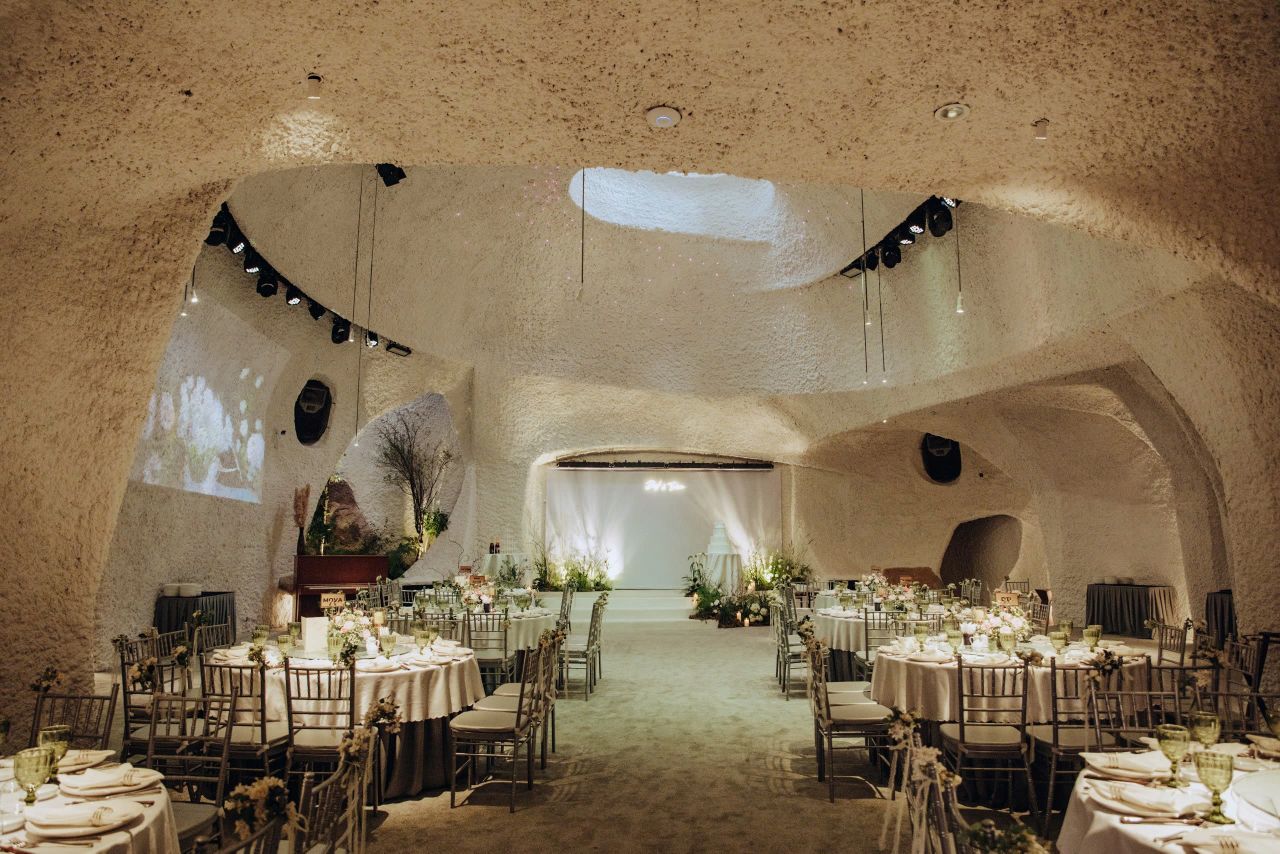
Why a year-end party is worth doing well
It is easy to treat the year-end party as a line item, a dinner to be booked and survived. That is a missed opportunity. For most teams it is the only evening all year when everyone is in one room with nothing on the agenda but each other. The people who rarely cross paths in daily work sit at the same table. The new joiner meets the founder. The quiet department gets its moment on stage.
Done well, the night does real work. It signals that the year mattered and that the effort was seen. It gives leadership a natural stage to thank people by name, to hand out an award, to tell the story of the year in a way a group email never can. And it builds the shared memory that carries a team through the harder months. None of that requires a big budget. It requires intent, a clear reason for gathering, and enough planning that the evening runs without anyone visibly holding it together.
The decisions that shape the night
Almost everything about a year-end party comes down to a few early decisions. Settle these first and the rest falls into place. Leave them vague and you will feel it on the night.
- Goals and tone. Is this a formal thank-you with awards and a sit-down dinner, or a loose, celebratory party where people mingle and dance? Decide the tone before anything else, because it drives venue, catering and programme.
- Budget and headcount. Fix a per-head figure and a firm guest count. Everything else, from the room to the menu, is chosen inside that frame. Plus-ones, partners and any clients also need deciding early.
- Date and venue. The two are locked together, because the best rooms on the best December dates go first. More on both below.
- Catering and programme. Buffet or set menu, and what actually happens across the evening, from the MC to the awards to the entertainment.
If you would rather work from a single, ordered list you can tick off, we have built one. Our year-end party planning checklist takes these decisions and turns them into concrete tasks with owners and deadlines. And if you are wondering when to start, our 90-day planning timeline works backwards from the party date so nothing gets left to the last week.
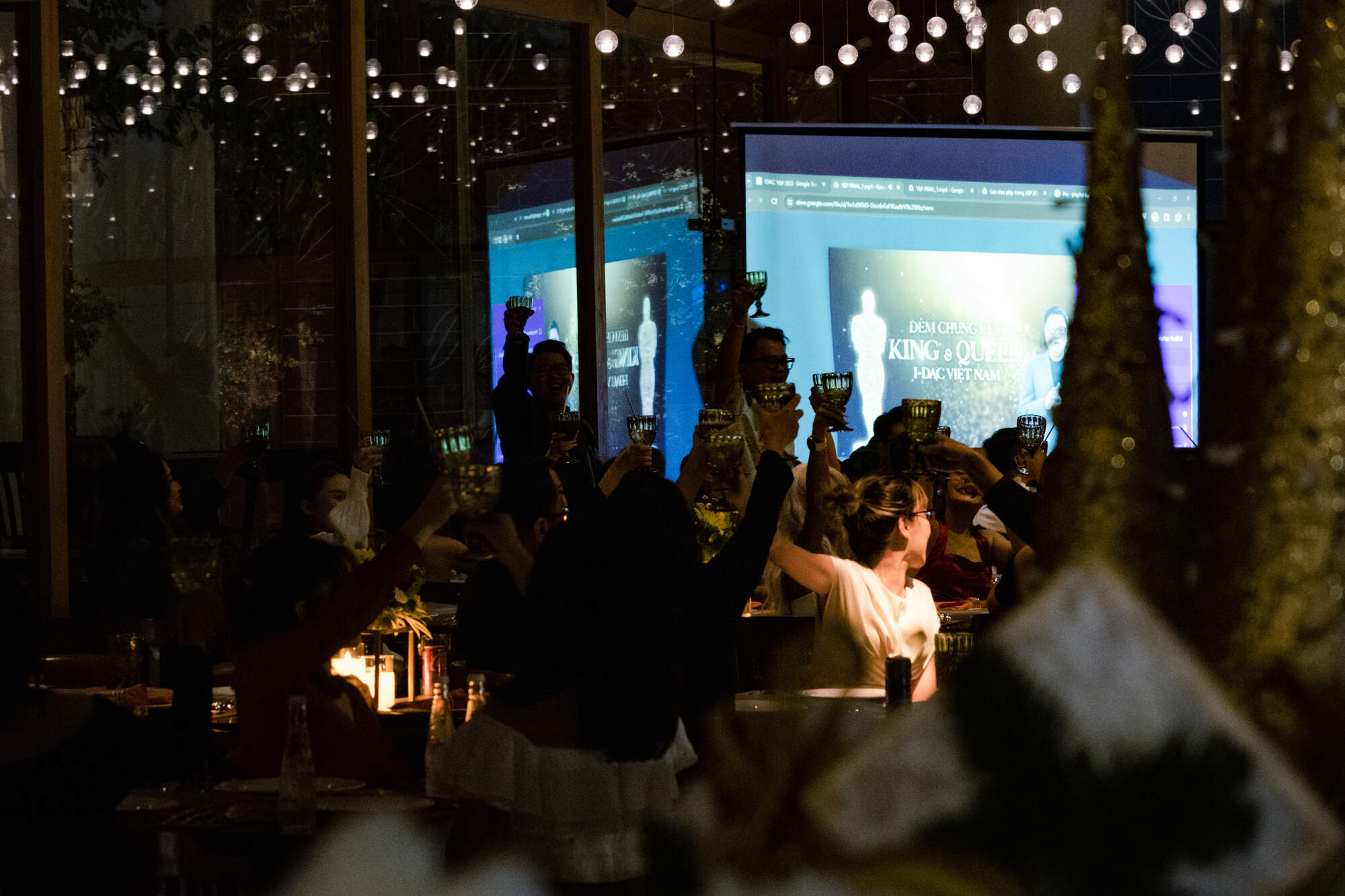
Choosing the date and the venue
Timing is the first real constraint. In Vietnam the year-end party season runs from early December through late January, tapering off as Tết approaches. Fridays and the two weekends before the holiday are the most contested, so if your team has a preferred date, treat it as the thing you book first, not last. Popular venues in central Saigon are often reserved two to three months out for those peak evenings.
The venue then has to fit the night you have described. A theatre-style awards ceremony needs a stage, a screen and a room that seats everyone facing forward. A mingling party wants standing room, a bar and space to move. A sit-down dinner needs round tables and service that keeps pace. Capacity, layout, sound, parking and how easy the place is to reach after work all matter more than the photos on a website. We set out what to look for, and the trade-offs between hotel ballrooms, restaurants and rooftops, in our guide to choosing a year-end party venue in Saigon.
One more timing note. Because the year-end party sits right before the lunar new year, some teams choose to combine the two moods, closing the working year while looking ahead to Tết. If that is you, our overview of Tết 2027 in Saigon is worth a look for the wider season.
Food, programme and the flow of the evening
Catering shapes both the budget and the feel of the room. A buffet keeps people moving, suits a mingling crowd, and handles mixed tastes and dietary needs with ease. A set menu is calmer and more formal, better for a seated evening built around speeches and awards, with courses that pace the night for you. Neither is simply better; it depends on the tone you chose at the start. We weigh the two in full, with the practical pros and cons, in buffet or set menu for a year-end party.
The programme is what turns a dinner into an event. A good MC holds the shape of the evening, moving it from welcome to speeches to awards to the lighter, freer part of the night. Awards and recognition are the heart of it for most companies, so build in time and thought there rather than rushing it between courses.
Entertainment, from a live band to a lucky draw to a simple photo corner, gives energy and pace. Keep the formal part tight, land the thank-yous clearly, and leave real time at the end for people to relax. A rough running order, even a loose one, is what keeps the night from drifting.
Plenty of good plans still come apart on the night, usually for the same reasons: a guest count that slipped, a programme that ran long, sound that failed, or a venue booked too late. We have gathered the ones we see most often, and how to head them off, in our note on the most common year-end party mistakes.
Hosting your year-end party at The Myst
The Myst Dong Khoi is a boutique heritage hotel in the heart of District 1, at 6-8 Hồ Huấn Nghiệp, a short and easy trip for city-based teams. It hosts year-end parties, weddings and corporate events across several spaces, so the room can be matched to the size and mood of your night rather than the other way around.
- ERY Ballroom. On the ground floor, 235 m², seating up to 200 guests theatre-style, 160 to 192 at round tables or 220 standing, suited to awards ceremonies and larger sit-down evenings.
- Galaxy Ballroom. On the mezzanine, 136 m², up to 120 theatre-style or 80 at tables, with a 320-inch screen and a ceiling scattered with tiny lights like a starry Saigon night sky, good for a programme built around presentations and video.
- Rooty Hall, indoors. On the rooftop, 53 m², up to 30 at round tables or 40 standing, a cosy room for a smaller team.
- The Nest. The restaurant on the twelfth floor, 152 m², up to 80 at long tables or 120 standing, with the city and river below for a party with a view.
- Rooty Hall, outdoors. The 90 m² open-air rooftop, up to 50 at round tables or 120 standing, for a more relaxed, mingling evening.
Catering can be served as a buffet or a set menu, and the events team tailors each package to the group rather than working from a fixed sheet. The clearest next step is simply to tell them your headcount, your date and the kind of night you have in mind, and let them suggest the space and format that fit. You can reach the team on the details in the box below.
Frequently asked questions
What is a corporate year-end party?
When should we start planning a year-end party?
How do we choose the right venue?
Buffet or set menu for a year-end party?
What should the programme include?
Can The Myst Dong Khoi host our year-end party?
Talk to our events team
The Myst Dong Khoi hosts year-end parties, tất niên nights and corporate events across ballroom, restaurant and rooftop spaces in the heart of District 1. Tell us your date, your headcount and the kind of evening you have in mind, and we will suggest the space and catering that fit. Reach the events team at [email protected] or +84 28 3520 3040.
→ Talk to our events team about your year-end party
→ Start with our year-end party planning checklist
Curated by Silverland Hospitality.