
Marseille Roof Tiles: From the Clay Pits of Marseille to the Roofs of Saigon
In 2004, when a few damaged tiles were taken down from […]

In 2004, when a few damaged tiles were taken down from the roof of Notre-Dame Cathedral in Saigon, the words on their surface read “Wang-Tai Saigon”. Not a French factory at all. Wang-Tai was a Chinese merchant in colonial Saigon with brick and tile works along the Bến Nghé creek, and some of the cathedral’s tiles came from his kilns. Most of the rest had crossed the sea from France. Those were the Marseille roof tiles Saigon’s cathedral was first covered with: flat terracotta tiles with ribs and grooves that lock into one another, a pattern developed around Marseille in the mid-nineteenth century. What follows is the tile’s story, how to spot one around the old centre, and why The Myst Dong Khoi keeps a roof of them in its lobby.
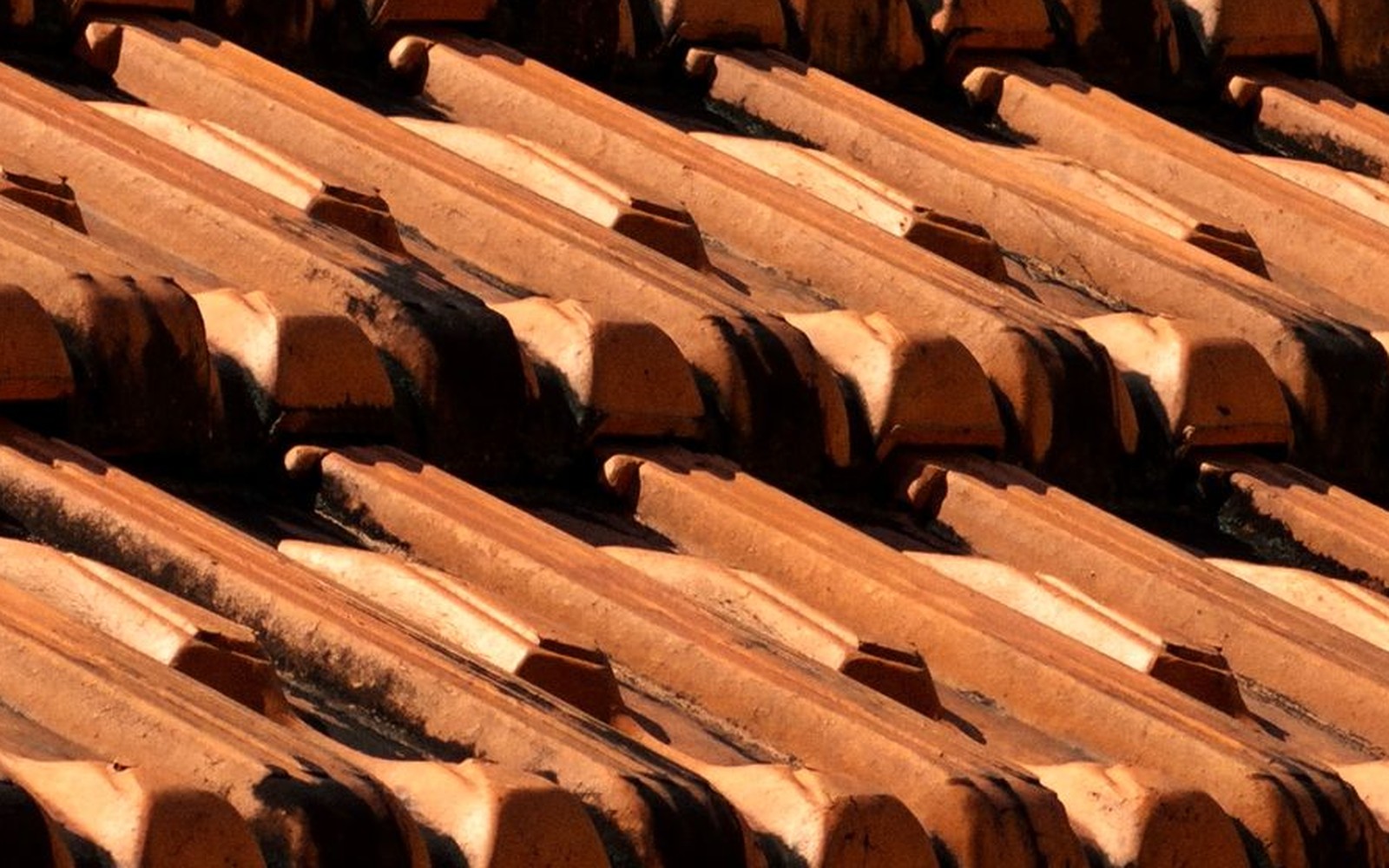
At a glance. A Marseille tile is an interlocking terracotta roof tile; in Vietnam it is often called ngói tây or ngói mũi tên. Saigon’s Notre-Dame Cathedral, built between 1877 and 1880, has tiles stamped “Guichard Carvin, Marseille St André France”. The restoration that began in 2017 re-covered its upper roof with 27,250 Monier arrow tiles. At The Myst Dong Khoi, the hotel’s records describe the Marseille tiles in the lobby as salvaged from the Ba Son shipyard.
In this guide
What a Marseille tile actually is
Pick one up and the first surprise is the size. Half of a Marseilles-pattern tile in a University of Melbourne heritage collection still measures 425 millimetres long. The face is flat, ribbed and grooved. Lay two side by side and the rib of one sits in the groove of the next, so the tiles hold each other in place and keep the rain out.
The French call the family tuiles mécaniques, mechanical tiles, or tuiles à emboîtement, interlocking tiles. Vietnamese newspapers and restorers tend to say ngói tây, literally “Western tile”, or ngói mũi tên.
The interlock pays off in numbers. According to French Wikipedia, a square metre of roof needs only 14 to 15 interlocking tiles, against 65 or 75 old-style flat ones. Each weighs around 2.8 kilograms, so the roof comes to roughly 38 kilograms per square metre instead of 65, and it needs four to five times fewer battens. Fewer tiles. Less timber. A lighter roof.
An Alsace patent and a Marseille pattern
The interlocking tile did not begin in Marseille. It began in Altkirch, in Alsace, home of the Gilardoni brothers. On 25 March 1841 François-Xavier Gilardoni patented his interlocking design, and in 1850 the brothers followed it with a double-interlocking tile that won a prize at the 1855 exhibition. Between 1845 and 1860 they licensed the patent to six other French manufacturers.
The Marseille pattern came soon after. The English Wikipedia article on the history of roof tiles credits the Martin brothers of Marseille with inventing it “as early as the 1860s”, while Sydney’s Powerhouse Museum dates its development in Marseille to the 1850s. The sources disagree by a decade. They agree on the city.
The Séon basin, a neighbourhood built on clay
Marseille’s tile makers clustered on a bed of clay called the Séon basin, spread between the districts of l’Estaque, Saint-Henri and Saint-André. In 1805 it held 21 small tileries with 45 workers between them. By 1860 there were 150, employing around 800, and the population of Saint-Henri grew from 714 people in 1820 to 10,950 by 1930, most of them working in the tile yards.
At the industry’s height, according to France 3, some 6,000 people worked for about fifty firms. Days ran to twelve hours before workers won a cut to ten.
The firms stamped their tiles. The Melbourne half-tile has “MARSEILLE ST HENRI” impressed on its underside beside a raised rooster. A tile at the Powerhouse Museum bears a bee, the mark of Guichard Carvin et Cie of Marseille St André, and dates from between 1890 and 1914. Remember that name. It turns up in Saigon.
A tile made to travel
Marseille tiles did not stay at home. English Wikipedia says they were widely exported, especially to European colonies in South and Central America, Africa and Australia, reaching Australia by 1886. One Sydney firm, Wunderlich, had shipped in about 75 million of them in 110 cargoes by 1914, according to the Powerhouse Museum.
So why Saigon? In truth, no source we found spells out why the French chose Marseille tiles for this city. What can be said is this. The tile was a major colonial export. It was lighter than older flat tiles and needed far fewer per square metre. And at Notre-Dame Cathedral, where the records are good, all building materials were imported from France. As for whether they once covered most of old Saigon, we found no figures to say so.
On the roof of Notre-Dame Cathedral
Bishop Isidore Colombert laid the cathedral’s first stone on 7 October 1877, and the building was blessed on Easter Day, 11 April 1880. The English Wikipedia entry on Notre-Dame Cathedral Basilica of Saigon records that its tiles carry the words “Guichard Carvin, Marseille St André France”, naming the district of Marseille where they were made. The same maker sits in a museum collection in Sydney and on a cathedral roof in Saigon.
The roof was never entirely French, though. Dr Nguyễn Đức Hiệp, who has published several books on old Saigon, wrote about the Wang-Tai tiles found in 2004: some of the cathedral’s century-old red tiles came from Wang-Tai’s works, while the majority were imported from France.
In December 2016, Thanh Niên newspaper reported that the cathedral’s roofs held around 50,000 tiles. Alongside the original Marseille tiles were Indochinois and Phú Hữu tiles, neither of which is sold today.
The restoration and the hunt for arrow tiles
Full restoration work began on 29 June 2017. The late Archbishop Paul Bùi Văn Đọc decided to import materials from France, Belgium and Germany. Father Hồ Văn Xuân, then vicar general of the archdiocese, tracked the rare arrow tiles down at Monier, and said he was happier than he could describe to find ones identical to those the upper roof needed. The new roof breaks down like this.
| Tile | Maker | Quantity | Used on | Warranty |
|---|---|---|---|---|
| Arrow tile (Marseille tile) | Monier, France | 27,250 | Upper roof | 30 years |
| Fish-scale tile | Meyer-Holsen, Germany | 86,000 | Lower roofs and spires | 40 years |
| Yin-yang tile | Meyer-Holsen, Germany | 10,300 | Lower roofs and spires | 40 years |
Monier is also the name on the last tile works operating in Marseille, in Saint-André, which has run in its present form since 1965. In November 2025 the French broadcaster ICI reported that its owner, the BMI group, would close it by June 2026 at the latest and move production to Limoux, with 52 staff affected. If the plan held, 2026 was the year Marseille stopped firing Marseille tiles.
How to spot a Marseille tile on a walk
You do not need to be an architectural historian. A few clues are enough.
- Read the shape. Marseille tiles are large and flat, with ribs and grooves running down their length, so a finished roof shows neat, regular lines. Fish-scale tiles (ngói vảy cá) are small with rounded tails. Yin-yang tiles (ngói âm dương) are curved and laid in alternating face-up and face-down rows.
- Look underneath if you get the chance. Museum examples carry a Marseille district (St Henri, St André), a maker’s name and an emblem such as a rooster or a bee. You will usually only see that side when tiles come down or go on display.
- Do not guess the age. One roof can mix French tiles, tiles made in Saigon, Indochinois and Phú Hữu tiles, and modern replacements. The Monier tiles laid on the cathedral since 2017 are Marseille tiles too, only new.
- Choose your light. Step back, zoom in with your phone, and go in the low sun of early morning or late afternoon, when the ribs throw clear shadows. The cathedral’s restoration is scheduled to run until 2027, so enjoy it from outside the hoardings.
The cathedral is in the same central district as the hotel, formerly District 1; for walking times, see what you can reach on foot from The Myst in fifteen minutes.
The hotel’s own Marseille tiles
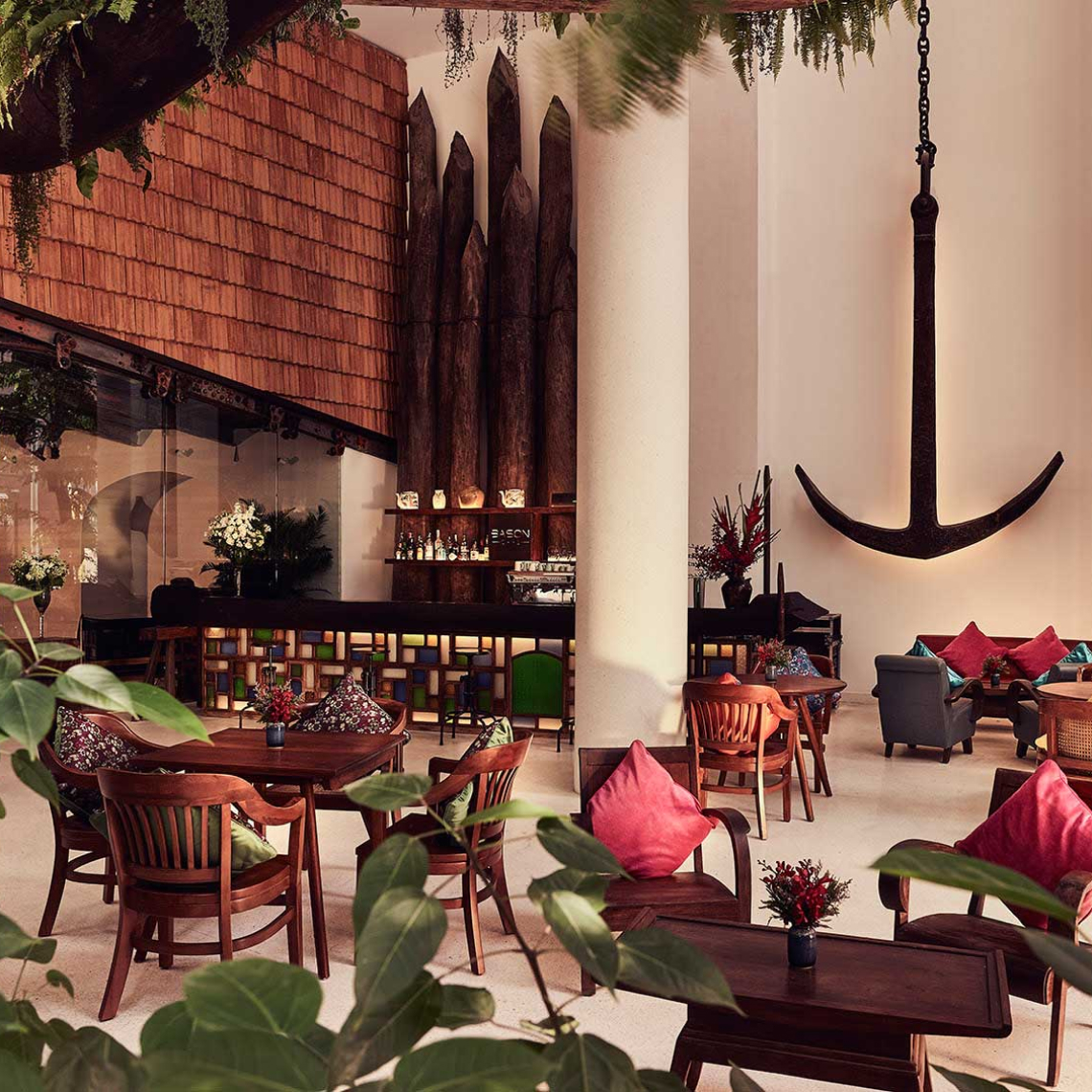
A five-star hotel with a plain tiled roof in its lobby sounds odd, until you hear where the tiles came from. According to the hotel’s own records, when the Ba Son shipyard was demolished in 2015, the owners bought back pieces of it: timber piles that had braced its foundations, steel trusses from Toulon, and Marseille tiles that had once roofed the yard, still marked with the word Marseille. The lobby was redesigned around them, so they are structure and exhibit at once; the stated aim was to keep a piece of the city’s history for the next generation.
The lobby is called Bason and opens onto Bason Café. Next time you stop for a coffee, look up at the tiled roof. Those tiles share a home town with the originals on Notre-Dame Cathedral; they simply spent their working lives keeping the rain off a riverside shipyard.
For the yard itself, read two centuries of the Ba Son shipyard. The wrought-iron flowers, stained glass and planted balconies are covered in the old Saigon design details throughout the hotel.
Frequently asked questions
What is a Marseille roof tile?
A Marseille tile is a flat terracotta roof tile with ribs and grooves that lock into its neighbours, which keeps the tiles in place and the roof watertight. It takes its name from Marseille in southern France, where a cluster of tile works made it. A square metre of roof needs only about 14 to 15 of them.
When were Marseille tiles invented?
The interlocking roof tile was patented by François-Xavier Gilardoni of Altkirch, France, on 25 March 1841, and the Gilardoni brothers produced a double-interlocking version in 1850. The Marseille pattern followed in Marseille itself. English Wikipedia credits the Martin brothers and dates it to the 1860s, while Sydney’s Powerhouse Museum places its development in the 1850s.
Which buildings in Saigon have Marseille tiles?
A well-documented example is Notre-Dame Cathedral, built between 1877 and 1880. Its tiles include ones stamped “Guichard Carvin, Marseille St André France”, and Thanh Niên newspaper reported in 2016 that the original roof tiles were Marseille tiles, alongside Indochinois and Phú Hữu tiles. Some of the cathedral’s tiles were also made locally, at the Wang-Tai works in Saigon.
How can you tell an old French Marseille tile from a new one?
The surest sign is the stamp on the underside. Old Marseille tiles in museum collections carry a Marseille district such as St Henri or St André, the maker’s name and an emblem like a rooster or a bee. From the street you can only judge the shape, so remember that a single roof may mix French tiles, locally made tiles and modern replacements.
Are Marseille tiles still made today?
Yes. The restoration of Saigon’s Notre-Dame Cathedral, which began in 2017, used 27,250 new arrow tiles from the French maker Monier on the upper roof. In Marseille itself, the last working tile factory, Monier’s plant in Saint-André, was due to close by June 2026 at the latest, with production moving to Limoux, according to the French broadcaster ICI.
Where do the Marseille tiles at The Myst Dong Khoi come from?
According to the hotel’s records, the Marseille tiles in the ground-floor lobby were bought back when the Ba Son shipyard was demolished in 2015. The lobby, named Bason, opens onto Bason Café and was redesigned to display these pieces. The hotel stands at 6-8 Hồ Huấn Nghiệp, just off Đồng Khởi street.
Coffee under a roof from Ba Son
Bason Café is on the ground floor of The Myst Dong Khoi, at 6-8 Hồ Huấn Nghiệp, Sài Gòn Ward. Drop in for coffee after looking up at the cathedral’s roof, or stay a few nights and walk the old centre at your own pace.
→ See Bason Café and opening hours
→ Book your stay at The Myst Dong Khoi
Curated by Silverland Hospitality.
Others
The Ba Son Shipyard: Two Centuries on the Saigon River
Ride Saigon’s ...

Old Saigon, detail by detail: inside a cultural design hotel Saigon can call its own
Turn off Đồng Khởi i...
The Myst Dong Khoi awards: what each recognition tells you before you book
Stand on Hồ Huấn Ngh...

What Is a Cultural Luxury Hotel? How to Spot One Before You Book
It is eleven at nigh...

Wedding Color Palette 2026 and 2027: Six Schemes to Love
Color is the first d...

Wedding Trends 2026-2027: Where Celebrations Are Heading
Weddings are quietly...