
Saigon’s New Pedestrian Bridge: The Coconut-Leaf River Icon
Every so often a city builds something that becomes a postcard before it even opens. That is the feeling around the new Saigon pedestrian bridge rising over the Saigon River. Shaped like a water-coconut leaf and built to carry only people on foot and on bicycles, it will finally let you walk from the centre […]

Every so often a city builds something that becomes a postcard before it even opens. That is the feeling around the new Saigon pedestrian bridge rising over the Saigon River. Shaped like a water-coconut leaf and built to carry only people on foot and on bicycles, it will finally let you walk from the centre of District 1 across to the Thủ Thiêm park. Here is what it is, the design story behind it, when it is expected to open, and how to watch it take shape today.
At a glance. Length about 720 metres, with a 187-metre main span. Steel arch shaped like a water-coconut leaf. Deck 6 to 11 metres wide. Navigation clearance 80 metres wide and 10 metres high. Investment near 1,000 billion VND, funded by Nutifood. Broke ground March 2025, targeting completion around National Day, 2 September 2026.
Table of Contents
What is being built
The bridge is a pedestrian and cycling crossing about 720 metres long, with a main span of 187 metres carried on a spatial steel arch. The deck varies from roughly 6 to 11 metres wide, and the structure leaves a navigation clearance of about 80 metres wide and 10 metres high so that boats can still pass beneath. It is built mainly from steel and reinforced concrete, finished in white, with glass and LED elements for night lighting.
Unlike the road bridges upstream, this one is designed purely for people. That changes how it feels: less a piece of traffic infrastructure and more a public space in its own right, a place to stroll, pause and photograph the river rather than simply cross it. At night the white arch is intended to become a canvas for artistic lighting.
The design story: a leaf over the river
The most striking feature is the shape. The steel arch is modelled on a water-coconut leaf, a plant of the southern Vietnamese wetlands, and it is described as the first structure of its kind in the country. The design comes from a team led by Chodai and Takashi Niwa Architects, working with Chodai Kisojiban Vietnam.
Just as notable is how it is being paid for. The bridge, at close to 1,000 billion VND, is funded in full by the nutrition company Nutifood, making it one of the city’s most prominent privately financed public landmarks. That backing is part of why the project has moved quickly since breaking ground.
Where it will land
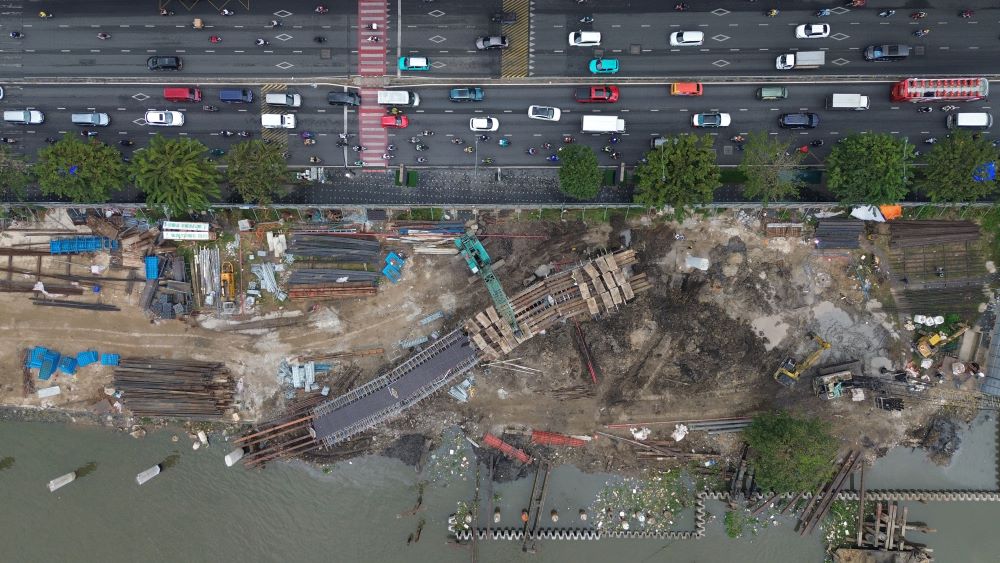
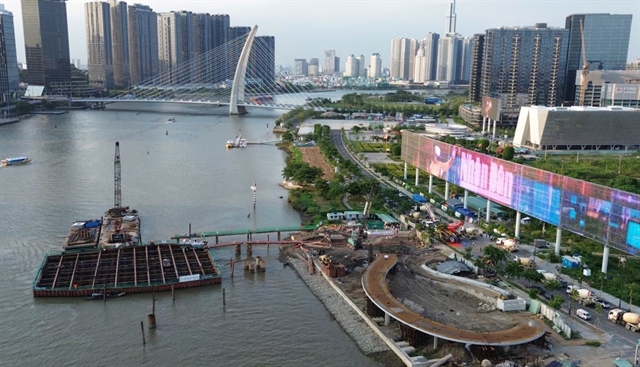
The crossing links the Bạch Đằng promenade on the District 1 side with the riverside park in the Thủ Thiêm new urban area on the far bank. In other words, it joins the two halves of the waterfront that people already love, so that an evening on the Bạch Đằng and Thủ Thiêm parks becomes a single continuous walk.
For a visitor staying in the centre, that is the exciting part. Today, reaching the Thủ Thiêm lawns means a short taxi ride or a boat. Once the bridge opens, it becomes a stroll of a few minutes straight across the Saigon River.
When will it open?
The bridge broke ground in March 2025 and has moved quickly, with the main structure well advanced through the year and the steel arch floated into place in 2026. Recent reports have the project accelerating toward completion around National Day, 2 September 2026.
Completion dates on works this size can still move, and this one has already shifted more than once, so treat 2 September as a target rather than a fixed promise. If your trip is close to the expected opening, it is worth a quick local check to see whether the bridge is walkable yet, since an about-to-open and a just-opened bridge make for very different evenings.
What it will change
Beyond the postcard, the bridge stitches the riverfront together. It gives the two parks a shared front door, makes a full loop possible on foot, and adds a genuinely new vantage point over the water at the exact hour the skyline lights up. With its white arch and night lighting, expect it to become one of the city’s most photographed sunset spots almost immediately. For the bigger picture of how the whole waterfront is changing, see our guide to the Saigon riverfront.
How to see it now
You do not have to wait to enjoy the story. From the Bạch Đằng promenade you can already watch the arch take shape across the water, and the view is especially good at dusk when the site is silhouetted against the Thủ Thiêm bank. A ride on the Saigon Water Bus also passes the construction, giving you the bridge from the river itself. Whichever you choose, it is a fine excuse for an evening by the water.
Frequently asked questions
What is the new pedestrian bridge over the Saigon River?
It is a pedestrian and cycling bridge about 720 metres long, with a 187-metre main span carried on a steel arch shaped like a water-coconut leaf, a symbol of southern Vietnam. It carries people rather than vehicles and is designed as a public space over the river as much as a way to cross it.
Who designed and paid for the bridge?
The design comes from a team led by Chodai and Takashi Niwa Architects, working with Chodai Kisojiban Vietnam, and it is described as the first structure of its kind in Vietnam. The project, at close to 1,000 billion VND, is funded in full by the nutrition company Nutifood.
Where does the bridge connect?
It links the Bạch Đằng promenade on the District 1 side with the riverside park in the Thủ Thiêm new urban area on the eastern bank. That joins the two most popular stretches of the waterfront into a single walk across the river.
When will the Saigon pedestrian bridge open?
It broke ground in March 2025 and recent reports point to completion around National Day, 2 September 2026. The date has shifted before, as large projects often do, so it is worth checking locally near your travel dates to confirm whether it is open to walk across.
Can I visit the bridge now?
You cannot cross it until it opens, but you can already watch it take shape from the Bạch Đằng promenade, and see it from the water on a Saigon Water Bus ride. Both make for a pleasant evening by the river while the bridge is being finished.
How long will it take to walk across?
Once open, crossing on foot between the Bạch Đằng and Thủ Thiêm banks is expected to take only a few minutes, turning what is today a taxi ride or boat trip into a short, scenic stroll straight over the Saigon River.
Right where the riverfront meets the city
The Myst Đồng Khởi is a 108-room boutique heritage hotel in the quietest corner of District 1, five minutes on foot from the Bạch Đằng promenade where the new bridge lands. Inducted into the Michelin Guide Hotels and Stays selection and named 2025 World Luxury Hotel Awards Country Winner for Vietnam, it puts the river and its newest landmark within an easy evening walk.
→ Book direct for our best rate
Crafted by Silverland Hotels.
Others

Wedding Color Palette 2026 and 2027: Six Schemes to Love
Color is the first decision that touches everything else. Before the flowers are chosen or the invitations are printed, a...

Wedding Trends 2026-2027: Where Celebrations Are Heading
Weddings are quietly changing shape. The five hundred guest banquet is no longer the default, the flower budget is being...

7 Year-End Party Mistakes Companies Make (and How to Avoid Them)
Every December, the same story plays out in offices across Saigon. The year-end party gets talked about in October, half-planned...

Year End Party Planning Timeline: A 90-Day Countdown
The year end party looks effortless only when the work behind it started early. Three months out, a good venue...

Year-End Party: Buffet or Set Menu? A Decision Guide
Once the venue and date are settled, one question tends to stall the whole plan: buffet or set menu? It...

Year End Party Venue: 5 Criteria for Choosing the Right Space in Saigon
The year end party is the one date the whole team actually looks forward to, and the venue decides most...